
I’m closing in on the Eastern Shore.
Northwesterly winds remained steady at 18 to 20 mph, with stronger gusts that at times threatened to bury the bow in the 4- to 6-foot swells that had built across the Chesapeake Bay.
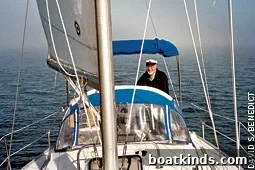
The spray from the bow as it split a wave shot up seven feet or more, soaking the foot of my jenny. Caper II, my 31-foot 1985 Hunter sloop with a 4-foot draft, felt right at home and cruised consistently above 6 knots, with occasional surges over 7.
On this early October day it felt like summer. I sailed a single tack, broad reaching across the Bay from New Point Comfort to Onancock, Virginia. To keep the helm manageable I put a deep reef in the jenny, and as the northwesterlies strengthened by midday I reefed it a second and then a third time. The boat balanced well and tracked confidently.
Covering 40 miles in just under six hours, that was the longest and fastest Bay crossing I’d ever made — and thoroughly enjoyable. The remainder of this six-day cruise from my home base at the Seaford Yacht Club in Yorktown, Virginia, would be equally memorable.
Luck comes in threes
I call this voyage “My Lucky Three.” Three is my lucky number, and I was granted three consecutive days of nearly perfect conditions. Clear, bright skies, dry warmth in the mid-70s and winds that shifted from northwest to southwest and finally to northeast allowed a natural circuit: Onancock the first day, north to the Pocomoke River the next, and then back south to the Occohannock River on the third day. From there I crossed back to the Rappahannock on southerlies and returned to Seaford on northeasterlies.
Those wind angles made gunkholing the Eastern Shore a delight. I found three fine anchorages in a compact weather window I’d been waiting four months to catch. Everything came together, and there were a few small bonuses along the way.

Onancock: a pleasant stop
Onancock is always a pleasure: a quaint historic village with good restaurants and a local watercolorist, Bill Crockett, who captures the Bay’s beauty. I anchored in the south branch—convenient for a quick dinghy ride to the town dock. When entering the “Y” at the river’s mouth, bear to starboard into the basin and stay relatively close to the port shoreline where the pilings and docks are. Give the shallow spots a wide berth; you can touch bottom at 4 feet at low tide if you get too close.
Over breakfast at Janet’s the next morning I met a couple who had sailed from Deltaville for a single night on the Eastern Shore. Their brief visit underlined how much more there is to see when you linger for several days in this relatively untraveled cruising area.
Exploring new territory: Pocomoke Sound
I had never explored Pocomoke Sound, about a dozen miles north of Onancock and east of Tangier Island. I was struck by its vastness: looking north or south feels almost oceanic, even though the bottom is generally shallow. To reach the Pocomoke River you enter through a narrowing passage. The Watts Island shoal blocks direct access from the west and north, so the most practical approach is from the south.
As you near the river’s mouth, a shallow delta prevents a straight approach. Instead you follow a narrowly dredged shoreline channel for a couple of miles, then take the cut-through behind Williams Point into the river. A few miles upstream, after a nearly 180-degree bend, you’ll find the entrance to Pitts Creek to starboard. Taking the deeper channel on that side, I anchored just inside the creek in a small cove where it turns into the river.
Unknown neighbor
A smaller sailboat with an unusual, Scandinavian-sounding name was anchored nearby. The vessel looked the worse for wear, and when I spoke with the owner he said he’d sailed over from Europe years earlier and now lived in Pocomoke City, a dozen miles upriver. In such a remote spot, with tidewater stretching between me and the nearest settlement of Shelltown, I took precautions and locked myself in the cabin for the night. Tales of offshore theft had made me a little cautious.
That evening offered a special reward: a thin crescent moon setting into an orange-purple afterglow while the sky darkened without any glow from distant towns. The stars came out in force, constellations etched sharply overhead. It was utterly still and perfectly quiet; my neighbor remained silent, and the anchorage felt timeless.
Heading south again
I slipped out of Pitts Creek before dawn with running lights on until sunrise. By the time I crossed Pocomoke Sound the easterly breeze had filled in and strengthened. Within four hours I was off the Onancock River again, covering about 23 miles in comfortable time.
My next goal was Occohannock Creek farther south—likely the last practical keelboat anchorage before Cape Charles. I had hoped to arrive early and enjoy an easy afternoon, but the winds lightened and shifted to the southeast, forcing tacks against an incoming tide. A couple of miles from the river channel speeds dropped under 3 knots, so I fired up the diesel, motored in and found the marked channel had good depths of 6 to 7 feet—until I absentmindedly took the wrong side of a marker and went aground. No damage done; I backed off and anchored mid-river near R-16. What had started as a planned easy day stretched into an 8½-hour run.
To shake off the grounding embarrassment I jumped in, cleared the prop, brushed the bottom, took a quick deck shower from my solar-heated water bag, and then took the dinghy up the river. The shoreline was attractive, but the tiny family marina had no gas for my outboard; it only opens for a few midday hours. These Eastern Shore rivers feel remote compared with the Western Shore’s sailing hubs.
Sensational fall sun
The big reward on the Occohannock was the sunset. For the first time I watched the sun set unobstructed into the Bay: huge, intensely red-orange, and then rapidly sinking—one third, half, two thirds—until only a bright speck remained and finally vanished into the water. The scene was breathtaking.
The next morning the sun rose just as clearly behind a treed eastern mass. Southerly winds pushed me across the Bay to Deltaville on the Rappahannock, where I reconnected with the marina staff who had sold me the boat in 1998. I spent a couple of productive hours with the diesel technician and the rigging man—work I’d been meaning to do as Caper II moved into her later years.
In the end, my Lucky Three was a near-perfect weather window after a passing low pressure system settled into a steady high. Few Bay cruises offer such a clear, reliable run. Cruising the Chesapeake doesn’t get much better than this.
David Benedict is a retired human resources executive living in Williamsburg, Va., who regularly cruises single-handed on the Bay.
This story originally appeared in the February 2009 issue.
See related article: A tale of two tugs