
South Carolina Boater Restores His 34-Year-Old Mako Center Console at His Own Pace
Refitting an older boat doesn’t have to be a single overwhelming project. Preserving a classic Boston Whaler, Wellcraft, SeaCraft or Mako can be accomplished in stages over the vessel’s lifetime. That is exactly the approach John Abess took with his 21-foot Mako center console, Alter Ego, a beloved family boat he bought new in 1977.
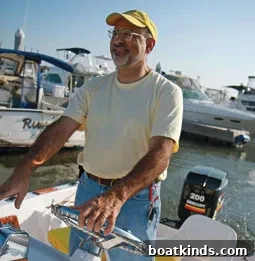
Abess, a psychiatrist and business consultant from Charleston, South Carolina, has renovated Alter Ego in phases since 1990. Over the years he has slightly modified the layout and repowered the boat twice. The result is a center console that draws compliments wherever it goes, painted and upholstered in bright yellow accents that make it stand out among modern center consoles.
The first major refit came in early 2009. G-Crafts Marine in Awendaw, S.C., handled most of the work. Owner Bobby Gehlken ([email protected]) has been restoring Makos, Boston Whalers, SeaCrafts and other classics since 1989. “John’s boat was solid,” Gehlken says. “The deck and hull were in good condition; Makos from that era used a substantial amount of fiberglass. We inspected the transom carefully, but overall the boat was sound.”
Before spraying the finish coat of Awlgrip, Gehlken repaired spider cracks and patched gouges in the hull, painted the engine, replaced the rubrail and deck hardware, and refinished teak elements including the anchor pulpit, anchor locker door, gunwale rod compartment trim, stern storage compartment doors, and the trim around the console access cutout. No structural work was needed at that time, and the boat relaunched in spring 2009. That first refit cost about $20,000.
“Repairing the boat was far more affordable than replacing it,” says Ann Abess, John’s wife of 44 years. “We have a lot of history with this boat, and it remains the perfect size for us.” The Abesses have long been a boating family. John grew up in upstate New York and spent childhood hours in a 16-foot hydroplane. Over the years the family owned sailboats and smaller Makos, and they used Alter Ego for exploring Wadmalaw Sound, creeks and marshes, and even shrimping from a homemade skiff they dubbed the Marsh Patrol.
Repowering Alter Ego
The couple enjoyed the newly refreshed Alter Ego only briefly before the boat experienced a major engine failure. While returning to port, the 1990 Mercury Black Max 200-hp 2-stroke stalled after the boat took a hard wave. Abess discovered severe corrosion around the lower motor mount and swivel bracket areas and had to be towed in. That experience prompted a decision to repower the boat — and to address a long-standing concern about the original low cut-out transom.
Although a cut-out transom makes it easy to haul in fish, it can let water come over the stern if the boat loses power and is oriented poorly. Abess decided a full-height transom and an outboard bracket would provide better safety and more usable cockpit space, so he engaged Armstrong Nautical Products for a heavy-duty bracket and returned to Gehlken for structural work.
The refit required significant fiberglass and structural work. Gehlken removed the old transom and built a new one. Armstrong specified a minimum transom thickness of 2-1/2 inches to support the bracket and outboard; a conventional transom is typically 1-1/2 to 2 inches. The original transom’s wood core proved to be wet, so they installed a rot-free plywood core supplied by Greenwood Products. Gehlken also replaced transom and livewell through-hulls, bilge hoses and deck access plates.
To strengthen the stern, Gehlken cut the aft ends of the stringers forward about 30 inches and replaced those sections with beefier, higher stringers. He removed and replaced the aft portion of the cockpit sole, eliminated the splash well, and redesigned the port and starboard cockpit corner storage lockers. “The boat basically received a new stern,” Gehlken says.
While working on the stern, they also replaced the original 86-gallon aluminum fuel tank mounted under the console. Gehlken found several pinholes and identified poor drainage and trapped water as contributors to corrosion. He spot-foamed areas to improve drainage and epoxy-coated the tank to minimize future corrosion. Proper ventilation and drainage around fuel tanks are vital, especially in saltwater environments, to prevent accelerated deterioration.
Abess was closely involved in the project, documenting progress with photos and specifying how he wanted details finished. He considered purchasing a new boat but was unimpressed by the ride quality of newer, lightweight models. “Many modern designs aim for economy,” he says. “I value the safety and softer ride of a heavier, deep-vee hull even if it uses a little more fuel.” That deep-vee design served well during a violent hailstorm when Abess kept the bow into the waves and maintained control until the storm passed.
Returning to Evinrude
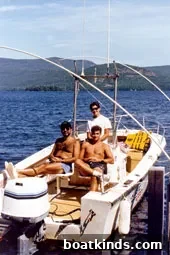
When Abess originally bought the Mako in 1977 it was powered by a 175-hp Evinrude 2-stroke. After a period with a Mercury outboard, he ultimately decided to return to Evinrude for Alter Ego’s most recent repower, choosing a 250-hp Evinrude E-TEC direct-injected 2-stroke.
Abess cites several advantages of the E-TEC: lighter weight compared with comparable four-stroke outboards, low maintenance requirements, reduced emissions and competitive fuel economy. At a cruising speed of about 33 mph, the boat consumes roughly 11 gallons per hour (approximately 3 mpg); backing off to 29 mph yields about 3.6 mpg. At economical idle speeds — around 1,000 rpm — the engine burns roughly 0.8 gph, delivering nearly 8.75 mpg for leisurely harbor cruising. Top speed is in the neighborhood of 50 mph, and the E-TEC requires minimal routine maintenance until 300 engine hours.
The new outboard was installed along with updated hydraulic steering and modern electronics by skilled technicians at Cape Romain Marine & Pawley’s Island Marine, south of Myrtle Beach, South Carolina. Abess also embraced digital throttle and shift controls, enjoying the precise incremental rpm adjustments and the confidence that comes with digital throttles that resist slipping back under load.
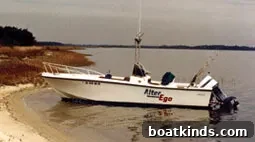
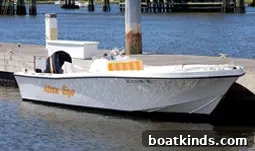
The second major refit, including the structural stern work and repower, cost about $25,000. For the Abesses it was a worthwhile investment that will keep Alter Ego in service for many more years. The boat continues to provide quiet family memories — lazy Intracoastal Waterway runs, swims from the anchored boat, picnics on deck, and longer explorations of the ACE Basin, with its endless marshes, creeks and islands.
While the boat is up to date mechanically and cosmetically, the family still plans to add shade in the form of a T-top or Bimini — a priority for Ann, who wants protection from the midday sun. For now, Alter Ego remains a well-loved, modernized classic: repowered, reinforced and tuned to the family’s needs, ready for many more cruises and outings in South Carolina waters.
This article originally appeared in the December 2011 issue.