
Yamaha Marine Unveils Hydrogen-Powered Outboard Prototype at 2024 Miami Boat Show
At the 2024 Miami International Boat Show, Yamaha Marine showcased a prototype hydrogen-powered outboard built in collaboration with Regulator Marine and Roush Performance. The project converts Yamaha’s 450-hp XTO outboard to run on hydrogen and demonstrates the company’s early efforts to explore alternative fuels and pathways to carbon neutrality for the marine market.
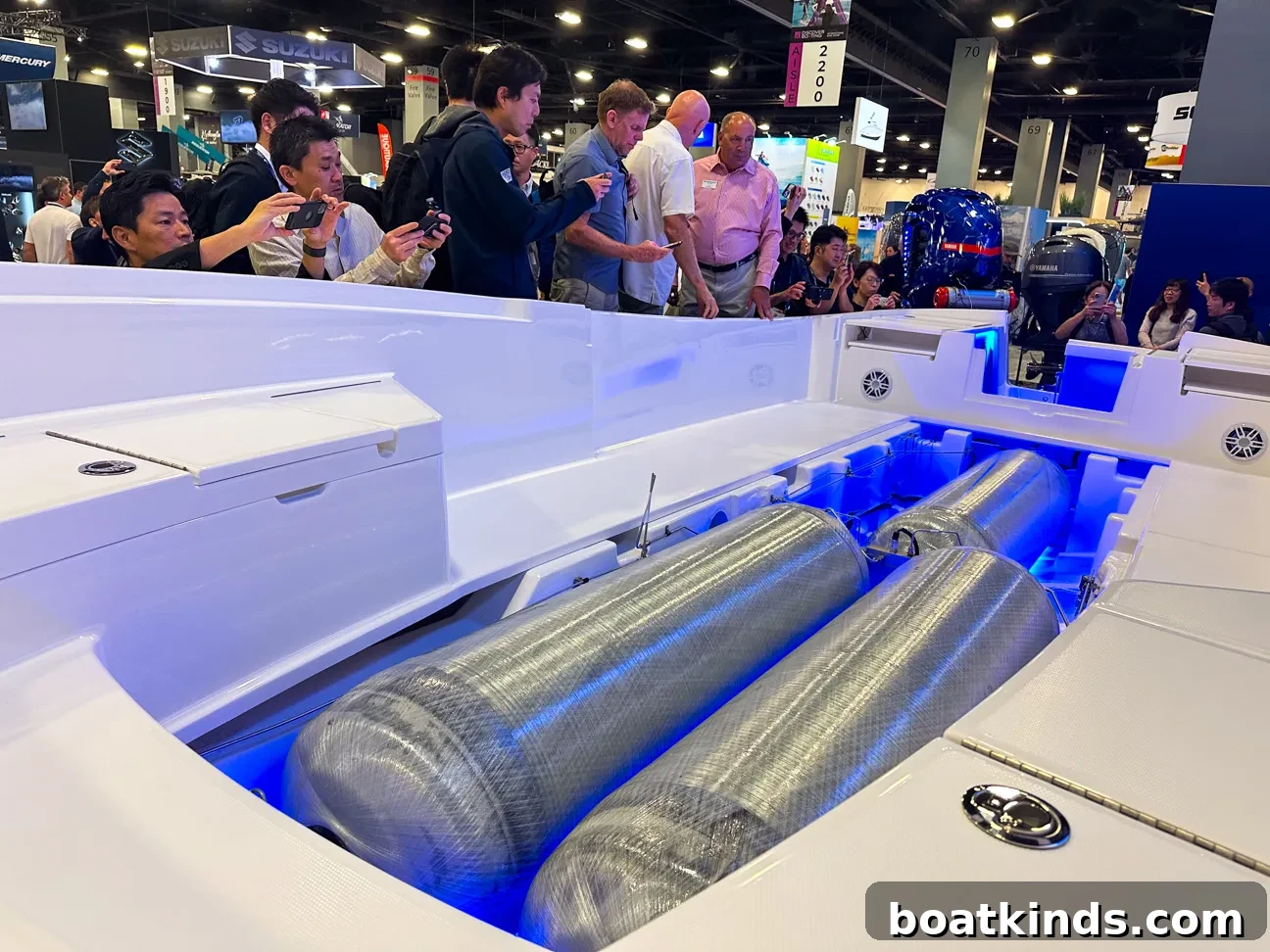
The demonstrator combined a modified Yamaha XTO outboard with a Regulator 26XO hull that was adapted to carry large hydrogen storage tanks below deck. Yamaha U.S. Marine Business Unit President Ben Speciale said several internal components of the XTO were replaced — including fuel lines and injectors — to enable hydrogen combustion. The prototype was displayed with three oversized hydrogen tanks installed in the hull’s voids, revealing the current packaging and range limitations of on-board hydrogen storage.
Speciale explained that the hydrogen capacity installed on the Regulator 26XO is equivalent to roughly a 25-gallon gasoline tank, and that under the present configuration the boat’s range would be limited to about 50 miles. He described the effort as an early-stage exploration intended to help Yamaha and the broader marine industry understand real-world constraints and opportunities for hydrogen propulsion. The company planned live testing of the prototype during the summer of 2024.
Roush Performance was enlisted for the project because of its long experience with hydrogen applications, including high-performance and experimental programs. Matt Van Benschoten, vice president for advanced engineering at Roush, noted that current hydrogen storage technology is a primary limiting factor. For the Regulator demonstration the hydrogen was stored at 700 bar, which he described as the most common standard for compressed hydrogen tanks today. Van Benschoten added that 1,000-bar tanks are becoming more common and could extend range in future applications.
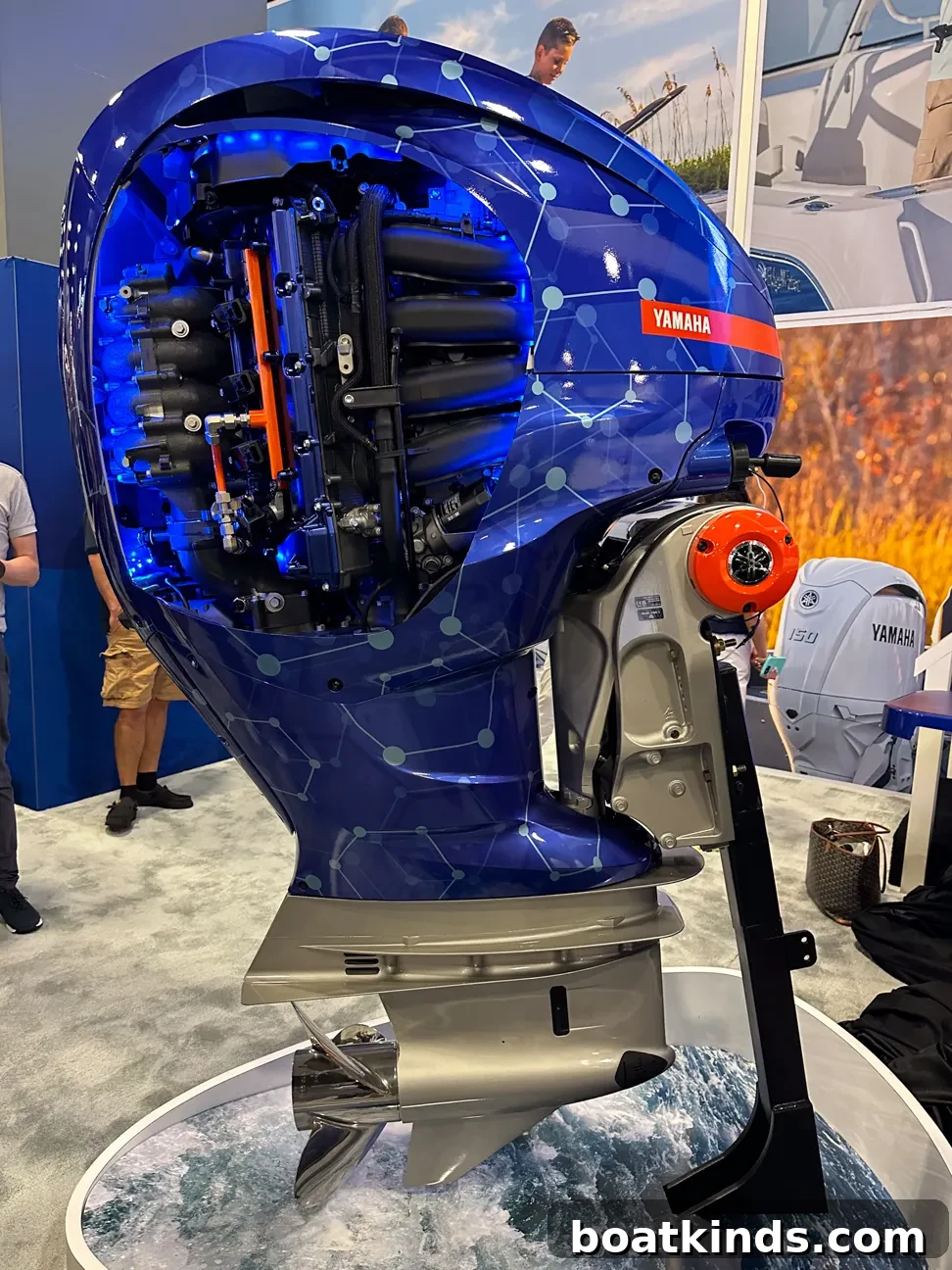
On power delivery, Yamaha and Roush reported the hydrogen-powered outboard produces slightly less than the engine’s rated 450 hp but still exceeds 400 hp. That level of output shows hydrogen can deliver performance comparable to conventional gasoline outboards, while highlighting the trade-offs between power, storage capacity and practical range in current implementations.
Speciale framed the project as one of several simultaneously pursued approaches to reach Yamaha’s carbon-neutrality commitments. Yamaha has pledged to make its operations carbon neutral by 2035 and its products carbon neutral by 2050, and the company said reaching those goals in the marine market will require multiple technologies — from improved internal combustion with alternative fuels to electric propulsion systems. Yamaha recently announced plans to acquire the German electric propulsion firm Torqeedo, underscoring its multi-pronged strategy.
“Yamaha is exploring all possibilities to achieve carbon neutrality, and we’ve made commitments for our operations to be carbon neutral by 2035 and our products to become carbon neutral by 2050,” Speciale said. “That goal within the marine market can only be reached through an approach that leverages multiple solutions.” He added that industry progress will depend on companies pushing technical boundaries while coordinating on infrastructure and policy necessary to support new fuel systems.
The Regulator-XTO hydrogen prototype is an early proof-of-concept rather than a market-ready product. It demonstrates that hydrogen can be adapted to existing high-performance outboard platforms but also highlights the immediate challenges: compressed hydrogen storage volume, pressure standards, and the resulting limited range when tanks are sized to current technology. Yamaha, Roush and Regulator intend to use the data from lab and sea testing to refine designs and to inform future decisions about tank technology, system packaging and powertrain performance.
For now, Yamaha continues to introduce new conventional outboards — including its recently released 350-hp model that appeared on several test boats at the Miami show — while simultaneously investing in electric propulsion and alternative-fuel combustion options. The hydrogen outboard prototype is a tangible example of that strategy: testing technical feasibility, measuring real-world trade-offs, and inviting broader industry participation in developing the infrastructure and policies needed to support low-carbon marine propulsion.