
Boeing 307 Stratoliner: From Howard Hughes’ Flying Penthouse to the Yacht Londonaire and Cosmic Muffin
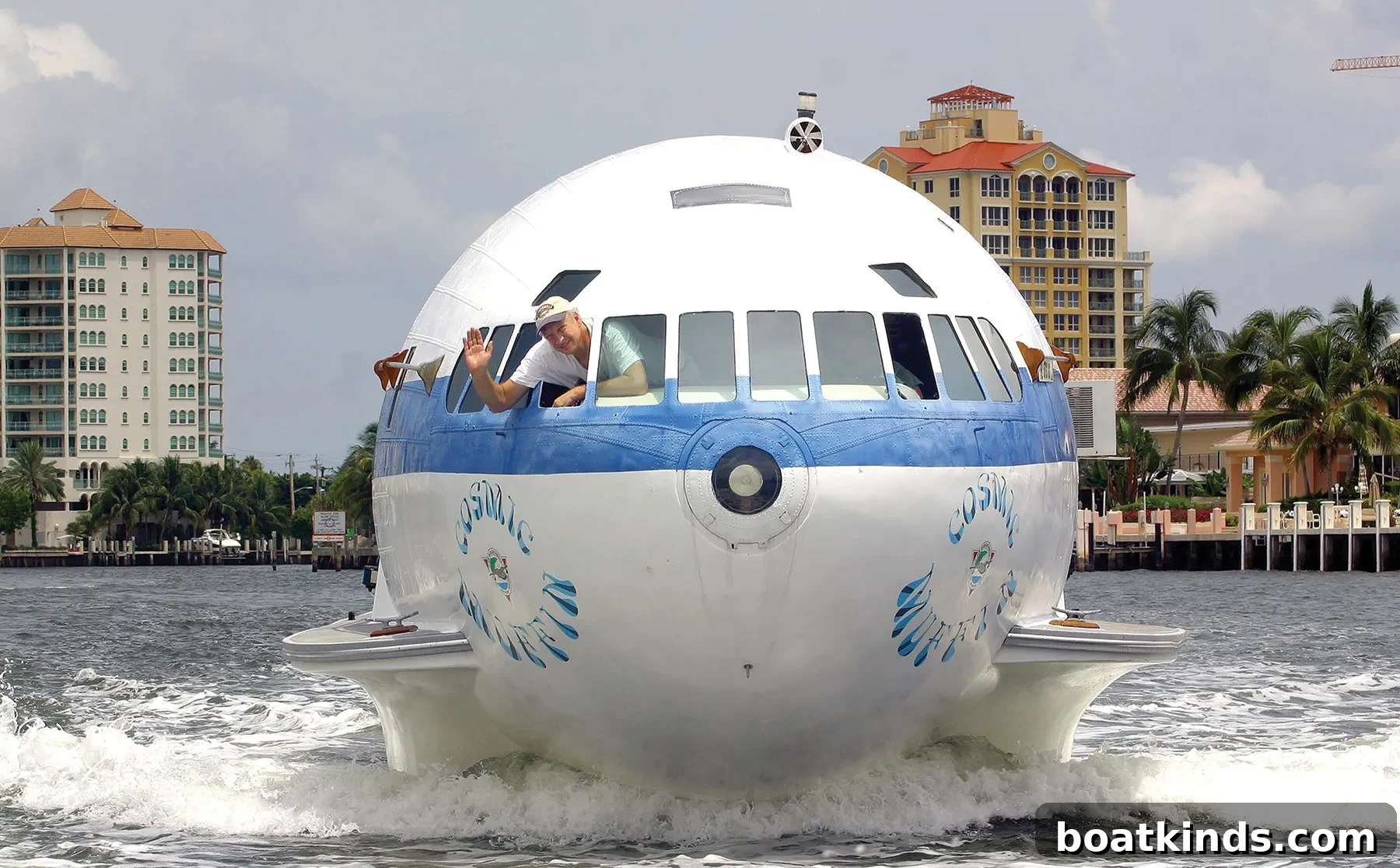
This Boeing 307 Stratoliner enjoyed an extraordinary life that crossed aviation and maritime worlds. Originally a passenger airliner, the aircraft was purchased in 1939 by American billionaire Howard Hughes for approximately $315,000 — roughly equivalent to $6.5 million today. Under Hughes’ ownership the Stratoliner received an extensive interior makeover, becoming known as “The Flying Penthouse” thanks to luxurious additions such as a bar, a comfortable lounge, bunk beds and an opulent bathroom more reminiscent of a mansion than a commercial plane.
From Airliner to Storm Damage
Hughes sold the Boeing about a decade after his purchase. Over time the aircraft changed hands and uses until, in 1964, Hurricane Cleo struck Florida and severely damaged the plane. The storm left the Stratoliner beyond practical repair for flying; its tail and wings were removed, and the airframe was no longer considered airworthy. Rather than consign the impressive fuselage to scrap, a creative transformation began that would preserve much of the aircraft’s character while repurposing it for life on the water.
Transformation into the Yacht Londonaire
Under new ownership the plane was reborn as a motor yacht, taking the name Londonaire. The conversion was substantial: the lower portion of the fuselage was removed and replaced with a custom-built fiberglass hull to make the structure seaworthy. Twin inboard V8 engines were installed and creatively linked to the aircraft’s original flight controls, blending elements of the Stratoliner’s heritage with practical marine engineering. While the exterior and propulsion changed dramatically, much of the aircraft’s interior was preserved, retaining the sense of luxury that had earned the Stratoliner its nickname.
Ken London oversaw the metamorphosis and later sold the vessel. By 1981 the former Stratoliner was listed in Fort Lauderdale as a 56-foot houseboat with an asking price of $8,500 — a remarkable shift from its origins as a cutting-edge airliner and Hughes’ private transport.
Cosmic Muffin: A Houseboat, a Home, and an Inspiration
Dave Drimmer discovered the aircraft-turned-houseboat while searching for a property on the water. Struck by the price and the unusual craft, he purchased it and undertook a major refit. During the time Drimmer owned the vessel, singer-songwriter and author Jimmy Buffett spotted it in Fort Lauderdale and drew inspiration from its eccentric character for his novel Where Is Joe Merchant?. In tribute to that connection, Drimmer renamed the houseboat Cosmic Muffin, after a fictional element in Buffett’s work.
Drimmer made extensive upgrades to live aboard comfortably. He installed new teak flooring and converted the airplane’s bunk berths into a single queen-sized bed, among other interior improvements. The hull was later replaced, and the craft’s propulsion was modernized: initially fitted with a pair of 9.9-horsepower Yamaha outboards, these were eventually upgraded to 50-horsepower models to improve performance and handling. Drimmer lived aboard Cosmic Muffin for nearly 20 years, maintaining and improving the unique vessel while using it as his personal residence.
Preservation and Restoration
As maintenance and repair needs mounted, Drimmer chose to donate the vessel to the Florida Air Museum in 2016, ensuring its history would be preserved and made accessible to the public. In the year following this publication, noted aircraft collector Kermit Weeks purchased the Stratoliner-turned-houseboat with plans for restoration, continuing the long tradition of caretakers who have adapted and preserved the craft over many decades.
The Stratoliner’s journey—from commercial airliner to Howard Hughes’ luxurious Flying Penthouse, to the yacht Londonaire, and later the houseboat Cosmic Muffin—illustrates a remarkable example of adaptive reuse. Its story spans aviation history, hurricane survival, inventive marine engineering, and cultural influence through literature and music, making it a unique artifact cherished by enthusiasts of both flight and maritime heritage.
This article was originally published in the May 2024 issue.