I come from a family of engineers, but I’m the outlier: a journalist who, despite being handy enough to restore a Whitehall skiff and five houses, has always avoided electrical work. Aside from installing an auxiliary power outlet on my boat years ago, I left electronics to the pros—until my 14-year-old handheld Garmin became impossible to read while my 17-foot RIB bounced over Maine’s rocky waters. It was time for a larger, boat-powered MFD.
What began as a simple MFD upgrade quickly evolved into a full marine electronics overhaul. I chose a Raymarine Axiom+ 9-inch MFD and decided to add a Raymarine Ray 90 VHF, a Raymarine RV-100 transducer, an RMK-10 keypad for easy control in rough seas, and a Raymarine AIS 700 Class B transceiver for better situational awareness. I also planned to add the MOB+ wireless man-overboard system to replace the kill cord, USB charging ports, a powered horn, and a Rule Mate bilge pump. The MFD installation justified a second 12-volt battery, so I mounted that and a battery switch beneath the driver’s seat.
I wouldn’t have attempted this without help. Photographer and Soundings contributor Onne van der Wal had just finished a similar Raymarine install, and my brother-in-law Nabil—an electrical engineer and self-described techno geek—became my project partner and teacher. Nabil isn’t a boater, but he loves tech and he’d always navigate trips with charts on his iPad. He studied every manual, drew a schematic, and guided me through proper connections and fusing. Between his electrical knowledge and my willingness to cut, drill and pull wires, we made a good team.
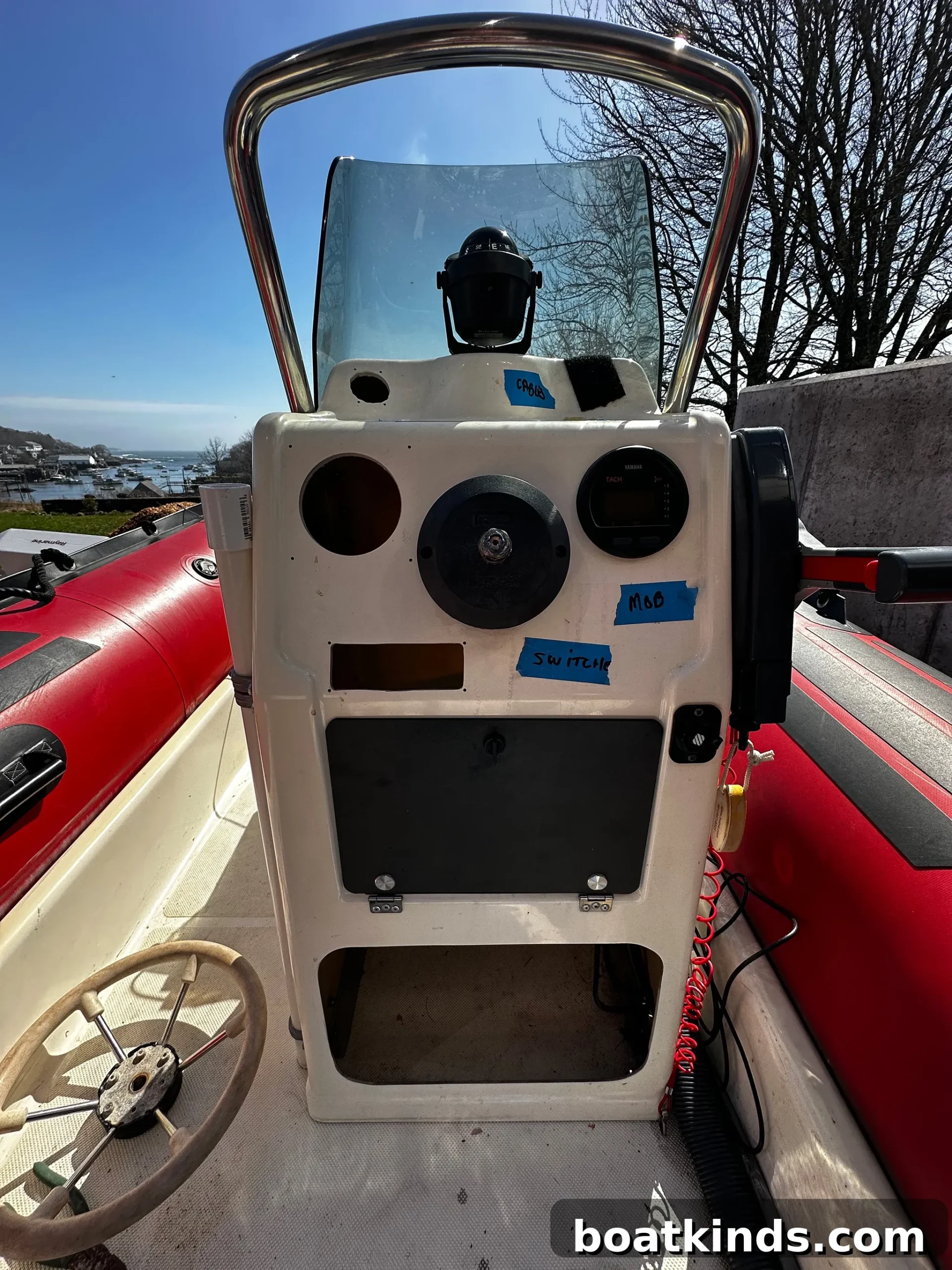
The first challenge was fitting the 9-inch Axiom+ onto my small Zodiac console. The unit crowded the available space, but we routed the wiring down into the console so the VHF, AIS and a busbar could live inside. A trip to Hamilton Marine in Rockland stocked us with the connectors, switches, panels, bolts, seals, heat shrink tubing and other supplies—two rounds totaling roughly $2,000—so we had what we needed before cutting fiberglass.
Removing the steering wheel proved unexpectedly difficult. Years of corrosion had fused the wheel hub, Woodruff key and steering shaft together. After weeks of penetrating oil, pounding and creative attempts, a boat mechanic’s son finally freed it using heat, brute force and a few leverage tricks. With the wheel gone and the windshield removed, the console looked like Swiss cheese after we drilled mounting holes for the MFD, brackets and wiring funnels.
Progress slowed as the project expanded. I added a Clarion CMM-10 stereo head unit with speakers in the bench seat, replaced a flimsy plastic shelf with 1/2-inch King Starboard to hold the stereo and breaker panel, and fabricated an Azek cover to protect wiring near the battery boxes. I also researched and installed collapsible VHF and Raymarine GA200 GPS antennas on adjustable stainless mounts so they could be lowered for garage storage. Each decision required measurement, reinforcement and protection to prevent wires and mounts from failing when the boat slammed through waves.
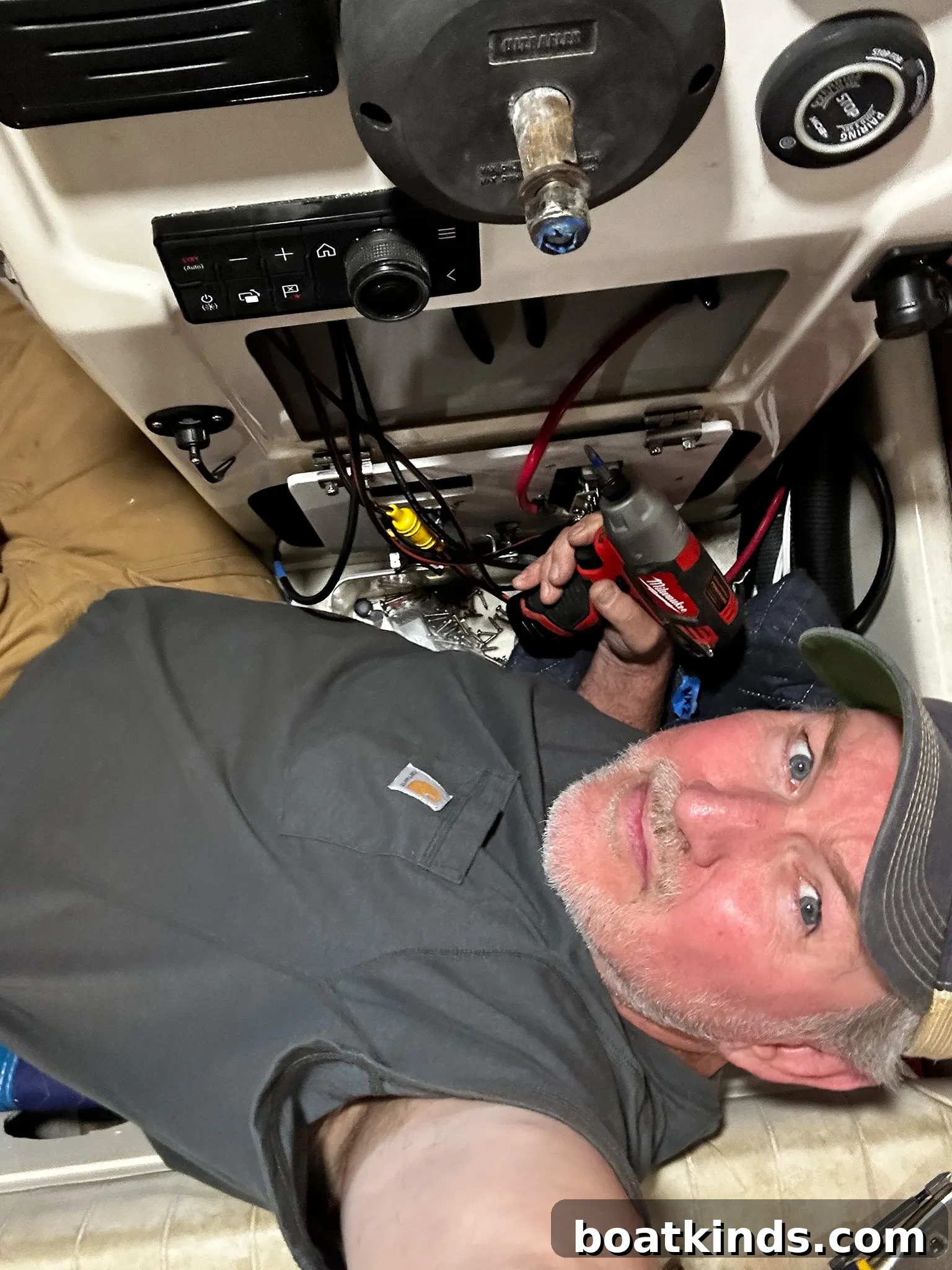
Space inside the console was painfully tight. I rebuilt shelving from King Starboard and Azek to hold the busbar, VHF and AIS while still being narrow enough to pass through the odd 8-by-11-inch opening. I often worked blind, wedged between the console and bench seat with one arm reaching into the cavity, coaxing a wire into a connector by feel. Mike Garretson of Sea & Land Yacht Works reviewed our schematic and recommended adding a Blue Sea 100-amp ANL fuse block to protect the 6-gauge feed wire—a smart safety upgrade we implemented.
By late spring 2024, after more wiring, soldering, heat-shrinking and liquid electrical tape where appropriate, the system was wired and ready. Nabil and I completed the final hookups in two marathon days. Watching the MFD light up for the first time felt almost as thrilling as seeing a child born; after two years of fits and starts it was a major payoff. The AIS revealed how many Maine boats broadcast positions, and I now leave the VHF on all the time without worrying about dead handheld batteries.
Not everything is finished—MOB+ still needs final orientation and connection, and I have manuals to read to exploit all the new features—but the installation is functional and robust. The interior of the console isn’t as tidy as a professional install might be—try fitting 20 pounds of equipment into a five-pound space—but I’m proud of getting everything into such a small area. I learned a ton about marine electronics, gained new skills, and developed real appreciation for the technicians who do custom installs professionally. Would I do it again? Yes—but next time I’ll pick a boat with a larger console and aim to finish in months, not years.
December 2024