
Ariel Pared is vice president of sales and marketing for SeaVee Boats in Miami. In 2008 SeaVee became the first company in the United States to produce a center-console boat with pod-drive propulsion, a 39-foot model that helped establish the company as an innovator in propulsion technology.
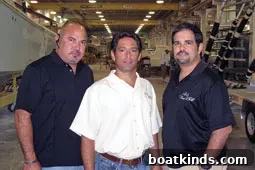
Pared, 43, and his partners Ralph Torres and Moises Rodriguez recently introduced a 34-foot center console powered by a single 480-hp Cummins MerCruiser diesel engine coupled to a ZF Marine pod drive — a first for a U.S.-built single-pod center console. SeaVee also showed its new 43 Express configured with twin Volvo Penta IPS600 drives, underscoring the company’s focus on advanced propulsion options.
Pared was born in Cuba and moved with his family to the United States at age 3. He was raised in Miami and continues to live there with his wife, Ginny, and their two sons, Jacob, 15, and Jason, 10. An avid angler, Pared regularly runs the company’s IPS-powered 39-foot Open in tournaments across Florida, the Bahamas and the Florida Keys.
New single-pod 34-foot center console
Pared explains that SeaVee has committed to pod propulsion as an important part of the company’s product strategy. “Pod systems are the future,” he says. While the Volvo Penta IPS is designed for twin-engine applications and suits SeaVee’s 39- and 43-foot models, the company sought a pod solution appropriate for the 32- to 34-foot range. When ZF approached SeaVee with a single small pod option, the team pursued it right away. The 34-footer is the first single-pod center console built in the U.S., and, outside of SeaVee’s IPS models, it is the only center console with pod propulsion on the market.
Pared is building the 34-foot prototype as his personal boat for the season so he can put extensive time on it and identify refinements before any potential move to full production.
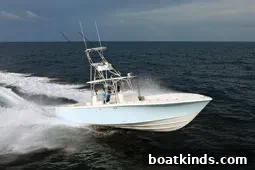
How the single ZF pod works on a 34-foot hull
The prototype is powered by a single Cummins MerCruiser Diesel QSB5.9-480 tied via a jackshaft to a compact ZF pod. To assist maneuvering, SeaVee paired the pod with a heavy-duty bow thruster. Unlike most pods that have limited turning angles, this ZF unit can rotate a full 180 degrees and is designed to work in concert with the bow thruster for exceptional low-speed control. The bow thruster runs on 110 volts; SeaVee uses an inverter that converts 24 volts to 110 to power it, and the thruster is rated for approximately an hour of continuous operation—enough to provide sustained maneuvering when needed.
The 34-foot single-pod layout is based on SeaVee’s existing 34-foot center-console hull, which has historically been available with twin outboards or a single inboard diesel. For the pod version, SeaVee modified the inner liner and altered the hull bottom to accommodate the pod. Because SeaVee performs much of its own tooling, those modifications were manageable. Aside from the changes required for the oversized thruster and pod installation, the boat remains consistent with the standard 34-foot model. Pared plans to camp-test the boat in sailfish-season tournaments to evaluate its real-world performance.
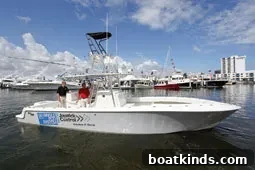
The 43 Express and IPS configuration
SeaVee also refined its 43 Express. After debuting an outboard version last year, the company retooled the model for what it calls the 430 IPS. Using the same 43-foot hull, SeaVee redesigned nearly everything else: a new inner liner, a remodeled engine room and a relocated fuel system. The 43 Express measures 43 feet with a 13-foot, 4-inch beam and includes a private stateroom, a forward V-berth, a full galley and a dry head—features that make it a substantial express-style center console. Power comes from twin Volvo Penta IPS600 units.
Construction methods and materials
SeaVee builds boats using a time-intensive, hands-on process. All SeaVee hulls are 100 percent hand-laid with vinylester resin. The company vacuum-bags roughly half of its core materials and uses PVC foam core for strength and bonding — a higher-cost core material the company prefers for its structural properties. Each hull spends seven to 10 days in the mold. The process begins with the hull, then the one-piece stringers are installed followed by bulkheads so the glass runs continuously over the stringers. SeaVee vacuum-bags the hull sides, installs fuel tanks and the inner liner, then bonds everything as a single, integrated unit before removing it from the mold. Pared says the deliberate approach requires more time but yields a higher-quality product.
Design priorities for a good fishing boat
Pared stresses that layout and storage are essential for a capable fishing boat. SeaVee emphasizes ample, well-thought-out storage so there is “a place for everything.” The three-piece construction—hull, inner liner and deck—enables 360-degree fishability and allows for multiple compartments, bait wells and insulated fish boxes. According to Pared, understanding the typical owner’s needs is key: “If you know who you are building for, you’ll know what you need to do.”
Factory-direct sales and customer relationships
SeaVee sells its boats factory-direct, a model Pared believes brings significant advantages. Direct sales allow the company to spend more time with customers, which improves product development and speeds identification of issues with vendor components that might otherwise be delayed or lost in a dealer network. By controlling the entire experience—selling, outfitting, rigging, delivering and servicing—SeaVee can focus on product quality and offer custom work that many dealers cannot provide. Pared notes that without the margin dealers typically require, SeaVee can invest more in manufacturing, wiring and finish work, producing a more serviceable, durable boat.
Market focus and company history
SeaVee’s typical customer is someone who runs offshore—whether to the canyons or the Bahamas—and who wants a boat that’s easy to clean and stow. The brand’s core market is the Southeast U.S.; SeaVee operates a factory in Miami and an office in West Palm Beach, and the company is opening an office in the Keys to strengthen regional coverage.
SeaVee traces its roots to 1973, when the company was founded by a boat captain named Don McGee. Pared bought his first SeaVee in the early 1990s, fell in love with the brand’s dedicated owners, and purchased the company from McGee in 1994 with partners Moises Rodriguez and Ralph Torres. Torres oversees manufacturing and new product development, Rodriguez manages finances and daily office operations, and Pared leads sales and marketing. Before joining SeaVee full time, Pared and Rodriguez operated communications retail locations selling cell phones and pagers; they sold that business around 1992 before acquiring the boat company.
Looking ahead: propulsion, quality and the post-recession market
Pared expects propulsion to be a major driver of change for powerboats in the 20- to 40-foot range. He predicts greater adoption of pod systems, continued growth in larger outboards and improved fuel efficiency, and suggests traditional inboard drives may decline. Regarding the broader market, he believes the recession will reduce sales opportunities but also thin competition, creating a chance for smaller manufacturers with strong reputations and new products to gain market share. Pared emphasizes that going forward consumers will prioritize quality, reliability and follow-up service, and that manufacturers should design boats to be serviceable and durable rather than rely on gimmicky features that won’t hold up in demanding offshore conditions.
Life on the water
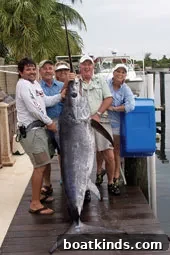
For Pared, the water is primarily for fishing. He fishes most weekends—locally, in the Bahamas and in the Keys—and plans to compete in about a dozen tournaments this year, many of which SeaVee sponsors. He typically fishes aboard the company’s 390 IPS and often brings customers who have become friends through years of shared time on the water.
See related story:
– Putting the single-pod 34 to the test
This article originally appeared in the February 2011 issue.