
Lester Fagans: The 1959 Flybridge Motoryacht Cover and a Career in Marine Illustration
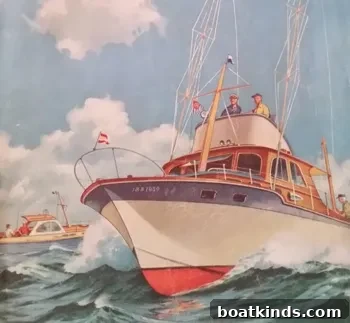
A dramatic 1959 magazine cover by Lester Fagans captures a flybridge motoryacht powering through choppy seas. The image — bold, kinetic and precise — is representative of a long career in marine illustration that made Fagans a respected name in commercial and recreational boating art. Though lesser-known to the general public today, he was recognized in his time by the American Merchant Marine Institute as “one of the country’s leading contemporary marine artists.”
Fagans’ reputation began with highly detailed boat portraits. One early example, Breezy Day from 1939, depicts Henry Gibson’s powerboat Vesta, which was built by Hubert Johnson’s yard in Bay Head, New Jersey. These precise portraits showcased not only his technical draftsmanship but also his ability to convey the personality and presence of a vessel on the water.
After serving in the South Pacific during World War II, Fagans transitioned into a prolific career in commercial art. His commissions spanned many industries and formats. He produced road maps for Esso (Standard Oil), illustrated technical and lifestyle articles for publications such as Popular Science, and executed complex cutaway drawings — for example, a detailed centrifuge illustration used in an article about supersonic aviation. He also designed striking promotional posters for shipping lines like Moore-McCormack, Grace Lines and American Export Lines, helping to publicize the fleets of new ocean liners through compelling visual storytelling.
Although he worked successfully across a variety of commercial assignments, Fagans became particularly known in the recreational boating world. The postwar decades of the 1950s and 1960s were a golden era for pleasure boating, with rapid advances in design, technology and consumer interest. Fagans’ magazine covers and feature illustrations helped communicate that excitement to potential buyers and enthusiasts. His drawings also appeared in reference material, including the long-standing Chapman Piloting: Seamanship and Small Boat Handling, where his technical clarity supported practical instruction.
Artistic Approach and Reputation
Fagans described his own working methods modestly, calling much of his process “quick sketches” and famously saying he had “no ideas.” This self-effacing stance belied a disciplined work ethic: he once observed that he had to work “pretty hard” and that, “once in a while,” he received a check. Colleagues and clients remembered him for his draftsmanship and meticulous attention to detail — qualities that made his ship and boat illustrations both accurate and visually engaging.
His technique combined technical precision with a sense of motion and atmosphere. Whether rendering the gleam of a new hull or the spray of a vessel cutting through chop, his images balanced documentary clarity with evocative composition. That balance is evident in the 1959 flybridge motoryacht cover, where dynamic sea conditions and a powerful silhouette create a memorable visual statement.
Community Life and Legacy
Fagans was also active in the artistic and civic life of his hometown, Chatham, Massachusetts. He gave demonstrations, taught lessons and engaged with local groups and schoolchildren — efforts frequently noted in the Chatham Press. Those contributions reflect a practical, community-minded artist who shared his skills and encouraged interest in maritime art and craft.
Lester Fagans died in 1964. To those who commissioned and worked with him, he was a “popular choice” in illustration because of his reliability, clarity and eye for detail. Today his work remains a recorded part of mid-20th-century marine and commercial illustration, valued by collectors, historians and boating enthusiasts who study the era’s visual culture.
This article originally appeared in the April 2017 issue.