
Jack Sherwood was a writer who delighted in telling the stories of people who lived and worked on and around Chesapeake Bay — watermen, boatyard hands, itinerant cruisers and the memorable characters he met along the waterfront.
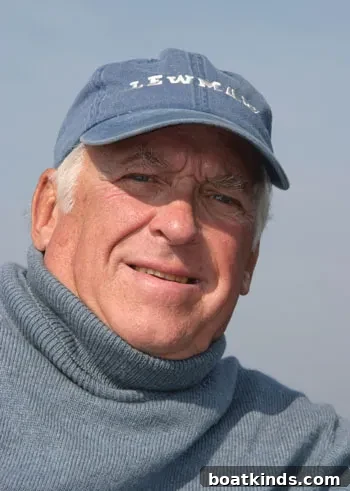
A former feature writer and columnist for the Washington Star, Sherwood wrote the monthly Bay Tripper column for Soundings for nearly two decades. His final Soundings piece, published in the September 2014 issue, recalled a treasured summer sail with his granddaughter Claire aboard his beloved Sailmaster 22, Erewhon, designed by Sparkman & Stephens. Sherwood died Dec. 7 in Maryland of cancer at age 84.
Bill Sisson, a former editor-in-chief at Soundings, remembered Sherwood as “a sailor’s sailor and a writer’s writer.” Sisson praised Sherwood’s reporter’s instincts and ear for dialogue, saying he continually discovered vivid waterfront personalities to bring to life on the page.
Sisson particularly enjoyed Sherwood’s profiles of people such as Capt. Freddy, a homeless sailing veteran in the Florida Keys, and a former Washington, D.C., lawyer who lived aboard a succession of junk boats and kept reappearing at anchorages until he and his vessels finally vanished. “He loved sailing, and he loved the people he met along the way,” Sisson said. “In the process he became as much of a character as the people he wrote about — a lovable curmudgeon who called things as he saw them and had an aversion to yachting pretension.”
John Barry, a retired Caribbean schooner captain and long-time friend, first met Sherwood decades earlier through Sherwood’s wife, Betty, who worked at the Bay Yacht Agency in Eastport, Maryland. After leaving the Star, Sherwood profiled Barry’s daysail operation, Sail Daily Aboard Lady, in a Washington Post Weekend section feature in the summer of 1980. “That piece made my season,” Barry recalled. “I had to turn away guests and hire someone to answer the phone. This was the beginning of a lasting friendship.”
Barry fondly recalled sailing adventures with Sherwood and his wife, noting trips to Nantucket and Martha’s Vineyard out of Newport, and passages aboard Bluejacket, an Alden 54, through the Grenadines. He admired Sherwood’s dedication to boat work, even in harsh weather. Barry remembers gray, 38-degree days off Spa Creek helping Sherwood on Erewhon and being struck by Sherwood’s meticulous to‑do lists. “He loved to mark off finished projects,” Barry said, “which gave him a real sense of accomplishment.”
After Sherwood’s cancer diagnosis the previous summer, he asked Barry to oversee the sale of Erewhon. “It was bittersweet,” Barry said. “To me, Erewhon was like a good friend and part of Jack’s family.” The boat was later purchased by Winston Groom, the novelist best known for Forrest Gump, who had worked with Sherwood at the Star; Groom now sails Erewhon in Mobile Bay, Alabama.
In a remembrance published in the Annapolis Capital Gazette, Groom praised Sherwood’s ability to illuminate everyday people often overlooked by mainstream coverage. “With a Runyonesque flair,” Groom wrote, Sherwood brought to life ferry operators, tea-room waitresses, pigeon racers, linotype workers, toll-booth attendants, tugboat drivers and many more whose stories might otherwise never have appeared in a city newspaper or magazine. Sherwood had a gift for revealing why those lives mattered.
Groom noted Sherwood’s talent for drawing out candid, revealing answers with what Groom called “innocently outrageous questions.” One example appeared in Sherwood’s 1994 book Maryland’s Vanishing Lives: an 81-year-old Italian bread baker in Baltimore’s Little Italy who refused retail customers and insisted on the simple life his father had built. When Sherwood asked about retirement, the baker snapped back, “We sell 1,000 loaves a day, that’s enough. We could bake and sell 5,000 loaves a day if I expanded, but what for? I don’t wanna be a millionaire. I ain’t married. I ain’t got children. I want to stay here until I die. Poppy-pop liked it here. I like it here.”
Sherwood continued to write and reflect on sailing into his later years. His final column, published in the October 2016 issue of Spinsheet, explained that an “unfortunate illness” had convinced him to sell Erewhon and give up solo sailing. He described a long and intimate relationship with the classic Sailmaster/C sloop, noting that after 30 years cruising the middle Chesapeake and nearby waters, the partnership had run its course.
He often credited Robert de Gast’s Western Wind, Eastern Shore — which recounts a solo Sailmaster cruise of the Delmarva Peninsula — as inspiration for his own voyaging. Sherwood enjoyed routine daysailing courses he described in detail: close reaches to Kent Island, tacks toward Thomas Point Light and broad reaching returns home. Far from boring, he said, those runs allowed him to focus on performance and never tired him.
Over the years he adapted Erewhon for single‑handed sailing with a series of practical modifications and clever solutions. “The boat never failed me in three decades,” he wrote, reflecting on its reliability and his deep attachment to it.
This article originally appeared in the March 2017 issue.