
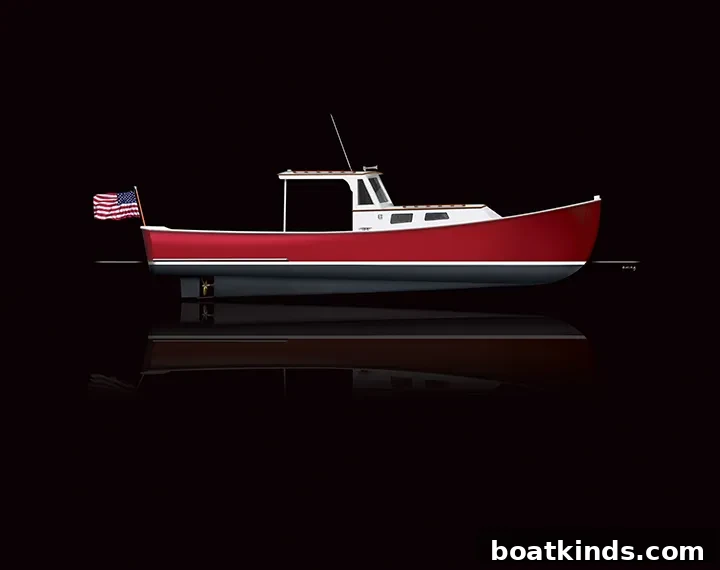
Holland 32: Glenn Holland’s Iconic Down Easter Lobster Boat
The Holland 32, the signature lobster boat designed by Glenn Holland, stands as a classic example of Maine’s Down Easter tradition. Its lines combine practical workboat virtues with an aesthetic that appeals to those who appreciate traditional New England boatbuilding. Derived from an earlier 30-foot design, the Holland 32 preserves the functional qualities required for fishing and towing while offering improved performance and seaworthiness.
Visually, the Holland 32 is immediately recognizable. A tall bow with pronounced flare helps deflect spray and provides reserve buoyancy in head seas, while tumblehome toward the stern and a gracefully curved transom contribute to the boat’s traditional profile. Fullness amidships gives the hull lift and stability, traits that are valuable both for fishing operations and comfortable cruising. Built in the skeg tradition associated with Jonesport and Beals Island yards, the Holland 32 reflects deep roots in Maine boat design and construction.
Glenn Holland, born in Castine and raised among boats and boatyards, brought firsthand knowledge of working craft to his designs. After creating a successful 30-foot hull in the mid-1970s with the guidance of Royal Lowell—son of Will Frost, a prominent figure in modern lobster boat evolution—Holland extended that hull by two feet when the original mold was lost in a fire. The resulting Holland 32 entered production in 1979 and became popular with fishermen and enthusiasts alike. More than 150 Holland 32s have been built, and the model remains a respected semicustom option.
Perhaps the most famous Holland 32 is Holland’s own Red Baron, hull No. 11, which gained renown on Maine’s racing circuit. Entered in the Jonesport race on July 4, 1981, Red Baron arrived in a striking red gelcoat (a surprise to Holland, who had ordered white) and immediately drew attention by placing first and second in its first appearance. Over the years Red Baron achieved a remarkable racing record: it reached a top speed of 57.8 mph in 1999 when fitted with a 1,100-hp supercharged gas engine, and it reportedly won 75 percent of the races it entered, never finishing worse than second in the remainder. That performance helped cement the boat’s place in Maine lobster-boat lore and showcased what a well-designed hull can accomplish under extreme conditions.
Speed aside, the Holland 32’s reputation rests on more than racing pedigree. Builders and users alike have praised the design for its ability to handle rough water with relative comfort and confidence. Jamie Lowell, a boatbuilder from a family long associated with Maine boat construction, described the Holland 32 as both capable in heavy seas and fundamentally a sound workboat. That balance of utility and seaworthiness is a hallmark of successful Down Easter designs and explains the Holland 32’s enduring appeal among fishermen, small-boat owners, and those who value traditional lines paired with practical performance.
Holland’s Boat Shop in Belfast continues to offer the semicustom Holland 32 alongside larger models in the line, including 38- and 42-foot versions. The shop provides options for owners who want to tailor the standard design to their needs while preserving the core characteristics that made the Holland 32 notable: a robust hull form, traditional aesthetics, and sensible seaworthiness.
For enthusiasts of classic Maine boatbuilding, the Holland 32 represents an intersection of design heritage, practical function, and an unmistakable visual identity. Its lineage from the 30-foot hull, connections to notable figures in lobster-boat history, and the enduring fame of Red Baron all contribute to the model’s place in the story of New England’s coastal craft.
Illustration by Jim Ewing
December 2013 issue