
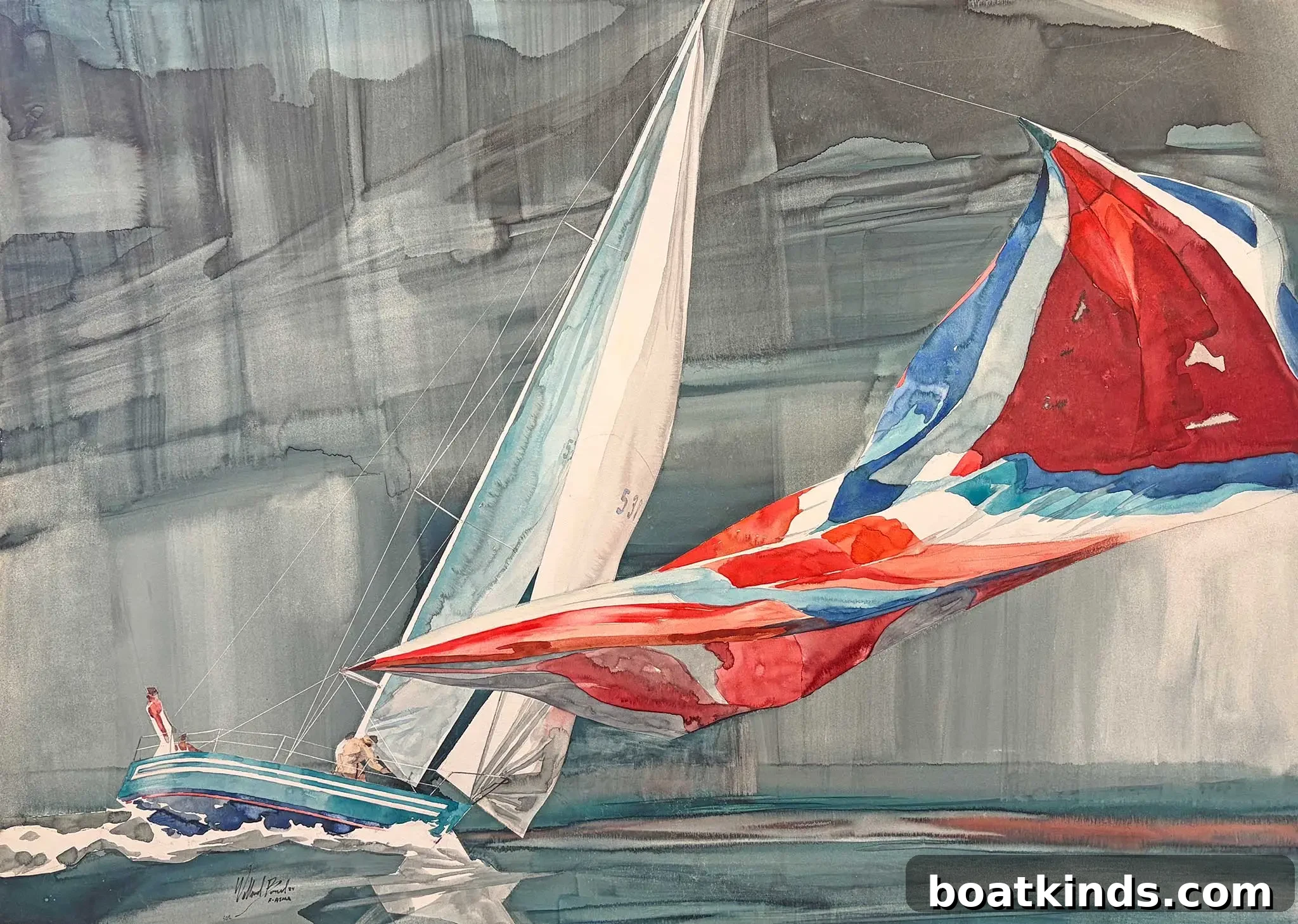
Willard Bond: Painter of Sailing, Speed and Light
Courtesy J. Russell Jinishian Gallery, jrusselljinishiangallery.com
Setting the Spinnaker — Motion Captured in Color
In Willard Bond’s 28- by 30-inch watercolor-on-board painting Setting the Spinnaker, a moment of high drama is distilled into a single, powerful image: a red, white and blue sail abruptly billows against a subdued sky and sea. The composition does not merely reproduce the yacht’s form; it conveys the rush and tension of sailing at speed. As marine art authority J. Russell Jinishian observed in his 2003 book Bound for Blue Water, Bond’s paintings focus less on photographic likeness and more on the feeling of being aboard—on the energy, motion and atmospheric nuance that define a race or an afternoon on the water.
Early Years and a Lifelong Connection to Boats
Willard Bond was born in 1926 in Colfax, Washington, and he began drawing and painting landscapes at the age of 12. His affinity for boats and the sea developed alongside his artistic interests. Summers on his grandparents’ houseboat on Idaho’s Lake Coeur d’Alene left a deep impression: those childhood experiences of water, light and motion became the wellspring for a lifetime of maritime imagery.
Military Service and Formal Artistic Training
Bond enlisted in the U.S. Navy the day after his 18th birthday in 1944. While stationed at the naval base in Chicago, he began formal artistic training, attending night classes at The Art Institute of Chicago. In 1945, his ship, the USS Montpelier, was among the first U.S. vessels to reach Japan to evacuate prisoners of war. Honorably discharged in 1946, Bond pursued further education in New York at the Pratt Institute School of Art in Brooklyn and at the Art Students League in Manhattan. Those academic experiences helped refine both his technical skill and his unique visual approach to maritime subjects.
New York, Tall Ships and the Racing Scene
Bond lived and worked in Manhattan, where an event in 1976 proved pivotal to his career. During the U.S. Bicentennial celebrations, historic square-rigged tall ships from around the world sailed into New York Harbor. As Pier Master of the South Street Seaport, Bond had direct access to these magnificent vessels, allowing him to board them and study their forms, rigging and presence at close range. These immersive encounters deepened his understanding of traditional sailing craft.
Seeking more contemporary subjects, Bond later became captivated by the 12 Meter yachts of the America’s Cup races in Newport, Rhode Island. The combination of sleek modern hulls, competitive intensity and extraordinary sail shapes became a recurring theme in his work. His reputation within the racing community led to invitations to sail aboard 12 Meter yachts during practice sessions, including time aboard Freedom during the 1984 America’s Cup races—opportunities that allowed him to observe the boats and crews from the water, translating firsthand impressions into vivid compositions.
Sailing Life and Artistic Practice
Bond was an active sailor throughout his life. He sailed his own 18-foot wooden sloop out of Long Island Sound and later sailed from East Hampton on a 33-foot Chesapeake Bay skipjack. These personal experiences aboard small and traditional craft informed his sensitivity to wind, light, deck lines and the small narrative moments aboard a ship. That intimacy with sailing life enabled him to capture more than appearances; he painted the sensations of balance, movement and the shifting interplay between sea, sky and canvas.
Technique, Legacy and a Seven-Decade Career
A master of both oil and watercolor, Bond maintained an active career for more than 70 years, producing works celebrated for their economy of line, atmospheric color and the way they evoke motion without resorting to photographic detail. In a 1998 interview he summed up his approach plainly: “I’m a sailor, and I’ve always been an abstract painter. I guess I’m blessed with a gift that brings it all together.”
Willard Bond passed away in 2012, leaving behind a body of work that continues to resonate with sailors, collectors and lovers of maritime art. His paintings remain valued for their ability to translate the physical and emotional experience of sailing into visual form—works that emphasize sensation, light and the poetry of boats in motion.