
First Trap: Robert Beck’s Dawn on a Jonesport Lobster Boat
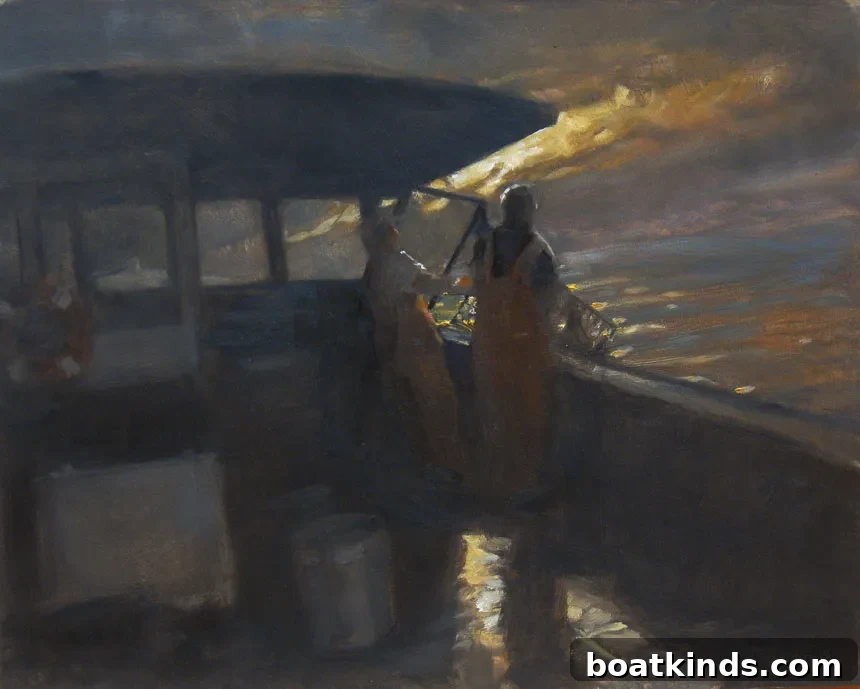
Long before sunrise off the coast of Maine, fifteen miles out from shore, a Jonesport lobster boat prepares for a day at sea. In his painting “First Trap,” artist Robert Beck captures that precise moment between night and morning—the cool hush over the water, the softened, low-angle light, and the way human figures partly dissolve into shadow. The canvas conveys the fragile balance of atmosphere and activity that defines early morning fishing: the quiet anticipation, the routine motions, and the dramatic arrival of light.
Beck, who was present for this scene, recalls how the sun began to break through clouds as the crew reached their first lines. He watched two men pause on deck to watch the sunrise, remarking to each other on the beauty of the moment and the privilege of working in such a place. That quiet exchange, the artist says, made a lasting impression and became the emotional core of the painting.
There is a distinct specificity to painting the Maine coast, and for Beck, the Jonesport-Beals Island area holds unique importance. He explains that the community’s character—its coastal topography, its relative remoteness from heavy tourism, and its enduring fishing culture—creates an environment that resists easy picturesque reduction. Instead, it offers real human stories and daily rhythms that inform his work. Beck has painted in many places around the world, but he returns repeatedly to Jonesport because the region’s authenticity continually inspires him.
The technique behind “First Trap” reflects Beck’s emphasis on atmosphere and observation. Working in oil on a smooth, gessoed panel, he builds subtle layers and occasionally applies glazes to refine color and value. This approach allows him to achieve delicate shifts in light and shadow, producing the soft, early-morning quality that defines the scene. While Beck often paints from life—setting up in challenging, dynamic conditions—he also completes work in the studio, combining direct observation with moments of studio refinement and imaginative composition.
Beck describes his broader artistic objective as documenting contemporary life: the places people work, the tasks they perform, and the interactions that shape communities. His interest in maritime life falls naturally into that focus. By positioning himself inside those environments—on docks, aboard boats, or along rocky shores—he records a visual narrative of occupations and experiences that might otherwise go unnoticed. Critics and viewers have referred to him as a documentary painter because his practice frequently involves responding to shifting weather, movement, and the distractions of real work while isolating the essential story within the scene.
The painting’s narrative is modest but resonant. “First Trap” does not dramatize; it observes. The two fishermen looking toward the horizon embody a familiar mix of labor and reverence—people who have long relied on the sea and who, even amid routine, can still pause to admire a sunrise. Beck’s composition allows the viewer to inhabit that pause: the boat’s rigging and deck become part of the visual language, the distant horizon frames the day ahead, and the diffuse morning light ties the elements together into a cohesive, contemplative whole.
For those interested in technique, the work illustrates how controlled brushwork, careful underpainting, and selectively applied glazing can produce a luminous yet restrained effect. The choice of a smooth panel rather than a textured canvas emphasizes the subtle transitions between shadow and light, making it possible to suggest fog, cool sea air, and the reflective surfaces of wet decks without relying on harsh contrasts. The result is an image that feels lived-in and immediate, an honest representation of a working moment rather than a staged tableau.
Beck’s commitment to returning year after year to the same coastal communities reinforces the documentary aspect of his work: repeated engagement yields deeper understanding. By consistently observing the same people and places, an artist can reveal gradual changes in landscape, industry, and daily practice while preserving visual records of maritime life. In “First Trap,” that continuity is evident in the careful attention to both environment and human presence.
This article originally appeared in the October 2018 issue.