
Captain George Farnsworth — “Tuna George” and the Birth of Modern Game Fishing
Captain George Farnsworth, widely known to his friends and fellow anglers around Catalina Island as “Tuna George,” stands among the early innovators who shaped big-game sportfishing off Southern California. Born in Connecticut, Farnsworth made his career on the ocean in the early 1900s and built a reputation as a charter captain who understood both the behavior of large pelagic fish and the practical gear and techniques needed to catch them. His name became synonymous with bluefin tuna fishing and with methods that would influence generations of anglers.
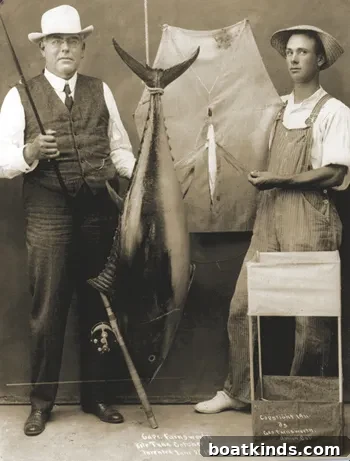
Farnsworth played an active role in the formative years of the Catalina Tuna Club, a group that gathered anglers and enthusiasts intent on documenting and improving big-game fishing. Through his work with the club he helped anglers record notable catches, including assisting in the account of the first broadbill swordfish ever taken on rod and reel. Those early records and the culture of careful documentation helped establish standards for sportfishing records that remain important today.
Beyond mentoring and recordkeeping, Farnsworth was an inventor and practical technician at heart. Along with fellow club member William Boschen, he helped develop the internal star drag reel—an innovation that made fighting large fish more manageable and ushered in a new era of game-fishing tackle. The internal star drag reduced the need for heavy external winches and allowed anglers greater control during long runs, changing how big-game fishing was practiced from that time forward.
Perhaps his most striking contribution to the sport was the introduction and refinement of kite-trolling. Farnsworth and other anglers discovered that flying a kite with a live or natural bait attached could present the bait some distance from the boat, imitating the natural movement of a flying fish and dramatically reducing the chance of spooking wary tuna. When properly rigged, the kite carried the bait a considerable distance—often around 200 feet of kite and fishing line were used—so the presentation appeared natural and enticing to predators below the surface.
The kite-trolling setup typically involved a cord joining the kite line to a wire leader; that cord was designed to break when a fish struck, freeing the fishing line and allowing the angler to retrieve the kite without undue drag on the hooked fish. Skilled boatmen could make the bait mimic the erratic skimming or skipping of a real flying fish, coaxing tuna into explosive surface strikes. Contemporary observers described the spectacle vividly: whether the bait drifted on the surface or hovered a few feet above it, bluefin tuna would attack with astonishing aggression, sometimes sending three or four fish at the same bait in a single frenzy.
Farnsworth devoted his life to understanding the ocean and teaching others how to work with it. His approach combined practical seamanship, an intuitive feel for fish behavior, and a willingness to tinker with gear until it performed reliably under pressure. That blend of curiosity and craftsmanship is a hallmark of many early pioneers in sportfishing, and Farnsworth’s contributions are often cited as central to the modern practice of big-game angling.
His influence endured long after his active years on the water. In recognition of his role in advancing the sport, George Farnsworth was posthumously elected to the International Game Fish Association Hall of Fame in 1998, honored as “one of the most innovative pioneers of big game angling.” He passed away in San Francisco in 1959 at the age of 73, and, true to his life at sea, his ashes were scattered on the ocean he loved.
Farnsworth’s story reminds anglers today that innovation often comes from hands-on experience and a willingness to experiment. Whether through a new drag mechanism or the simple brilliance of flying a bait on a kite, his techniques helped transform tuna fishing from a local challenge into a structured sport with a lasting legacy.
This article originally appeared in the August 2015 issue.