
A Boyhood Voyage to Diamond Rock and Pigeon Island, St. Lucia
Growing up in Marigot Bay, St. Lucia, during the 1960s felt like living inside an endless adventure. Only a handful of children lived in the village overlooking the bay, and we quickly became friends. Lewis Dalawas was my peer and constant companion on fishing and exploration trips. He sailed with my brothers and me on Peggy, our 25-foot wooden sloop that my father had given us one Christmas.
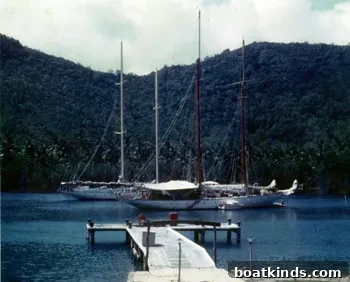
Peggy had a red hull, a simple gaff-rigged main and a single jib. The cockpit was small and oblong, seating four, and a sliding hatch led down into an austere cabin that offered little more than the hull frames and benches. She was plain below deck, but she handled beautifully and, to us, was the best boat in the world.
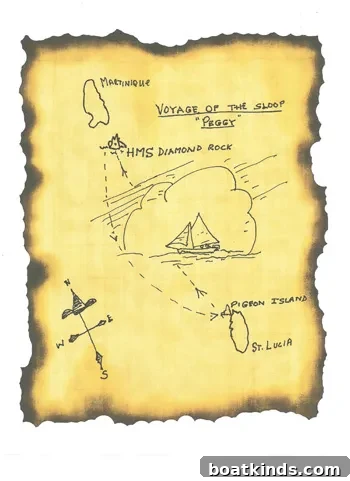
If my parents had known where some of our voyages would take us, they likely would have been horrified. We often made overnight trips to remote bays and coves, generally following the routes our father had shown us. One summer day, when I was fourteen, we planned to sail overnight to Pigeon Island at the northern tip of St. Lucia. My brother Peter took the role of mate, Lewis was deckhand, and we stocked Peggy with a container of fried chicken, a loaf of bread and water before setting off.
The day was perfect: a blue trade-wind sky dotted with fluffy white clouds and a steady easterly breeze tossing spray off the bow as we steered north from Marigot Bay. Our little sloop danced across the swell, occasionally dipping her lee rail. Before long we were well offshore, beyond the limit my father had set for us, and the island of Martinique, along with Diamond Rock, seemed closer than usual.
“Pete,” I said, brimming with mischief, “let’s go to Diamond Rock.” Peter hesitated — the rock was roughly 19 miles from St. Lucia and clearly out of our bounds. He asked if it would be safe, though his voice implied he already knew the answer.
“Yes man, come on, we’ll be there real quick today,” I urged. Surprisingly, he agreed. Typically I hatched the schemes and bore the blame, while Lewis openly voiced his fears. His superstitions about the deep ocean were strong.
“De deeper de wata, de more dangerous it is,” he warned.
I laughed it off. “Depth doesn’t make it dangerous,” I said. Lewis insisted otherwise, telling stories of people lost in deep water. Outvoted and outranked, he reluctantly came along.
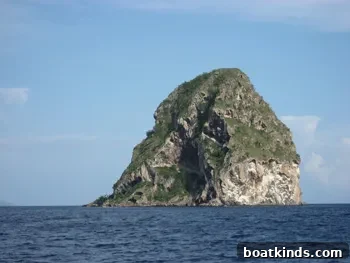
As we closed on Diamond Rock, the steep promontory loomed larger and more threatening than it had from the deck of our father’s schooner. Dark cliffs, black-mouthed caves and jagged overhangs rose straight from the sea. My earlier bravado faded; alone at the rock, my confidence wavered.
Massive submerged rocks reached up from the deep blue to within a few feet of our keel. “That’s a big rock, man,” Pete said, exhaling. I tried to act fearless, pointing out the history my father had told us about Diamond Rock — how, during the wars between Britain and France, the British had fortified the rock, installing cannons and a garrison and naming it HMS Diamond Rock.
My father’s story explained how the British used the rock to keep French warships offshore. They moored a frigate, hauled guns to the summit, built cisterns and quarters, and placed a garrison. The strategy worked until the French emplaced heavier artillery on Martinique’s hills and cut off supplies. A drought followed, and the men on the rock slowly succumbed to thirst and hunger. The Union Jack flew until the end, and the name HMS Diamond Rock remains to this day.
Pete suggested we take Peggy into the rock’s lee, drop anchor and swim a line to a landing. Lewis was terrified. “We all go dead, you know dat?” he muttered, convinced that bad spirits guarded the place. Still, we anchored in a calm cove and lowered the little Danforth anchor. Lewis — as the lowest-ranking crewmember — was expected to swim the stern line ashore. After some reluctance and a dramatic snort, he dove and tied the line to an outcrop before clambering back aboard. He watched us from the safety of the hatch, clutching a drumstick for courage.
Pete and I climbed the rough path up the rock under a fierce tropical sun. The terrain was arid and bleak, with cacti, baked sand and only sparse vegetation. Seabirds wheeled above us, their cries like warnings to intruders. On a ledge, Pete called out with excitement after brushing sand away from something long-buried in the dirt: the rusted barrel of an old musket. The wood was gone, but the metal remained, and for the first time in a century or more it was in human hands.
As we continued, we found more relics: brass sword hilts still clinging to heavily corroded blades, pistol barrels complete with flintlock mechanisms, white leather straps likely from uniforms preserved by the dryness, and dozens of musket balls. We took what we could carry, noticing scores of heavier cannonballs we had to leave behind. The artifacts felt heavy not just in weight but in history — tangible traces of the men who had lived and died on the rock.
Standing among those remains, I felt a chill of reverence. The story my father had told echoed in my head. For a moment I could picture soldiers in red coats, muskets shouldered, facing Martinique with stoic determination as heat and thirst took their toll. Peter’s voice pulled me back to the present: “Look down there, Lou.” From the heights the tiny red hull of Peggy rode the water like a dot, Lewis waving from the hatch. The sun was dipping and it was time to leave.
At the landing Lewis fretted over the artifacts. “I tellin’ you, Lou, dem tings is dead people tings, an’ you should trow dem in de sea.” I shook my head and showed him a brass sword hilt, while Lewis recoiled as if he had seen a spirit.
We weighed anchor hastily with the main up and sailed away, Peggy heeled to the easterly breeze as we set a course for the peaks of Pigeon Island some twenty miles distant. Night fell, and with it an unfamiliar solitude settled over us. We had no compass or navigation lights, Lewis had consumed all the chicken, and the small comforts of shore were hours away. Peter steered while I kept watch; the sky filled with countless stars and the soft trade winds rocked us gently. We spoke through the night about the sea, the birds and the strange history we had touched, the relics warming our palms like pieces of a lived past.
By sunrise we anchored at Pigeon Island. The wind had died, and our little sloop had drifted across the channel under calm skies. We slept most of the day, except for Lewis, who had lain below in fear of sea spirits and the aftereffects of eating too much of Ma Boudreau’s chicken. When we returned home, we told our parents we had found the items on the far side of Pigeon Island. They accepted the tale, though with a measure of doubt.
This article originally appeared in the June 2017 issue. More stories by Capt. Lou Boudreau can be found in publications such as Soundings and Where The Tradewinds Blow.