
Many factory marine alternators are not up to the task of charging the large battery banks and meeting the electrical demands of modern boats. Often adapted from automotive designs, these alternators can struggle when paired with deep-cycle batteries and frequently fail to serve as a reliable primary charging source. While true high-output alternators exist that can handle these loads, they are rarely simple, drop-in replacements.
If your alternator can’t keep up, the right upgrade and installation choices can make a dramatic difference. Below are the essential considerations for selecting a high-output alternator and tips to get the best real-world performance from your charging system.
Why upgrade your alternator?
Boat electrical loads have grown rapidly, but many stock alternators have not kept pace. Internally regulated, factory alternators—common on many engines—are typically designed for basic charging profiles and are often unsuitable as a boat’s main charging source.
Internally regulated alternators usually fall into two broad groups. Some support a simple two-stage charge profile (bulk and absorption), while others only offer a single absorption-stage charge. Both approaches are limited: they use fixed voltage setpoints that cannot be adjusted for varied battery chemistries, do not compensate for battery temperature, and produce output that varies directly with engine rpm. When these limitations are combined with large deep-cycle banks, the result can be slow or incomplete charging and potential overheating.
Another common shortcoming is where the alternator senses voltage. Many stock units measure voltage at the alternator case rather than at the battery bank. Long cable runs, diode isolators, corroded lugs, and voltage drops can reduce the battery-end voltage below recommended levels—often below the roughly 13.6 volts needed for flooded lead-acid batteries and below the 14.4 volts recommended for AGM batteries. Older alternators were sometimes designed to provide only 13.6–13.8 volts, which is increasingly inadequate for modern battery systems and charging profiles.
For boaters who are relying more on battery-based systems and sometimes retiring onboard generators, a well-specified high-output alternator combined with an inverter can lower annual generator maintenance and improve the cost-effectiveness of engine run time by making each charging hour more productive.
Factors to consider
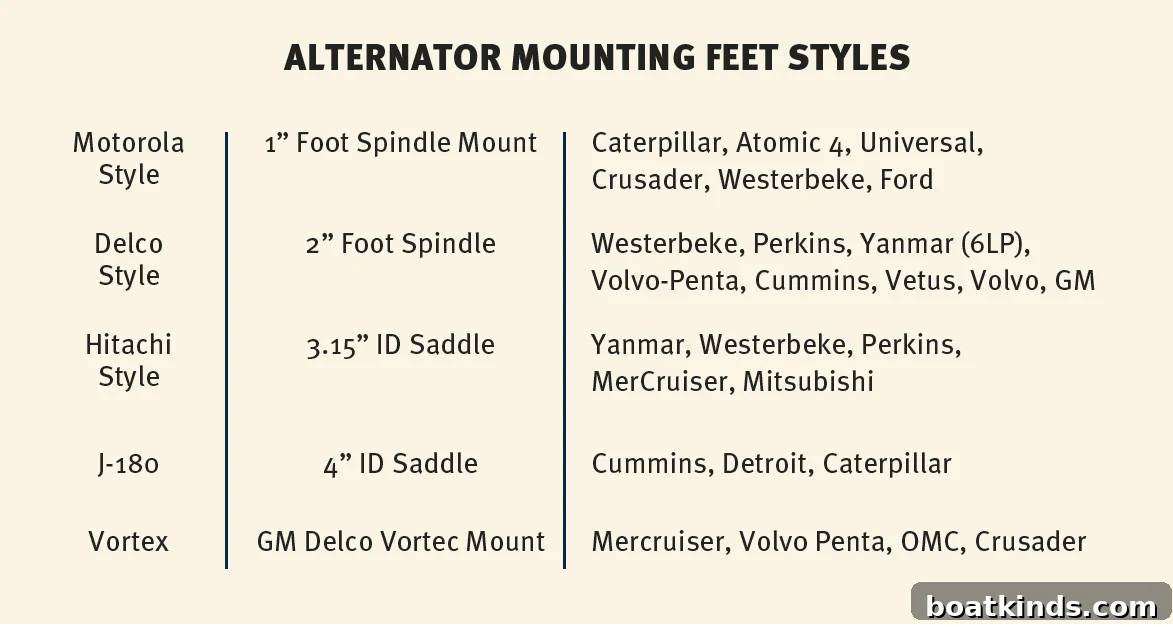
Replacing a factory alternator with a high-output unit requires attention to mechanical fit and drive system compatibility. Key factors include the alternator mounting saddle, belt type and size, pulley alignment and overall clearance around the unit.
Mounting saddles vary by engine manufacturer and design. Verify the saddle dimensions and ensure there is adequate clearance for the new case size before ordering. Alternator case sizes range from small to extra-large; while small-case high-output alternators can sometimes drop into the original space, large-case units are generally preferred for continuous-duty marine applications because they dissipate heat better and tolerate higher sustained loads.
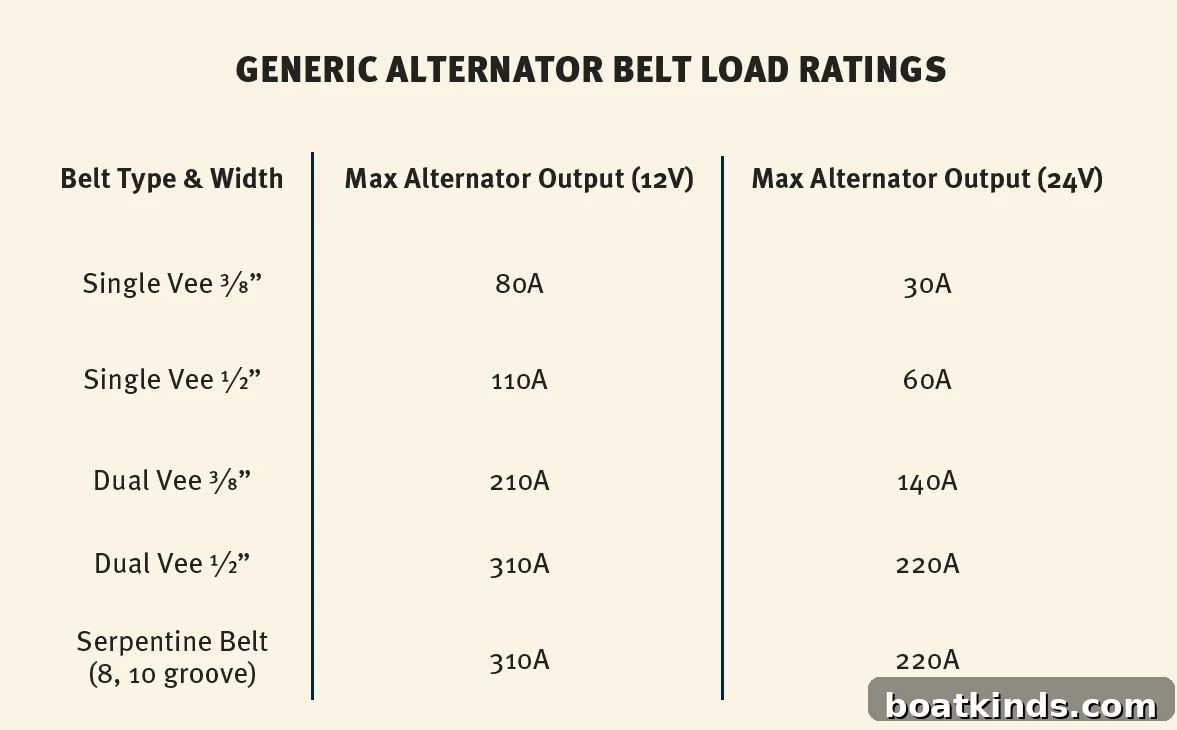
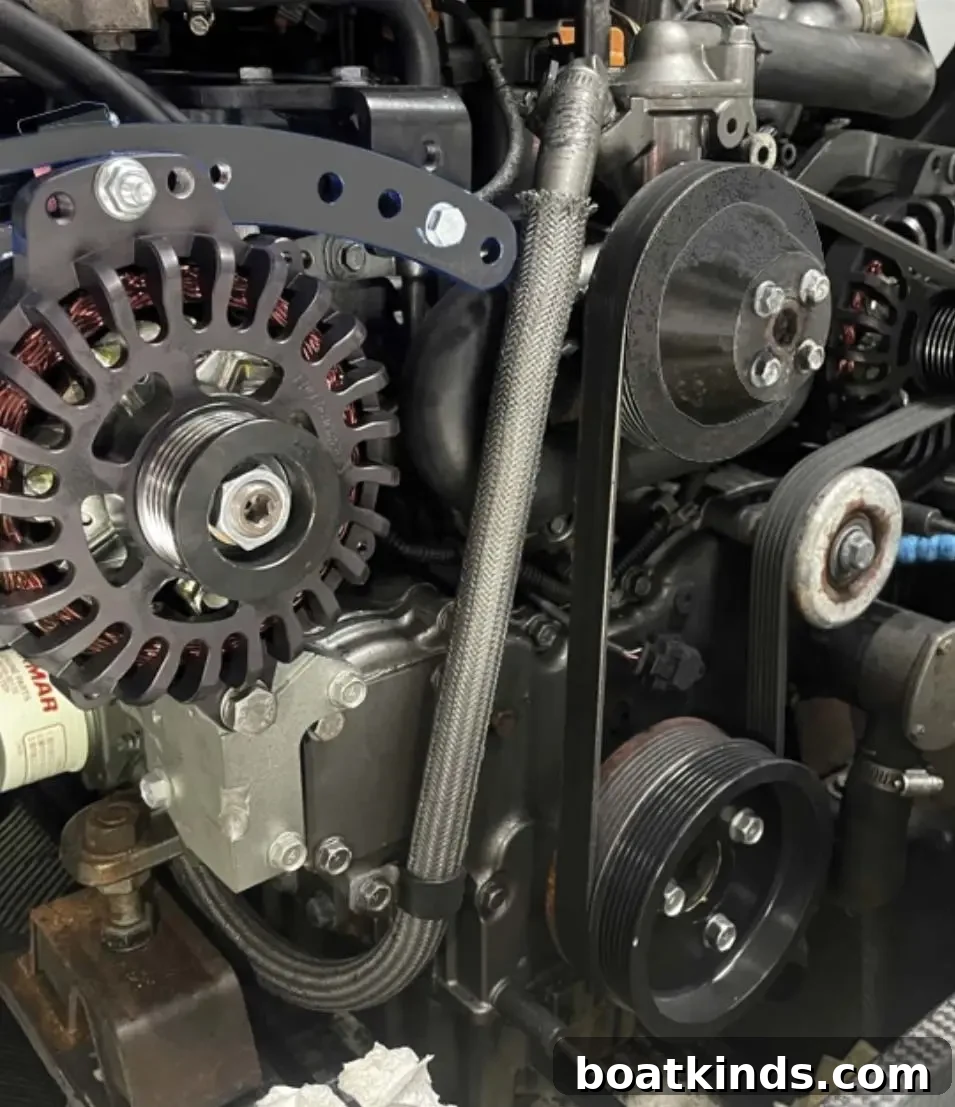
Belt selection matters. When possible, convert to a serpentine belt: serpentine belts are more efficient (typically around 99% efficiency versus roughly 92% for V-belts) and handle higher torque and output demands. Some manufacturers and aftermarket suppliers offer conversion kits to retrofit an existing V-belt pulley system to serpentine. If conversion is not possible, increasing alternator pulley diameter can help reduce belt slip and let the alternator operate at higher effective output—though pulley changes may require a crank pulley swap to preserve correct ratios.
Even if you retain stock pulleys, check pulley alignment carefully after installation. Identical mounting feet do not guarantee perfect alignment. Shims at the mounting point can correct misalignment and prevent uneven belt wear or premature belt failure.
Also double-check the dimensions and mounting details of the replacement alternator before purchase. Manufacturers occasionally change case sizes or mounting details, and a misfit can lead to costly last-minute modifications.
How big of an alternator do I need?
Choosing alternator size depends on your battery bank’s charge acceptance rate (CAR or C-Rating), the alternator’s rated output (hot vs. cold rating), how long you plan to run the engine for charging, and your onboard loads while charging.
Charge acceptance rate is the percentage of a battery bank’s capacity it can accept safely as a charging current. Typical CAR values vary: AGMs often accept 30–40 percent of capacity, flooded lead-acid batteries usually accept 20–30 percent, and gel cells often accept around 20 percent. Thin Plate Pure Lead (TPPL) AGM batteries typically require a minimum of about 40 percent of capacity for effective charging. These figures can differ by manufacturer, so check your battery’s specifications. For example, a 500 Ah AGM bank with a 30–40 percent CAR suggests a maximum recommended alternator output in the range of about 150–200 amps.
Alternator ratings are usually given as cold and hot outputs. Hot ratings reflect the reduced performance you will see in a warm engine compartment; this can be significantly lower than cold-room numbers, so plan on the hot rating when sizing for marine use. Also remember alternator output falls at idle or low RPM, so consider whether you will be running the engine at higher rpm during charging sessions.
Choose a quality marine alternator that includes robust cooling, reliable rectifiers, and appropriate diode protection. Reputable brands commonly used in marine upgrades include Balmar, Arco, Electromaax and American Power Systems.
Maximizing your charging investment
Installing a high-output alternator is only the first step. To maximize charging efficiency and battery life, consider these complementary upgrades.
Switching from an internal regulator to an external regulator delivers the greatest performance benefits. External regulators manage field current actively and can adjust charging voltage based on battery temperature, alternator temperature, and measured output current. Advanced regulators optimize charging through programmable setpoints and temperature compensation. Examples include the WS500 from Battleborn (a widely favored option), and other units such as the Balmar 618, Arco Zeus, Revatek Altion and the E-Maax by Electromaax. When choosing a regulator, confirm whether your alternator is a P-type or N-type, since some regulators are compatible with only one type while others support both.
Adjusting pulley ratios can also improve charging across the engine rpm range. Stock ratios are often around 2:1 (alternator spins twice the engine speed). Altering that ratio can increase low-rpm output or reduce peak overspeed risk, but any change must avoid overspeeding the alternator at maximum engine rpm.
By selecting the right alternator, verifying mounting and belt systems, installing a capable external regulator, and matching alternator output to your battery’s charge acceptance, you can build a reliable, high-performance charging system. This ensures faster charging, longer battery life and better support for modern onboard loads—helping you get the most from both your batteries and your engine-running hours.
Mike Garretson owns Sea & Land Yacht Works in Wakefield, Rhode Island.
March 2025