
About a dozen years ago, a friend and I took a 16-foot Zodiac Medline RIB on a roughly 60-mile trip from Essex to Norwalk, Connecticut. Until then my experience with inflatables had been limited to small, soft-bottom tenders used to ferry people through mooring fields or to reach shore for lunch. The comfort, stability and performance of that RIB opened my eyes: a rigid inflatable boat could easily serve as someone’s primary—and only—boat.
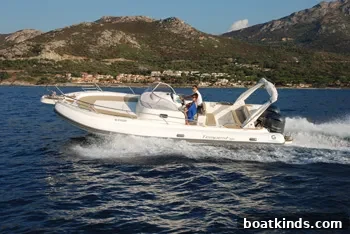
Rigid inflatable boats (RIBs) have become popular in Europe as soon as manufacturers produced models large enough to carry families. Lightweight, seaworthy, safe and fast, RIBs combine buoyant tubes with a solid hull to create exceptional transverse stability and a smoother ride in rough conditions. Those buoyancy tubes not only cushion wave impacts but also make RIBs ideal for rescue work—attributes that explain the type’s long-standing use by police forces, coast guards and navies. Add a dose of luxury, and it’s easy to see why RIBs are increasingly popular with recreational boaters in the United States.
The RIB’s development traces back to Great Britain’s Royal National Lifeboat Institution (RNLI) in 1964. Early attempts used hard plywood bottoms to protect inflatable inshore lifeboats’ fabric floors, but flat or improperly shaped bottoms punished crews in anything but placid seas. Development transferred to Atlantic College in South Wales, where designers introduced a deep-vee plywood hull that reduced pounding and improved strength. By 1968 students had developed a fiberglass deep-vee that evolved into the Atlantic 21, which entered RNLI service in 1972 and spawned a family of designs that served for decades.
The design reached North America through Canada. Atlantic College sent two 21-foot RIBs to the Lester B. Pearson College of the Pacific in British Columbia, where graduates taught students to build and operate X-27 and X-28 boats as safety craft for sailing and diving programs. The Canadian Coast Guard later evaluated and adopted similar boats for rescue work, including Avon Searider RIBs used in Great Lakes stations during the 1970s.
Transitioning the RIB from a workboat to the refined pleasure craft we see today took time. Written promotion alone couldn’t convince many boaters to trade traditional fiberglass center consoles for an inflatable; the benefits—lighter weight, quicker acceleration, sharper handling and a gentler ride—had to be experienced firsthand.
For a given length, a RIB generally weighs less, accelerates faster and turns more responsively than an equivalent fiberglass center-console boat. The inflatable tubes absorb wave impacts, reduce pitching and lessen heel in high-speed turns. Tubes are typically made from durable materials such as neoprene-coated Hypalon, a chlorosulfonated polyethylene noted for resistance to chemicals, UV and temperature extremes. Multiple independent air chambers with separate valves reduce the risk that a single puncture will render the tube unusable. Early buoyancy tubes were black; later models arrived in red, white and a wide range of colors.
That said, the tubes create one practical compromise: they reduce usable deck width. With typical tube diameters of around two feet, the effective beam available for deck space is smaller than on a comparable non-inflatable hull. Most RIBs pair those tubes with deep-vee fiberglass or aluminum hulls to balance performance and durability.
If you’re considering a RIB, visit boat shows and arrange demos. Below are notable examples that demonstrate how versatile and refined modern RIBs have become.
Capelli Tempest 900 WA
Unmistakably Italian in style, the Capelli Tempest 900 WA blends sporty lines with comfortable accommodations. A forward sundeck sits ahead of the console, while dual aft benches and a dining table make the cockpit versatile for cruising or entertaining. The console houses a cabin with a teak sole, a convertible dinette that becomes two berths, a refrigerator, a sink and a marine head. Standard features include hydraulic steering and an electric anchor winch; the forward helm seat folds up to form a leaning post. Teak decking and stainless-steel safety rails add luxury and secure handholds, and an optional soft top deploys from an arch at the aft end of the cockpit.
LOA: 30 feet, 6 inches • BEAM: 10 feet, 8 inches • DRAFT: 2 feet, 4 inches • WEIGHT (dry): 4,189 pounds • TANKAGE: 103 gallons fuel, 16 gallons water • POWER: twin 250-hp outboards • BASE PRICE: $219,268 • CONTACT: Capelli USA, Palm Harbor, Florida. Dealer locator at capelli-usa.com
Ribcraft 9.0
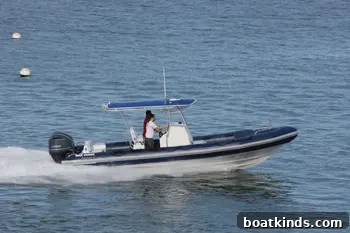
Ribcraft reworked its proven 9.0 platform to meet the current demand for luxury center-console RIBs. Derived from the company’s offshore rescue hull, this model adds wraparound bow seating, a convertible teak table that becomes a sunning platform, a comfortable helm and aft seating, a powder-coated T-top and a head tucked into the console. Built to order, each Ribcraft can be specified with options such as a live well, tackle station, electronics packages and synthetic teak decking. With twin 300-hp Yamaha V6 outboards the 9.0 can reach near 60 mph. Its deep-vee hull, with about 20 degrees of deadrise at the transom, helps keep the ride composed at speed.
LOA: 29 feet, 7 inches • BEAM: 10 feet, 3 inches • DRAFT (hull): 22 inches • WEIGHT (dry, no engines): 3,395 pounds • TANKAGE: 135 gallons fuel • POWER: twin 225–300-hp outboards • BASE PRICE: $178,158 • CONTACT: Ribcraft, Marblehead, Massachusetts, (866) 742-7872. ribcraftusa.com
Novurania LX Series 750
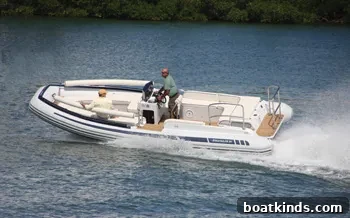
Novurania has long been a favorite for superyacht tenders, but the LX Series 750 demonstrates how their designs also serve well as owner-operated boats. The deep-vee hull, deck and liner are hand-laid fiberglass, and a foam-encapsulated stringer system adds rigidity. A self-bailing deck, custom gelcoat colors, NMEA-compatible gauges, integrated swim platform with ladder, blue LED deck lighting and 316 stainless fittings are part of the standard specification. The LX 750 balances practical build quality with comfortable detailing.
LOA: 24 feet, 7 inches • BEAM: 9 feet • DRAFT: 2 feet, 4 inches • WEIGHT (dry): 3,800 pounds • TANKAGE: 36 gallons fuel, 8 gallons water • POWER: 220-hp Volvo Penta D3 diesel sterndrive or a single-outboard equivalent • BASE PRICE: pricing unavailable • CONTACT: Novurania of America, Vero Beach, Florida, (772) 567-9200. novurania.com
Protector Targa 30
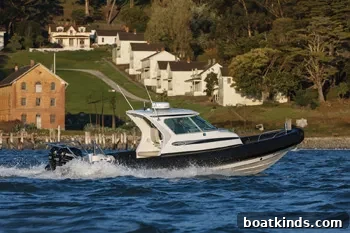
The Protector Targa 30 evolved from the company’s Center Console 30 to offer a roomier option over the Targa 28. The two-foot increase in length retains the same beam while allowing wider cabin berths, a larger dashboard for modern electronics, improved helm ergonomics and the optional Stidd shock-absorbing chairs. The added interior volume makes boarding easier and accommodates an optional picnic table. The design supports larger outboards and adds buoyancy to handle heavier power plants, creating a capable, comfortable offshore platform.
LOA: 30 feet, 6 inches • BEAM: 9 feet, 6 inches • DRAFT: 2 feet, 1 inch (average load) • WEIGHT (dry, with engines): 7,900 pounds • TANKAGE: 130 gallons fuel, 26 gallons (optional freshwater package) • POWER: twin 350-hp outboards or single diesel • BASE PRICE: $250,000 • CONTACT: Protector Boats, Richmond, California, (415) 793-8282. protectorboats.com
Brig Eagle 780H
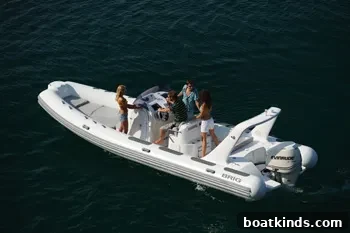
The Brig Eagle 780H is the largest and most luxurious model in Brig’s Eagle lineup. Built in Ukraine by a company founded by ex-military aeronautical engineer Slava Rodionov, the 780H rides on a deep-vee fiberglass hull and uses Hypalon ORCA tubes with five independent chambers. Practical features include space in the center console for a marine head, a seat locker large enough for a refrigerator, an electric anchor hoist, a shower, a folding boarding ladder and a ski post. Seating occupies the bow and cockpit, while a bench under the arch provides additional stowage. The Eagle 780H will appeal to buyers who prioritize performance and functionality over flash.
LOA: 25 feet, 9 inches • BEAM: 9 feet, 6 inches • WEIGHT (wet): 3,612 pounds • TANKAGE: 90 gallons fuel, 12 gallons water • POWER: 250-hp Honda outboard (300 hp max) • BASE PRICE: $89,000 • CONTACT: Sirocco Marine, Annapolis, Maryland, (410) 690-7780; Sirocco Marine Fort Lauderdale, Dania Beach, Florida, (954) 692-8333. brigusa.com
Zodiac N-ZO 760
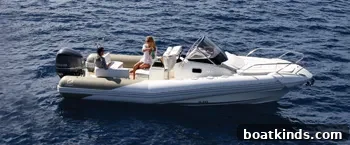
The Zodiac N-ZO 760, designed by Vittorio Garroni, steps up from the N-ZO 700 Cabin with a distinctive broken sheer line inspired by Carolina sportfishing boats. Riding on a fiberglass hull with about 22 degrees of deadrise at the transom, the 760’s higher bow freeboard and large-diameter tubes create a quiet, cocoon-like cabin environment. A compact console design frees up deck space, while folding seats in the bow convert to a large sun pad. High bulwarks behind the helm and convertible bench seating improve safety and comfort without sacrificing performance.
LOA: 24 feet, 11 inches • BEAM: 10 feet • DRAFT: 20 inches • WEIGHT: 3,373 pounds • POWER: 250-hp outboard (300 hp max) • TANKAGE: 75 gallons fuel, 21 gallons water • BASE PRICE: $109,102 • CONTACT: U.S. dealer locator at zodiac-nautic.com
Originally published in the December 2016 issue.