
Massive Floating Seaweed Mat Off Alaska’s North Coast Mistaken for Oil Slick
What residents and mariners first feared was an oil spill turned out to be an enormous floating mat of decomposing vegetation — most likely seaweed or algae — drifting across the Chukchi Sea. The unusual event drew attention from local fishermen, the U.S. Coast Guard and state environmental officials after the mass was spotted off Wainwright, Alaska, in early July.
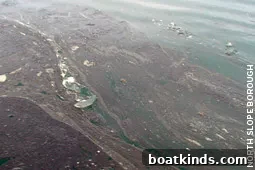
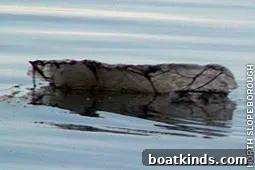
On the morning of July 10, fishermen near Wainwright contacted the Coast Guard Sector Anchorage Command Center to report a dark, oily-looking substance on the water roughly a quarter-mile offshore. Petty Officer Terry Hasenauer, who described the sighting, said those on the boat saw “patchy, broken-up globules all collected in a large mat.” Hasenauer estimated the floating mat measured about 13 miles long by half a mile wide and was moving steadily eastward along Alaska’s north coast toward Barrow.
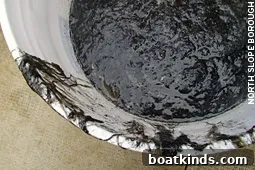
University of Alaska Fairbanks phytoplankton researcher Dr. Dean Stockwell examined descriptions and samples and characterized the material as gooey, dark green to black chunks of vegetation — basically rotting seaweed. He compared the texture to a head of lettuce left in the freezer until it wilts and goes slimy. As the seaweed decomposes it releases oils and organic films that coat the surface of the water, creating the slicky appearance that alarmed observers.
What makes this occurrence notable is the scale of the accumulation. Stockwell explained that seaweed usually anchors to rocks and coastal structures, but beaches in the Wainwright area are predominantly sand, gravel and pebbles, which are less conducive to large buildups. That unusual shoreline composition helps explain why a mat of this size is rare in the region.
The Coast Guard receives hundreds of spill reports across Alaska each year, often involving mistaken identity — wood chips, mixed fresh and salt water, or other natural phenomena can mimic an oil sheen. Hasenauer noted that in his four years stationed in Alaska, this was the first incident he had seen caused by seaweed or algae on this scale. “This is an unprecedented event,” he said.
Responders acted quickly. Within six hours of the fishermen’s report, two pollution investigators from Coast Guard Sector Anchorage and a C-130 crew from Nome were on the scene in Wainwright. Using a cutter, the team collected a sample and sent it to the state environmental health laboratory in Anchorage. Laboratory testing confirmed the material was natural and not petroleum-based.
Tom Deruyter, acting on-scene coordinator for Alaska’s Department of Environmental Conservation prevention and emergency response program, said his team had not encountered this type of report in their history of spill response in the state. “This is a first for me, and I’ve been working here for 15 years,” Deruyter said, noting that most spill reports across Alaska — roughly 2,000 annually — are related to land-based sources. “We have never taken a spill report of oil just bubbling up out of the ocean.”
Stockwell has been trying to obtain fresh, uncontaminated samples to identify the precise type of algae or seaweed involved, but the initial sample sent by the Coast Guard had already decomposed by the time it reached him. He said the sample emitted a strong sulfurous odor consistent with advanced decomposition.
Based on available observations, Stockwell offered two plausible explanations for the origin of the mat:
- A severe storm and heavy seas could have dislodged seaweed from the seafloor, bringing it to the surface where it is now decomposing into a large, floating mat.
- Seasonal ice melt may have introduced a significant influx of fresh water into the saltwater environment, lowering dissolved oxygen and causing large amounts of plant material to rise and accumulate at the surface.
“It’s definitely organic — almost like compost floating on the surface,” Stockwell said, emphasizing the biological nature of the slick. The mass continued to move with ocean currents and winds: by late July, the mat had traveled roughly 90 miles eastward and was observed near the converging area of the Beaufort and Chukchi seas. Hasenauer noted the mat’s movement was variable, continuously reshaping and reforming as forces at the surface and below acted on it, making its speed and direction dependent on multiple environmental factors.
The response and testing by the Coast Guard and state laboratory helped reassure residents and mariners that the sheen was not petroleum-based. Still, the event highlights how natural marine processes can occasionally mimic pollution and prompt coordinated investigations to rule out environmental hazards.