
Replacing the Windlass and Installing a Mantus Anchor on Snow Goose
Onne van der Wal’s 1986 Grand Banks 32, Snow Goose, was ready for an update: the original Vetus windlass had seen better days and Onne wanted to replace the boat’s 35-pound CQR anchor with a Mantus anchor he’d relied on previously. Having had positive experience with a Mantus anchor on his prior boat, he chose to go with a familiar and trusted design.
The removal of the old Vetus windlass proved easier than expected. Because the windlass was mounted on a stand with access ports on both sides, Onne could reach the mounting bolts without disassembling surrounding structures. “It was a very straightforward job,” he says, noting that the old bolts came out easily, which made the disassembly quick and tidy.
With the old windlass out, Onne fitted a new Lofrans windlass, an Italian unit imported by Imtra. He laid out the new mounting pattern, drilled fresh bolt holes in the windlass stand, and used a hole saw to create the larger openings needed for the anchor chain to pass into the chain locker. That required two chain openings: one through the top of the stand and another through the deck into the chain locker below. Careful alignment and accurate drilling ensured the chain would feed smoothly and the windlass would sit flat and secure.
Before finalizing the installation, Onne restored the teak on the bow. He sanded the teak surfaces and applied a coat of Semco natural teak sealer to protect the wood and provide a clean, finished appearance around the new windlass base. Protecting the surrounding deck and wood is an important step to prevent future leaks and preserve the boat’s cosmetic and structural integrity.
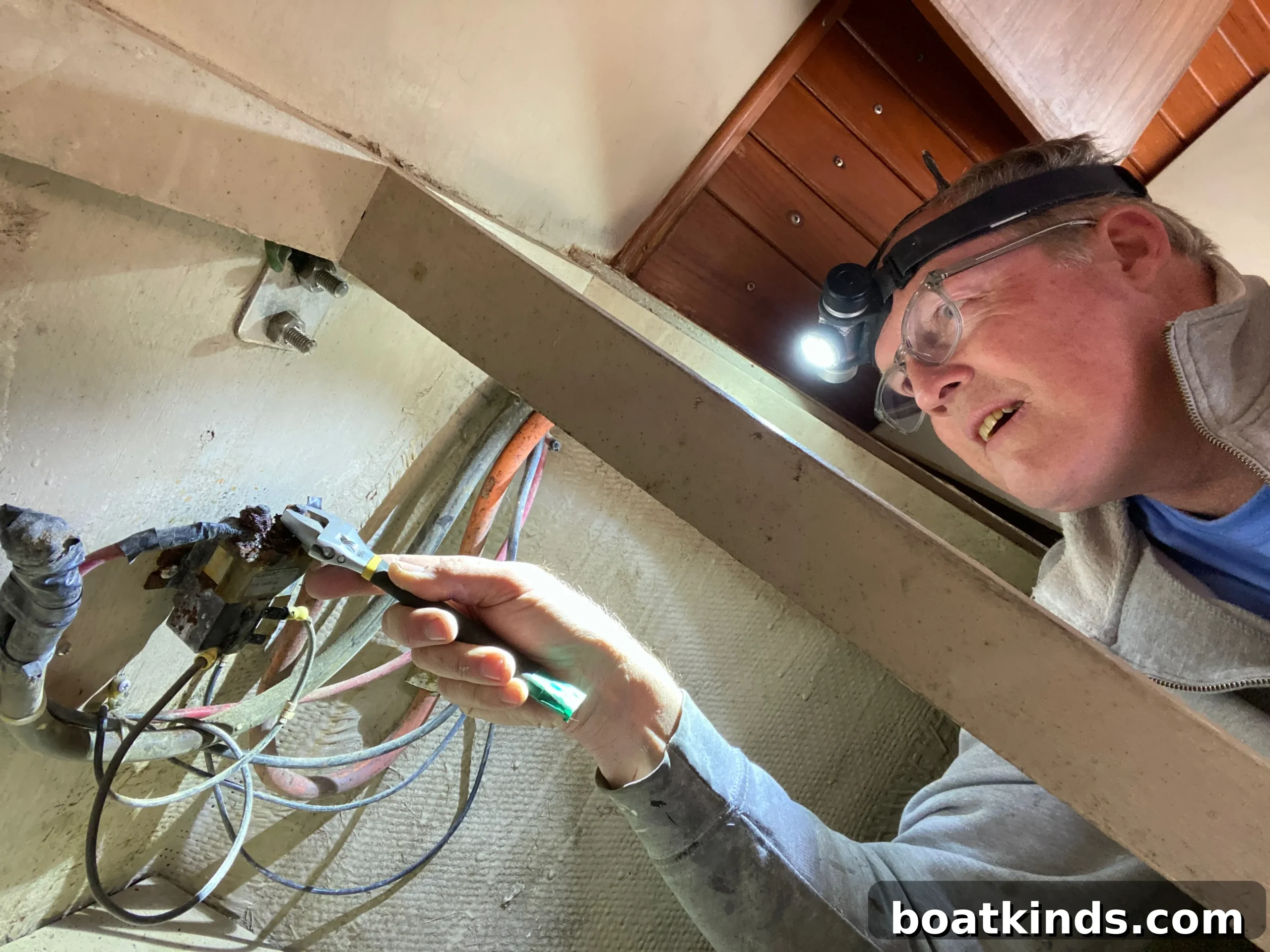
Electrical work followed. The original wiring and solenoid had become tired over the years, so Onne removed them and started fresh. Using the Lofrans wiring drawings as a reference, he sketched a wiring plan and labeled everything in his workshop. He attached blue tape to the new solenoid and marked each terminal location so that later reconnection would be straightforward and error-free. This pre-marking is a simple but effective way to avoid wiring mistakes during installation.
For reliability, Onne prepared new wiring ends by crimping terminals and heat-shrinking them with a heat gun. He went a step further on the larger power cable and soldered the connection for extra security and long-term peace of mind. The new solenoid and wiring were installed under the foredeck in the bow area, tucked away and protected from the elements.
Topside, he drilled holes at the base of the windlass stand to mount foot switches and connected those switches to the wiring harness. After powering up and testing the windlass, he confirmed the unit operated correctly and smoothly before turning attention to the anchor and rode.
Preparing the anchor and rode was done at home. Onne spray-painted the 5/16-inch, 100-foot chain at 20-foot intervals to aid in depth estimation and visual identification while anchoring. He attached a 100-foot pre-spliced 5/8-inch rode—delivered by Imtra—on one end and the new Mantus anchor on the other. To prevent chain kinks and improve deployment and retrieval, he installed a Mantus stainless swivel between the anchor and chain. Having used the same swivel previously on his other boat, he trusted its performance and praised its stainless-steel casting quality. After fitting the swivel correctly, he secured it with stainless wire and wrapped tape over the wire ends to protect hands from sharp points.
Loading the gear was a one-man logistical task. The rode, chain, and anchor were transferred from the driveway into a Chevy Suburban and then, at the boatyard, the Suburban was backed up to the bow of the boat. Using the new windlass, Onne hauled the entire package aboard and stowed it in the chain locker. After a final operational test, the installation was complete and ready for use.
This whole process—from removing the old Vetus windlass to installing the Lofrans unit, rewiring the system, refinishing teak, and fitting the Mantus anchor and swivel—highlights a practical, methodical approach to upgrading anchoring systems on a classic cruising boat.
You can watch the full procedure in the video below.