
No part of the marine market has benefited more from advances in electronics than fishermen. Anglers have driven a steady stream of innovation in fishfinding technology, and the resulting developments have improved electronics for every boater. Many of us who grew up fishing remember the progression: basic electronic flashers, paper graphs, monochrome CRT echosounders, color CRTs and then high-resolution color LCDs.
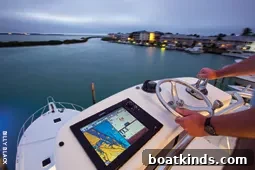
The pace of improvement over the last five years, however, has been exceptional. Modern fishfinders and echosounders can detect fish under docks at precise distances from the hull, reveal submerged trees, reefs and wrecks in near-photographic detail, and—after some experience—help an angler distinguish species by how they appear and behave on screen. That capability only scratches the surface of what today’s sonar, CHIRP sonar, side-scan and StructureScan systems can reveal beneath the surface.
Oceans of technology: how modern echosounders work
At their core, all echosounders operate on the same sonar principles. A transceiver sends a sound pulse into the water through a transducer and listens for echoes returning from the bottom, structures or suspended targets. What has changed dramatically is the way these systems emit pulses, process returns and display information.
One of the biggest recent advances is CHIRP technology. CHIRP (compressed high-intensity radar pulse) sounders transmit a pulse that sweeps across a wide band of frequencies—from low to high—rather than a single frequency. Advanced processors separate and analyze the returns from that sweep to produce much clearer, more detailed images of the bottom, structure and fish targets than traditional single-frequency sounders.
Capt. George Mitchell, who runs dual Furuno NavNet TZtouch multifunction displays and a Furuno True Echo CHIRP black-box sounder on his 36-foot Yellowfin, says CHIRP delivers unprecedented detail. That detail has helped him learn how certain species appear and move on screen. For example, when fishing a wreck at 150 feet for kings, he notes he can distinguish amberjack from kings by their position and behavior: amberjack often hug structure closely, while kingfish tend to occupy the lower third of the water column and present on the display more like a “train.”
“Learning” is the operative word. CHIRP provides more data, but it also requires practice to interpret returns correctly. The more time you spend with a modern echosounder and fish under different conditions, the better you become at translating on-screen marks into real-world targets.
Side-scan and StructureScan: looking sideways and beyond the hull
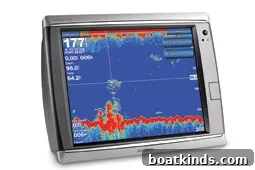
Scanning sounder technology—side-scan, forward-looking and downward scanning—has dramatically expanded what anglers can see around a boat. Brands have developed ultra-wide fan-shaped beams that sweep horizontally or at targeted angles, allowing fishermen to inspect areas alongside or in front of the boat in addition to straight-down CHIRP readings. When used together, side-scan and down-looking sonar provide a comprehensive picture of structure, bait and suspended fish.
Because side-scan projects a cone of sound to the side, its effective depth and range are limited; in many systems the reliable bottom read is roughly to about 125 feet, though manufacturers continue to push for improved deep-water side-scan performance. Even with those limits, side-scanning is invaluable for locating bait and game fish suspended in the water column, mapping wrecks and reefs, or checking the legs and corners of an offshore rig for bait concentration.
Capt. Mark Maus, who runs Simrad NSS multifunction displays with CHIRP/SideScan/StructureScan on his tournament boats, underscores the practical gains. He uses side-scan to identify where bait congregates on a rig and to see fish holding beneath docks or along inshore structure. For deep-water work like swordfishing, CHIRP combined with scanning sounders lets him read bottom relief and pick up bait or squid balls at depths of 800 feet or more, then position baits precisely where the fish are holding.
MFDs versus dedicated sounders
Modern echosounder capability is most often delivered through integrated black-box sounders and multifunction displays (MFDs). An MFD-centered setup can combine charts, radar, thermal cameras, entertainment and sonar on a single or multiple screens. The benefits are clear: touch-friendly zooming, instant chart-and-sounder overlays, the ability to scroll back through sonar history and mark waypoints, and flexible screen layouts that show multiple views at once.
That convenience comes with practical trade-offs. Touchscreens can be awkward to use in rough seas or when your hands are wet, slimed with bait, or covered in squid ink, and many anglers still prefer tactile controls. Manufacturers recognize this and offer hybrid control options—touchscreen when conditions allow and physical keypads, knobs or remote controllers when they don’t.
At the same time, dedicated standalone sounders remain popular, especially among commercial fishermen and operators who need a simple, rugged primary sonar unit. Dedicated echosounders from manufacturers with commercial roots continue to evolve with features like digital signal processing, frequency tuning and bottom-discrimination tools that help characterize substrate. Those systems can be cost-effective and extremely reliable for anglers who prioritize sonar performance above full electronics integration.
Choosing the right fishfinder for you
With so many options—CHIRP sonar, side-scan, StructureScan, black-box sounders, MFDs and hybrid control schemes—picking the right system can be overwhelming. The best approach is practical: talk with experienced users at your local marina, consult message boards carefully, and seek unbiased advice rather than sales pitches. Real-world users will tell you how systems perform in the conditions you fish.
Technology has changed how we see beneath the surface, but it hasn’t changed the core work of fishing. No matter how detailed the sonar picture, you still must interpret the returns, position your boat, present your bait or lure correctly, and apply the skills of a competent captain and angler. Advanced sonar and fishfinder technology give you far more information to work with, but they don’t replace experience and timing.
The challenge of finding fish and convincing them to bite has driven anglers to the water for generations. Today’s echosounders, CHIRP systems and side-scan sonar make that task easier and more efficient, but they also remind us that reading the screen and reading the sea remain collaborative skills—machine and human working together. Fortunately, that’s our job.
January 2015 issue