
In a world of niche markets and specialized branding, we often distinguish between true classics and contemporary interpretations of classic designs.
Some boats preserve the original spirit and form, appealing to purists who favor authentic retro styling. Others mimic the classic look but incorporate modern engineering to improve performance and ease of use. Both approaches are valid, and both attract their own audiences.
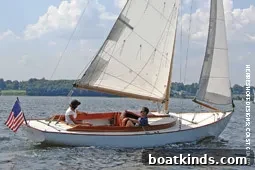
Over the past 15 years, a notable resurgence in daysailers has responded to shifting sailing habits: fewer crew, shorter outings, and a demand for boats that are easy to handle single-handed. These daysailers typically have small, simple accommodations and large cockpits for a handful of passengers, designed to be fast to rig and ready to go.
That 21st-century practicality echoes an idea pioneered more than a century ago by Nathanael G. Herreshoff, one of America’s most influential yacht designers. Known as Capt. Nat, he preferred to be on the water quickly after a long day, so his personal daysailer had to be ready at a moment’s notice.
His Alerion — a 26-foot daysailer with a 21-foot-9-inch waterline, a centerboard and a knockabout rig — was stowed in the lee of an L-shaped pier at the Herreshoff Manufacturing Company in Bristol, Rhode Island. With sails hanked on, the boat could be underway in five minutes or less. Capt. Nat arranged controls so he could manage everything from the cockpit and, when back at the dock, simply douse the sails, lash the canvas and step ashore without fussing with covers.
Retro, not relic
The Alerion concept has evolved over the years but has consistently stayed true to Capt. Nat’s original intent: a compact, seaworthy boat that’s simple to handle. More than 70 years after Herreshoff’s era, that lineage continues in the Herreshoff Alerion 26. Marketed by Herreshoff Designs of Bristol and built by Brion Rieff Boatbuilder in Brooklin, Maine, the modern Alerion is constructed using cold‑molded cedar sheathed in 10‑ounce fiberglass cloth, with Douglas fir backbone, frames and floors.
The interior is intentionally minimal: sitting headroom, a V-berth, a modest galley and a small head. A weekender version adds a built-in cooler, sink, freshwater tank and a compact stove for short cruises. The sloop-rigged Alerion 26 comes with a fixed keel, displaces 4,800 pounds and carries about 315 square feet of upwind sail on aluminum spars. Owners can choose options such as a 10-hp Nanni two-cylinder inboard or an electric Mastervolt-Bellman propulsion system.
“As people scale down their projects and look for classic styling, the Alerion fits the bill,” says Adam Langerman, partner at Herreshoff Designs alongside Halsey Herreshoff, Capt. Nat’s grandson and president of the Herreshoff Marine Museum. The model has been produced intermittently since 1977, often spreading by word-of-mouth among enthusiasts.
Over time the Alerion 26 has been built by several yards, including Carroll Marine and Proper Yachts, with Herreshoff retaining rights and molds. Today the model is back in production with Brion Rieff Boatbuilder, and Rumery’s Boatyard in Biddeford, Maine, offers a centerboard version with different dimensions and specifications.
Evolution of design
The Alerion 26 draws directly from Capt. Nat’s personal daysailer, Alerion III, built in 1912. When Capt. Nat began spending winters in Bermuda, he refined the design for that environment. Feedback from family and colleagues led to incremental changes: adding ballast, widening the beam, increasing forward volume and lengthening the hull slightly. One of these modified boats, built in 1914 for Wall Street investor Elias Cornelius Benedict and named Sadie, became one of Herreshoff’s most admired designs.
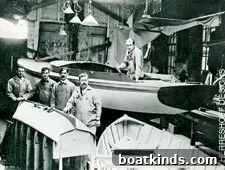
Sadie enjoyed a long career under various owners, ultimately returning to the Herreshoff Museum where she was restored and is still sailed today. In the same era Capt. Nat scaled the design up into the Newport 29 cruising class — a larger, fixed‑keel development with a 36‑foot overall length and a 29‑foot waterline. Several of those boats survive and continue to cruise and race in classic regattas.
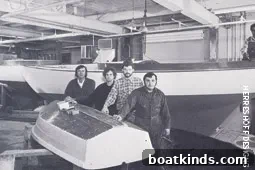
A key modern influence arrived in the 1970s when Isaac B. Merriman Jr., a collector and last private owner of Alerion III, asked if the Herreshoffs could build a slightly smaller fiberglass version. Using Sadie’s lines scaled down, the team produced what became the contemporary Alerion 26 — essentially a compact descendant of the Newport 29 lineage with a fixed keel and simplified systems suited to recreational owners.
From one-off to beloved classic
Merriman’s connection to the Herreshoff family extended beyond commissioning a boat. He later supported the nascent Herreshoff Museum with a donation that helped preserve the original shipyard buildings and the family’s legacy. The new Alerion he acquired drew attention during time spent in Key Largo and Nantucket, prompting demand that led to limited production and enduring popularity among daysailer enthusiasts.
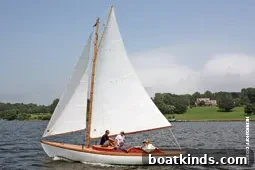
Over the years the Alerion received practical updates: a taller Marconi rig to improve performance in light air, a small inboard auxiliary engine, and a self-tacking club-footed jib configured for roller furling. Unlike many modern “retro” designs that mix classic looks with contemporary underbodies—fin keels, spade rudders and carbon spars—the Herreshoff Alerion 26 largely preserves the original concept. Apart from the inboard engine and aluminum spars, it remains a simple, ready-to-sail daysailer that honors Capt. Nat’s intent: a boat you can rig quickly and sail alone with confidence.
LOA: 25 feet, 4 inches
LWL: 20 feet
Beam: 7 feet, 2 inches
Draft: 3 feet, 7 inches
Displacement: 4,800 pounds
Ballast: 2,525 pounds
Sail area: 315 square feet
Price: $130,000 sailaway
This article originally appeared in the New England Home Waters section of the April 2010 issue.