
Vendée Globe turmoil: Half the fleet forced to retire after brutal Southern Ocean conditions
The 2008–09 Vendée Globe, often described as the Everest of solo sailing, saw an extraordinary wave of retirements after severe weather in the Southern Ocean. By early January, half the starters had withdrawn from the nonstop, solo, around-the-world race, many after dramatic knockdowns, dismastings and gear failures that left competitors battered and boats damaged.

On Boxing Day, Dec. 26, French skipper Sébastien Josse on the Open 60 BT was knocked down in the Roaring Forties and was forced to retire, becoming one more in a growing list of casualties. An hour and a half later Derek Hatfield on Algimouss Spirit of Canada also withdrew after a knockdown, reducing the fleet of solo skippers still racing.
“Boxing Day” may be associated with gifts and goodwill on land, but the Roaring Forties — the fierce latitudes below the 40th parallel — showed little mercy. Gale after gale, with 60-knot winds and towering seas often exceeding 30 feet, pummeled the fleet through December and into January. The result was a string of broken masts, damaged rudders, cracked structural bulkheads and compromised keels as boats made their way southeast across the Indian Ocean toward the Southern Ocean and then on toward Cape Horn.
One of the most dramatic incidents occurred Jan. 6, when Jean Le Cam’s Open 60 VM Matériaux suffered a catastrophic keel-bulb failure about 200 miles west of Cape Horn. The keel bulb snapped free and the boat capsized. Le Cam, who had been running in second place, managed to trigger the emergency beacon, which enabled rescue resources to locate his overturned hull.
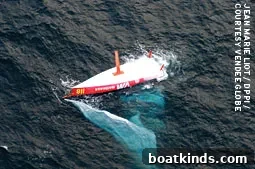
Le Cam spent roughly 18 hours sheltering in the bow in his wetsuit while a multinational rescue effort rallied. A Chilean aircraft sighted the boat and an oil tanker appeared on scene but could not launch a lifeboat in the 15–20-foot seas. Fellow competitors Vincent Riou and Armel Le Cléac’h arrived hours later and maintained position around the capsized yacht as a Chilean Navy ship with divers steamed to the area.
Rather than wait to be cut out, Le Cam decided to exit the inverted hull through the stern escape hatch. In near-freezing 41-degree water he tied himself to the rudder with a rope and waited. After several passes, Riou was finally able to pass a line close enough for Le Cam to secure and be winched aboard, an extraordinary self-rescue under harrowing conditions. Alain Gautier, the race safety consultant, called it “an incredible story that has a happy end.”

Other entries also required major search-and-rescue or medical intervention. French sailor Yann Eliès broke his left femur on Dec. 18 while working on the foredeck of Generali roughly 850 miles southeast of Perth. After a distress call, support from nearby competitors and a 48-hour search, the Australian Navy frigate HMAS Arunta transferred Eliès to safety and he later underwent surgery in Perth. Generali was secured but remained unrecoverable when its locator beacon ceased operating.
Many skippers reported the relentless nature of the Southern Ocean: high-speed surfing down waves, violent accelerations to 20–25 knots, sudden crashes into the following seas and repeated knockdowns that tested both sailor and machine. British skipper Jonny Malbon described constant fear of the next wave and frequent “pooping” — waves breaking into the cockpit — while others endured equipment failures that proved impossible to repair at sea.
Rich Wilson on Great American III experienced multiple knockdowns, sustaining facial injuries when he was thrown across the cabin, but kept racing after treatment. Derek Hatfield, by contrast, suffered terminal rigging damage when spreaders snapped loose and was forced to retire to Hobart. Sébastien Josse’s BT was eventually retired after losing a critical carbon-and-titanium fitting on the port rudder that misaligned the twin rudders and disabled the autopilot—repairs that could not be made underway.
Top contenders were not immune. Briton Mike Golding, a pre-race favorite, dismasted on Dec. 17 in a violent squall and limped some 1,000 miles under jury rig to Fremantle. Loïck Peyron had to retire after a snapped mast, and Swiss skippers Bernard Stamm and Dominique Wavre both suffered keel and rudder problems that required them to abandon racing and seek shelter or assistance in remote locations such as the Kerguelen Islands.
With the smallest, lightest Open 60 yachts pushed to extreme speeds, criticism resurfaced about whether contemporary high-tech designs sacrifice durability for performance. Merf Owen of the Owen Clarke Design Group, whose firm designed several entries, noted that historically the Vendée Globe has a high attrition rate and that asking one person and one machine to race nonstop around the world at top tempo inevitably creates breakages.
By early January the French Open 60s were leading: Michel Desjoyeaux aboard Foncia, Roland Jourdain on Veolia Environnement and Armel Le Cléac’h were at the front of the race. Yet even as leaders pressed on, the field had already experienced retirements from dismastings, collisions with unidentified floating objects and delaminating sails. With more than half the fleet sidelined and about 6,300 miles still to sail for many, the Vendée Globe’s reputation as the ultimate test of solo offshore sailing was emphatically reinforced.
This report originally appeared in the March 2009 issue and recounts the high toll exacted on skippers and boats by the unforgiving Southern Ocean during the Vendée Globe. The race remains one of the most demanding endurance challenges in ocean racing, where human courage, seamanship and the limits of modern offshore yacht design collide.
See related story: “Vendée Victims.”