
Supreme Court: Floating Home Is Not a Vessel — The Fane Lozman Case
Fane Lozman won a major legal victory against the city of Riviera Beach, Fla., when the U.S. Supreme Court ruled 7-2 that his two-story floating home was not a vessel under federal admiralty law. The decision, handed down on Jan. 15, resolved a contentious dispute over whether structures that float but lack propulsion or steering can be treated as boats subject to maritime seizure.

Lozman, a former Marine pilot, retired commodities trader and software developer, acknowledges that the ruling cannot restore his home — which U.S. marshals seized and the city ultimately destroyed after auctioning it as property subject to maritime lien — but he says the decision vindicates his long-held view that the boxy, stationary structure was a residence, not a vessel. Having fought the city in court for three years, he plans to pursue compensation for the loss and legal fees, which he estimates at roughly $300,000.
Lozman, 51, said the ruling is important not only for him but for thousands of other floating-home owners in the Southeast and beyond who could have faced similar seizures if the lower court ruling had stood. “This is too late for my floating home,” he said, “but the owners of some 3,000 other floating homes, especially in the Southeast, will not have to go through what I did.”
Reinstated Civil Rights Lawsuit
Shortly after the Supreme Court’s decision, the 11th U.S. Court of Appeals in Atlanta reinstated a separate civil suit Lozman originally filed in 2008. That suit alleges the city infringed his civil rights by subjecting him to surveillance, ejecting him from public meetings where he criticized redevelopment plans, and orchestrating his arrest after he refused to leave a meeting. Lozman contends these actions violated his First Amendment rights.
The Supreme Court’s ruling reversed the 11th Circuit’s prior holding that a floating home automatically qualifies as a vessel. That appellate decision conflicted with rulings from other circuits, notably the 5th Circuit in New Orleans and the 7th Circuit in Chicago, which had applied narrower tests when deciding whether floating structures are vessels.

Background: Marina Dispute and Seizure
After retiring to Riviera Beach, Lozman became a vocal civic activist during a 2006 campaign opposing a $2.4 billion redevelopment plan for 400 acres of waterfront. The plan would have transformed the area into a high-end residential, commercial and marine district. Activists succeeded in blocking aspects of the plan, but Lozman’s confrontations with city officials soured his relationship with local government.
Lozman says the city first attempted to evict him from the marina over complaints about his small dachshund and alleged use of unlicensed repairmen. He successfully defended against those eviction attempts in state court, arguing they were retaliatory. The city then adopted marina rules requiring tenants to register floating structures as vessels and to keep them operational so they could depart in an emergency—rules Lozman’s floating home could not meet.
When the city claimed Lozman owed $3,000 in rent, it filed an in rem action in federal court alleging trespass and seeking a maritime lien. Federal marshals seized Lozman’s floating home; he says three armed marshals broke down his door, took the house and his possessions, and left him temporarily homeless. The district court found he owed $3,039.88, ordered the home auctioned, and the city bought and then destroyed it.
Auctioned and Destroyed
Lozman, representing himself initially, argued the floating home was not a “vessel” under federal law and therefore not subject to maritime seizure. The district court and the 11th Circuit rejected that argument, but Lozman persisted and took his case to the Supreme Court. He later retained Jeffrey Fisher, a Stanford law professor and prominent Supreme Court litigator, who believed the 11th Circuit had applied an overly broad standard.
Under Florida law and in many states, floating homes are treated as real property—distinct from motorized houseboats designed to transport people and goods. Florida assessors had classified Lozman’s home as real property and even granted a homestead exemption. If recognized as a residence rather than a vessel, the floating home would have enjoyed stronger state-level protections against creditors and seizure.
Supreme Court Opinion: Breyer’s Practical Test
Justice Stephen Breyer, writing for the majority, criticized interpretations that equate anything that floats with a vessel. Federal law defines a vessel as “every description of watercraft or other artificial contrivance used, or capable of being used, as a means of transportation on water.” The key question, Breyer wrote, is whether a structure is “capable of being used … as a means of transportation on the water” in a practical, design-based sense.
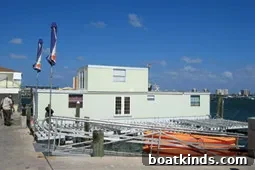
Breyer emphasized that not every floating object qualifies: a wooden washtub, a plastic dishpan, or a pontoon platform may float and be towed but are not vessels. Applying this logic to Lozman’s home—a 60-by-12-foot, two-story plywood structure with a flat bottom, no engines, no steering, no generator and a shallow hull—Breyer concluded a reasonable observer would not view it as designed to carry people or cargo over water to any practical degree. Thus, the floating home is not a vessel.
Breyer’s approach asks observers to evaluate both a structure’s physical characteristics and its typical activities. If those attributes indicate the object was not designed in any practical way to transport people or things on water, it should not be treated as a vessel under federal admiralty law.
Support and Opposition
Floating-home associations in Seattle and Sausalito, representing about 500 owners, backed Lozman, warning that the 11th Circuit’s broader test would bring many residential floating homes under federal admiralty jurisdiction instead of state and local law. The U.S. government also warned that an overly inclusive definition would needlessly extend Coast Guard safety and inspection rules to structures not intended to operate as boats.
By contrast, the National Marine Bankers Association and the Maritime Law Association of the United States supported the city, favoring a simpler, more inclusive test that would help lenders and maritime claimants determine when a maritime lien applies. The Supreme Court majority rejected that broad formulation as overly inclusive.
Implications and Reactions
Chief among the practical outcomes, Riviera Beach officials say the city will revise marina rules and contracts to reflect the court’s decision. City attorney Pamala Ryan said the marina will craft a clearer definition of what it will treat as a vessel and create policies to handle craft that change status while docked—for instance, vessels that lose propulsion and cannot leave under their own power. The marina, which recently underwent an $11 million renovation, allows liveaboards but does not want to become a permanent homestead site that would create conflicting legal status.
Not everyone agreed with the majority. Justice Sonia Sotomayor, joined by Justice Anthony Kennedy, warned that relying on a “reasonable observer” standard could introduce subjectivity and uncertainty in borderline cases. Still, supporters of the ruling say Breyer’s focus on design and real-world use provides a workable framework for future disputes about whether a floating structure is a vessel.
The case marks a significant clarification of maritime law: courts should consider a structure’s design and typical use before labeling it a vessel, rather than treating every object that floats as subject to federal admiralty remedies.
Is a floating home a vessel? We’d like to hear from you. Send your thoughts to [email protected].
June 2013 issue