There are pros and cons to repowering a boat, but one thing is certain: a new outboard can transform your ride.
Matt Herum discovered that firsthand after his 16-foot skiff no longer met his 15-year-old son’s offshore spearfishing ambitions. Matt and his wife sold the flat-bottom Sundance, planning to replace it with a larger boat. When months passed with no luck, Herum found a 20-foot 1974 SeaCraft and negotiated a trade that included the Sundance.
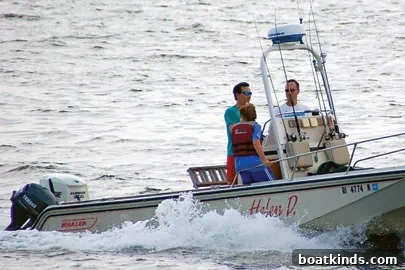
“It’s a classic,” says Herum, 51, of Tavernier, Fla., “but the SeaCraft was in rough shape and needed serious work.” The project demanded more than cosmetic repairs: the transom was rotten and required rebuilding, the fuel tank and lines needed replacement, and the boat had to be prepared to accept a heavier modern 4-stroke outboard. Without addressing weight distribution and hull modifications, performance and safety could suffer.
2-stroke to 4-stroke: what to expect
Replacing an older 2-stroke with a modern 4-stroke often requires time, money and thoughtful design changes. While second-generation 4-strokes have become slimmer and more efficient, they typically still weigh more than their 2-stroke predecessors. Herum’s 2008 Suzuki DF140, for example, weighs about 410 pounds versus 365 pounds for the mid-1990s 130-hp Johnson 2-stroke it replaced.
To compensate for the added stern weight, Herum relocated the batteries and live well forward, installing the batteries inside a new console and adding a forward-facing live well. He also rebuilt the transom 5 inches taller than the original. In total, Herum spent nearly $10,000 on the repower project—covering the rebuilt transom, new fuel tank, deck changes, and engine mounting and rigging—on top of the outboard cost.
Repowering is often a cost-effective alternative to buying a new boat. Fiberglass hulls frequently outlast engines, so replacing worn or obsolete propulsion can extend the life and usefulness of a well-loved boat. A new outboard can bring improved speed, better fuel economy, reduced noise and exhaust, and the peace of mind of a manufacturer warranty—many recreational outboards come with a standard three-year warranty.
Keep the boat you love
Repowering doesn’t always require major structural changes. Ed Gallucci of Johnston, R.I., has repowered his 1999 Dakota center console twice over a decade. He moved from older 250-hp 2-strokes to Mercury OptiMax 225 direct-injection 2-strokes and later to twin 300-hp Mercury Verado 4-strokes. The Verados added about 270 pounds to the transom, and while Gallucci notices a small amount of scupper flow with three people aft and full fuel, the gains are substantial: higher cruise speeds, quieter operation, power-assist steering, and better fuel efficiency. He also appreciates the three-year factory warranty.
Not every owner chooses 4-stroke conversions. Paul Jutras of Jamestown, R.I., repowered his 22-foot 1980 Boston Whaler Outrage with a 200-hp Evinrude E-TEC direct-injected 2-stroke. Concerned about extra weight, and as part of a larger rebuild that added two feet to the hull and a full transom, Jutras chose a modern 2-stroke and completed the work himself, investing hundreds of hours. He reports 300 trouble-free hours on the new engine.
Skip Stritzinger, who’s repowered five times in ten years, measures repower decisions against a 10–12 point checklist covering weight, noise, maintenance, acceleration and reliability. He notes trade-offs between single-engine and twin-engine installations: single engines cost less to buy and maintain, while twins offer redundancy and reduced strain on each engine at cruise speeds—potentially longer engine life. He also observes that while newer 4-strokes are improved, 2-strokes still often deliver more immediate low-end punch.
Boatbuilders adapt to new power
Boatbuilders have responded to the growing demand for 4-stroke compatibility by modifying hulls and transoms to handle the extra weight and torque. Southport Boat Works designs buoyancy aft and layouts with no accommodation for a 2-stroke oil tank, anticipating 4-stroke installations and faster plane times. Contender raised the deck on its 31-foot center console models to account for twin 225-hp Yamaha 4-strokes, noting that earlier models allowed more scupper flow when heavily loaded. Pursuit reinforced the transom and added longitudinal support to its C 34 center console to accept Yamaha’s 350-hp V-8 4-stroke without inducing stress cracks in the gelcoat.
These examples illustrate a broader industry trend: as outboard power evolves, hulls and aftermarket installations follow. Not every boat is a candidate for every engine—structural strength, weight distribution and intended use must all be evaluated before repowering.
Choosing to repower should come down to careful homework: assess the boat’s condition, required modifications, costs, weight and handling changes, and your performance goals. When done correctly, repowering can preserve a beloved boat while delivering improved speed, economy and reliability. “My son is pleased, and I’m pleased with the boat,” Herum says of his repowered SeaCraft. “I’m sending him out in a boat I’m confident is safe.”
Related article titles originally published in Soundings:
With factory incentives, it’s a buyer’s market
Will hybrid propulsion gain traction in the U.S.?
Yanmar gets into the sterndrive game
These articles originally appeared in the April 2009 issue.