
Editor’s note: There is no single “perfect” fishing boat—what suits one angler may be completely wrong for another. In this first of two columns, Zach Harvey interviews a charter skipper with 50 years on the water. The captain discusses the first two of the four boats he’s owned, describing the strengths and weaknesses of each and explaining why he eventually moved on.
What defines the ideal fishing vessel depends on countless variables: the species you target, the fishing techniques you use, the size of your crew, the sea conditions you expect, and the economics of purchase and operation. Hull shape, construction materials, power choice, and onboard layout all represent trade-offs. A design that maximizes speed may sacrifice stability; a hull tuned to ride a head sea may behave differently running with the waves; a wide beam can offer roomy fishing decks but affect performance in heavy ocean conditions.

Boatbuilding is fundamentally the art of compromise—balancing weight and stability with speed and handling, and matching vessel capabilities to the environment and the angler’s priorities. Ask 20 captains to describe the “perfect” fishing boat and you’ll get nearly as many different answers. What follows is the account of one experienced charter skipper, Capt. Al Anderson of Narragansett, R.I., who has spent five decades refining his idea of a functional, safe, and client-friendly fishing boat.
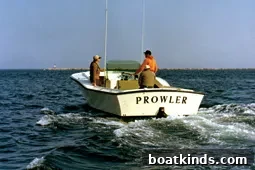
Anderson currently runs a custom 42-foot Willis Carolina express sportfisherman named Prowler. Over his career, beginning in 1961, he has owned four boats. His first was a 19-foot Aquasport that introduced him to striped bass fishing around the North Rip and the waters near Block Island. Those early years included some exceptional striper fishing along the Narragansett mainland, but as local fishing patterns changed, island grounds became more important to his business.
Regular crossings to Block Island highlighted another set of priorities: comfort, seaworthiness, and the confidence to carry a deck load of paying customers across the sound. After experiencing rough rides on smaller craft, Anderson decided he needed a different kind of boat—one that could handle volatile crossings while keeping anglers safe and comfortable.
First love
Around 1970, Anderson discovered a new design concept that would change the way he fished the island grounds. Boat designer Dick Lema was developing a 26-foot open bass boat influenced by a traditional wooden bass hull built by Manny Parece. Lema’s idea was to produce a fiberglass, center-console boat with an inboard gasoline engine—at a time when many local guides favored gasoline power over diesel and used conventional bow-enclosed, tiller-steered layouts.
The result, known as the 26-foot Bonito, had several attributes that appealed to Anderson. The solid-fiberglass construction made routine maintenance easier and reduced the extra weight that often comes from soaked wood. The higher topsides and full transom gave the boat a more protective cockpit area: the coaming stood about 5 to 6 feet above the waterline, providing anglers a secure place to brace and helping keep waves from swamping the boat during rough passages to Block Island.
Perhaps even more consequential for a working charter operator was Lema’s decision to move the helm aft to a central console. That configuration freed up the bow for a raised casting platform, allowed 360-degree movement around the deck, and positioned the captain amidships so he could reach anglers or return to the controls quickly. With an eleven-foot beam narrowing toward the transom, the boat offered ample room for fighting fish and moving around under pressure—advantages for a captain often running charters single-handedly.
Many pros, one big con
Lema’s Bonito delivered speed, efficient fuel use, and a practical fishing layout, all valuable features for a professional charter vessel. Fiberglass hulls also simplified cleaning and reduced long-term maintenance compared with wooden construction. In short, the design was a strong match for the needs of a guide working island grounds and chasing stripers.
Yet even a well-executed design has compromises. Anderson quickly discovered the Bonito’s most significant shortcoming: its behavior in a head sea. Because the original wooden bass boat hull had been designed to carry weight forward—enclosed bows, windshields, and forward steering—the hull’s forefoot was relatively blunt. When Lema converted the hull to an open center-console layout without sharpening the entry, the boat retained that fuller forefoot. In calm conditions the trade-off was acceptable, but in a head sea the boat could pound harshly, making heavy-weather passages uncomfortable and sometimes jarring for anglers.
That pounding was the primary reason Anderson began considering a larger, more seaworthy platform. By 1981, with changes in the fishery, a growing roster of repeat customers, and expanding offshore opportunities, he recognized the need for a boat that provided more range, more comfort, and better performance in rough conditions.
Next month, we’ll examine the two boats Anderson owned after the Bonito and how they addressed the compromises he faced: the search for greater comfort, improved seaworthiness, and enhanced range for charter operations.
See related article: The perfect fishing boat and the art of compromise. Part two
January 2013 issue