
There are as many ways to build boats as there are ways to skin a cat. From hulking floating fortresses to sleek racing sloops, each craft reflects the materials and methods used to make it. Today many boats are mass-produced from the same molds to meet demand and keep costs down. That approach is efficient and affordable, but it often produces vessels that feel anonymous, lacking personality and narrative.
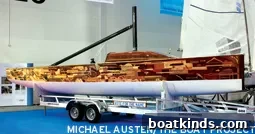
Imagine a different approach: boatbuilding removed from the factory floor and transformed into a public art project. Instead of robots and assembly lines, hundreds of people contribute small objects, fragments and memories—every donated piece carrying a personal history. The finished boat becomes a floating archive, an object to study and reflect upon, inviting passengers and onlookers to slow down and read the stories woven into its planking. Donations might include a kitchen utensil, a scrap of centuries-old timber, or a memento linked to a musician or an extraordinary event. What if a boat could be part vessel, part museum, part communal story?
Gary Winters helped make that question a reality. Winters is one of the founders of Lone Twin, a British performance-art duo that conceived The Boat Project, a public-art commission supported by Arts Council England and selected to represent southeastern England as part of the 2012 Cultural Olympiad. “The idea came to us 10 years ago, but the time was not there yet,” Winters says.
Winters and fellow artist Gregg Whelan met at Dartington College of Arts and have collaborated ever since. Many of their early performances took them to shorelines where they met boat owners and heard personal boating stories. Those conversations, combined with the artists’ own interest in travel and migration by sea—boats as early technology for exploration, trade and cultural exchange—helped shape the project.
At first the duo considered building coracles—small, bowl-shaped fishing craft light enough to carry on a shoulder. Ultimately they embraced a larger vision that made people central to the work: donors, volunteers and audiences who would give objects and share memories. Performance art, they argued, depends on participation.

Winters points to community responses to local boatbuilding efforts as inspiration. He recalls watching the 121-foot Team Philips catamaran, launched from Totnes in March 2000 by Pete Goss. At the time it was the largest and most innovative ocean-racing multihull; hundreds of people came to witness the launch, emotionally invested in the event. “Building large structures used to be a community effort, like raising a barn. It brings people together,” he says. (Team Philips later suffered structural failure and was lost in a storm, underscoring the risks of experimental design.)
With travel, storytelling and community at its core, The Boat Project earned a clear project proposal and a favorable feasibility study—winning Lone Twin a commission and £500,000 in funding. Between February and August 2011, the project invited residents across southeastern England to donate wooden objects of any kind or size. The response filled a warehouse with nearly 2,000 pieces from more than 1,200 donors: furniture, household knickknacks, sports gear, musical instruments and decorative items such as busts and masks.
Some donations were historically notable: slivers of timber from historic vessels HMS Victory and HMS Warrior, and two wooden boxes used to transport Britain’s gold reserves to Canada during World War II. Other gifts included an item from Spacelab and, Winters says, an authentic sliver of one of Jimi Hendrix’s guitars. Many items were damaged or rotten, but each remained connected to its donor, and those associations were incorporated into the story of the boat. The collection also captured lighter moments: two lacrosse sticks arrived—one from the player who once broke another man’s nose, installed on the starboard side, and the other from the player whose nose was broken, placed on the port side.
The technical task of turning disparate donations into a seaworthy hull fell to Mark Covell, hired as the project’s technical director. Covell brought experience as an Olympic silver-medal sailor and stints with campaigns such as the Volvo Ocean Race and the America’s Cup. He says he signed on because “too many people said it couldn’t be done.”
Working with donated material required flexibility and invention. Many objects arrived odd-shaped or in fragments, so Covell and the team had to decide how to cut, slice and position each piece. Decorative items were planed or sanded to 8mm thickness, traced and applied to solid wood panels underneath. Shapes were cut out, vacuum-bagged onto the hull exterior, and backfilled with an epoxy flow coat. Softwoods were saturated with epoxy to match density, then faired smooth to produce a continuous surface. The process was unpredictable—“a bit like a box of chocolates,” Covell says—so much of the layout relied on intuition and aesthetic judgment.
Naval architect Simon Rogers handled the boat’s performance design. Although the exterior was a collage of donated artifacts that reflected the twentieth century, Rogers and the team wanted a contemporary, performance-oriented hull. Practical constraints shaped the boat’s proportions: it had to be legally trailerable within the 2.55-meter beam limit, which set the overall length near 30 feet. The hull is cedar-strip planked and laminated beneath the decorative skin, fitted with a lifting keel and cassette rudder so it can be launched from a ramp, and carries a high-tech carbon mast—playfully decorated with wooden lollipop sticks printed with jokes.
Design and construction were labor intensive: Rogers estimates the project required more than 10,000 man-hours, far exceeding the time it would take to mold a conventional production hull. That extra effort, however, produced a boat rich in narrative and craft—an object whose meaning comes as much from its physical form as from the stories attached to each donated item. Those stories will be collected in a companion book documenting how pieces were laid out and affixed.
Rogers describes The Boat Project as a meaningful milestone in his career. He waited to see the completed craft at the London Boat Show and was astonished by the craftsmanship and artistry. “I was genuinely gobsmacked,” he says.
The yet-to-be-named boat, sailed by a captain and seven crew members chosen from hundreds of applicants, will make its maiden voyage from Emsworth, where it will be christened and launched on May 7. Planned stops include Brighton, Portsmouth, Hastings and Margate, with a final leg that humorously ends in landlocked Milton Keynes—where the boat will be displayed in a shopping mall for the public to encounter up close.
An oceangoing raceboat appearing in a shopping center will surprise many. The Boat Project turns a familiar vessel type into a communal artwork that records ordinary lives and historic fragments. What began as a “what if” has become a tangible, seafaring testament to memory, craft and community.
Dieter Loibner is sailing editor for Soundings.
This article originally appeared in the May 2012 issue.