
When Soundings first appeared fifty years ago, I was paying less than 50 cents a gallon to fill the six-gallon tanks that slid across the floor of my Glasspar Seafair Sedan. Now fuel seems to rise by about fifty cents a gallon every month. Back then, even that small amount felt like a luxury, but marinas often made it easier by letting me tie up overnight when I fueled—sometimes even when I didn’t buy gas. “Why not?” a marina owner once told me. “The dock’s here and nobody else is using it.”
There were many conveniences then that no longer exist. I didn’t own a VHF radio because portable units hadn’t become common yet. If I needed to make a call while cruising Chesapeake Bay, I tied up at a marina and used a pay phone. Pay phones were everywhere because cellphones didn’t exist. Today you can still find a marina, but pay phones are rare.
Signaling for help was simpler and rougher: if the engine failed, I’d wave a shirt, holler, and hope someone noticed. Flares were an option, but I was always wary of lighting one aboard a boat saturated with two-stroke fumes from a 25-hp outboard that seemed to breathe out oil and gas. The smell was worse than a date who’d just eaten garlic. Safety equipment and marine communications have come a long way since then.
I didn’t spend much time worrying about weather forecasts either. Without VHF weather channels and constant alerts, we listened to AM radio stations like WGH in Norfolk for the occasional forecast, or simply read the sky. Storms and lightning were the most immediate warnings. That lack of constant updates reduced a lot of stress: you relaxed, listened to music on a little battery-powered radio, and watched the sky.
Environmental awareness was also different. My bilge and feet were often oily from pouring gas from five-gallon cans into six-gallon tanks and mixing oil for two-stroke motors—sometimes while rocking in the Bay. I know now that leaving oil in the water or on docks isn’t acceptable. Today I hold a rag under the fuel vent when fueling and hunt for a proper disposal spot. The regulations and sensibilities have changed for the better.
One stressful change in my life coincided with those early years of Soundings: I went to college. For months at a time I couldn’t work on or even see my boat. Growing up on a peninsula bordered by rivers, being on the water was not a hobby but a way of life. Leaving it felt like stepping onto another planet. I always returned, and when I was away the magazines I read helped soothe the longing. Soundings wasn’t always my go-to in those early days—its focus was more Northeastern—but I devoured every issue I could find because I was always dreaming of the next boat.
Fiberglass and beyond
Fiberglass changed everything. I remember being skeptical when I first heard about boats that didn’t rot. My Glasspar Seafair Sedan was a revelation—no soft spots, no Git-Rot—and it opened up many carefree days on the water. But longevity brought new complications. Boats that lasted forever increased the used-boat market, putting more people on the water and creating crowding that didn’t exist before.
When Soundings was young, finding an uncrowded anchorage was usually easy. If other boats were nearby, we might visit by dinghy and make friends. Now, approaching another boat in a dinghy can sometimes make people uneasy. Anchoring in front of someone’s house used to be accepted; I’ll never forget a Rhode Island homeowner who rowed out during a hurricane and offered us shelter and a ride for supplies. Today, anchoring offshore can mean spotlights, boom boxes aimed at the water, and even visits from marine officers checking your plans.
There are more attempts at restricting anchoring, especially in warm climates. More boaters, more houses on the water, but not more shoreline. That imbalance creates conflicts: unattended boats that sink and become hazards, long-term liveaboards who treat anchorages like backyards, and people trying to tap into Wi‑Fi from their boats. I don’t think boaters are inherently more discourteous—there are simply many more of them, and a small percentage can spoil it for everyone. And no, I’ll never be convinced a Jet Ski is a boat.
As boats carried more people and amenities, they had to do more. Over the decades I moved from cooking on a paraffin burner to a portable gasoline two-burner, then an alcohol stove, then a propane range, and eventually to an electric range like those in houses. Throughout the changes, meals remained a highlight of cruising—thanks, Mel.
Dawn of the dink
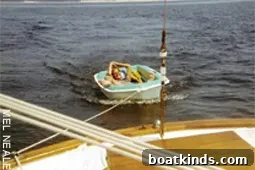
At first we didn’t have a dinghy—my boat was only 18 feet. By the time Mel and I bought a 27-foot Tartan in 1969, we towed a little Sportyak that doubled as a bathtub. Later we had an eight-foot rowboat with a tiny 1.5-hp outboard that was notoriously hard to start and all too easy to drop overboard. Trolling for that motor with a magnet was often nearly as fun as catching bluefish.
Inflatables arrived and I called them “poppables.” Ours seemed to leak more than most. The foot pump was as essential as oars and engine, and the whole operation depended on keeping the dinghy inflated enough to use the pump. Eventually we built our own aluminum dinghy with the handling, payload, and stability we wanted—features that have proved useful more than once.
We used to pull inflatables onto the deck; that likely contributed to their leaks. On long passages our daughters slid on the bottoms while I doused them with water—an impromptu playground. Today our aluminum dinghy rides on a hydraulic platform that stores, launches, and doubles as a swim and dive platform.
Water aboard has come a long way. Fifty years ago, water on a boat meant bilge water; bathing meant jumping overboard with soap. We tried sun showers and stooped in cockpits with towels on lifelines. Later boats brought hot-water tanks plumbed from engines and enclosed heads. Living aboard our Gulfstar 47, we carried hundreds of gallons of water and still worried about running out while cruising remote Bahamian anchorages.
We eventually installed a watermaker. The ability to produce 15 gallons of clean water an hour transformed cruising—drinking, showering, washing the anchor chain, even filling tanks in harbors where water is scarce. I don’t claim to be cleaner, but I can take a hot shower on a blowy day and still have water left for a drink.
Ice was always a concern. Block ice was ideal but hard to find. I learned to use shaved ice from fish houses; it packed into nooks and lasted far longer than cubes. When I upgraded refrigeration—holding plates, compressors, better insulation—the cold box could keep ice cream rock hard in August. Modern DC refrigeration units are impressive and efficient, though older systems sometimes outlived their reliability.
Plotter fodder
Navigation technology has undergone a dramatic evolution, and while the advances are impressive, overreliance on electronics can be risky. In the early years I used large paper charts that cost a fortune and were often worn and stained. Then chart books simplified piloting, and later Loran proved revolutionary. I remember one Loran unit that even displayed the manufacturer’s boat name when you switched it on—technology that would have seemed miraculous a few years earlier.
A memorable afternoon in Biscayne Bay showed both the promise and perils of navigation tech. A cluster of dinghies circling sailboats were recording GPS coordinates to find deep water through Cape Florida Channel at night. We had fared by watching aids, wave patterns, and the water for years and left at first light while many of those boats ended up waiting on the shoals, their notes useless at the tide’s whim.
Chartplotters and GPS made navigation seem foolproof, and more boaters pushed into inlets and reefs without paying attention to the actual water. Plotters rely on charts that can be decades or centuries old; islands and shoals aren’t always where the plotter icon predicts. The best practice has always been to combine traditional seamanship—reading the water, understanding marks, and local knowledge—with GPS precision.
That marriage of old and new is exemplified by people like Sarah and Monty Lewis, who explored the Bahamas in a Mainship 34 and created detailed charts by visiting inlets and anchorages, recording precise GPS positions, and publishing “Explorer Charts” that reflected actual, tested routes. Technology improves safety and convenience, but it works best when informed by experience.
Faster cruising boats introduced another challenge: stopping quickly enough. I’ve seen running-gear damage after a fast boat hit a hard-sand shoal a foot under water because the skipper expected his chartplotter to refresh instantly at speed. Reckless speed continues to cause collisions with buoys, bridges, reefs, and other vessels.
Still, some things haven’t changed. The first issue of Soundings, April 1963, contained a cartoon of a fast boat heading for rocks with the caption, “So what’s a little mist.” There was also a help-wanted ad offering writers “blue sky and almost no money.” Despite all the technological and cultural shifts over five decades, boating retains much of its timeless humor, challenge, and charm.
May 2013 issue