I spent the first week of the America’s Cup in San Francisco, immersed in corporate hospitality and running between Pier 27, the Marina Green, Crissy Field, the top of the Transamerica Building, St. Francis Yacht Club and out on the racecourse. From every vantage point I visited, the racing was spectacular — San Francisco truly acts as an amphitheater for sailing.

My favorite place to watch was the beach at Crissy Field, sitting on the sand with the race app open on my iPad. With the app’s live tracking and a chilled California sparkling wine, the experience was hard to beat. The coverage made it possible to follow every tack and jibe no matter where I was — whether ashore, on a rooftop or out on the water.
Credit has to go to the organizers and to Stan Honey’s team for delivering the permitting, logistics and technology that made this possible. Securing permits and coordinating with the City of San Francisco was a Herculean effort, and the fact that the event ran so smoothly felt like a small miracle. I hope the city makes it easier next time, because the spectacle and economic value are clear; if not, I understand Newport, R.I., is watching closely.
The on-water action was intense and unpredictable in the best way. Emirates Team New Zealand sailed with relentless pace and discipline; their boat and crew operated at full capacity a remarkable percentage of the time. They were fast, focused and smart in their maneuvers. Oracle Team USA, after finding their footing and making performance and handling tweaks, proved they could match and in many cases exceed that speed. Once Oracle raised their performance level, their boat often had the edge.
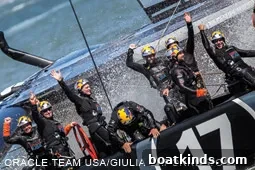
One recurring question I heard from fans was why there were no women on the competing boats. My response was that an equally important question is why there were so few Americans in senior roles at the sport’s highest levels. Four years ago, Oakcliff Sailing in Oyster Bay, New York, recognized that gap and launched programs to change it. Today we are beginning to see measurable results: women hold significant roles across our teams, and alumni are being recruited into high-profile youth and professional events.
Oakcliff graduates like Solomon Krevans have been invited to compete in top youth events, and teams from countries with strong sailing traditions are coming to train with us. Our coach Jeff MacFarlane is preparing for international offshore competition, and our crews are increasingly appearing on podiums at major regattas. These developments show the impact of targeted development programs and persistent grassroots investment in talent.
That said, the responsibility does not rest solely on organizations. Women who want to advance in competitive sailing should keep pushing for opportunities — to borrow Sheryl Sandberg’s phrase, they should keep leaning in. The sport benefits when diverse talent is supported and encouraged at every level, and the America’s Cup should be no exception.
The experience of that week in San Francisco offered many reminders of what makes sailing compelling: the drama on the water, the technical ingenuity behind the boats and the atmosphere created by enthusiastic crowds. I was fortunate to watch races in widely different settings — from a Delta flight to late-night streams while attending a conference in Beijing — and the live technology made each viewing engaging and informative.
I hope the adjectives I kept hearing — incredible, amazing, unbelievable — continue to describe future America’s Cups and, more broadly, the sport of sailing. When organizers, technology teams, athletes and development programs all work together, the result is an event that captures attention, inspires new competitors and showcases the very best of the sport.
Dawn Riley, executive director of Oakcliff Sailing Center, was “the girl” — the pit person — on Bill Koch’s 1992 Cup winner America3, team captain on the America3 women’s team in 1995, CEO and team captain on America True in 2000 and general manager of Areva Challenge in 2007.
Related article titles:
– Velocity Made Good
– Is This Model Sustainable?
– The Game Has Changed
– Capt. Nat Would Have Approved
December 2013 issue