Ferrocement Ships: Early 20th Century Concrete Vessels and Their Legacy
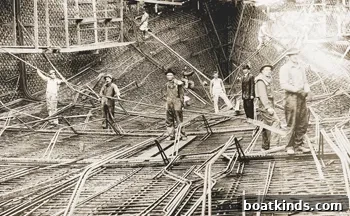
What are these men doing, and what is all that metalwork? Look closely at the background and the curved outline of a ship’s bow reveals the answer. It’s the early 1900s, and the workers stand inside a lattice of rebar and wire mesh, building what will become a ship made of cement — a ferrocement hull.
Origins and Early Examples
One of the earliest and most notable pioneers was Norwegian engineer Nicolay Fougner, who launched the first self-propelled, oceangoing ferrocement ship in 1917: the 84-foot Namsenfjord. The vessel’s success attracted attention across the Atlantic and led to an invitation for Fougner to help explore concrete shipbuilding in the United States. That collaboration resulted in the organization of the Fougner Concrete Shipbuilding Co. in Flushing Bay, New York, and the launch of two additional ships.
On the U.S. West Coast, designers Alan Macdonald and Victor Poss created America’s first large ferrocement vessel, the 6,125-ton steamer Faith, launched in 1918. In the same era, wartime shortages and the need for rapid expansion of transport capacity prompted government interest in alternative hull materials.
Wartime Production and the Emergency Fleet
During and immediately after World War I, the U.S. government established programs to accelerate merchant and auxiliary fleet construction. President Woodrow Wilson’s Emergency Fleet program commissioned the construction of 24 ferrocement ships for wartime duty. The war ended before all could be completed; nevertheless, a dozen vessels were finished and later found service as transport and storage ships.
The use of ferrocement surged again during World War II when steel shortages made concrete an attractive alternative for many types of auxiliary vessels. Contractors such as McCloskey & Co. of Philadelphia received orders for concrete self-propelled ships and barges. At Hookers Point, Florida, a large workforce contributed to the construction of dozens of vessels and barges. On the U.S. West Coast, builders produced engineless cement barges designed to be towed by tugs. These ferrocement barges — often called FCBs — played a valuable role in the D-Day invasion and subsequent operations, serving as floating pontoons, harbor protection units, and transport platforms for fuel and munitions.
How Ferrocement Construction Works
Ferrocement is a form of reinforced concrete that relies on a close-knit combination of steel reinforcement and a thin cement-sand mortar applied over a shaped framework. The structural framework typically consists of steel bars and multiple layers of wire mesh or expanded metal. Craftsmen build the framework to the hull’s shape, then apply mortar by hand or with sprayers until the hull is fully covered.
Key advantages of ferrocement include the ability to form complex shapes, relatively low material cost compared with plated steel in times of scarcity, good fire resistance, and a degree of redundancy in the reinforcement. The method is labor-intensive and requires skilled workmanship to ensure complete bonding between the mortar and the reinforcement.
Benefits, Limitations, and Maintenance
Ferrocement vessels are often described as economical and robust when constructed correctly. However, the technique has limitations: ferrocement hulls are heavier than equivalent steel designs, and they can be vulnerable to cracking and corrosion of embedded steel if water penetrates the mortar or if construction quality is inconsistent. Proper detailing, thorough curing, and ongoing maintenance to prevent water ingress are essential to preserving a ferrocement hull’s integrity over time.
Legacy and Modern Use
Although ferrocement never supplanted steel or aluminum for most commercial and naval shipbuilding, it proved a practical solution in specific historical circumstances and left a lasting heritage. After World War II, many concrete vessels continued in service for transport, storage, and stationary roles. In the postwar period, ferrocement also found a niche among recreational boatbuilders and amateur constructors. Enthusiasts and small yards have used the method for yachts, sailboats, and houseboats, attracted by the relatively low material cost, the ability to cast inexpensive hulls, and the flexibility of forming curves and shapes without expensive molds.
Today, ferrocement remains an option for specialty applications and for builders who prioritize affordability and DIY-friendly construction methods. Where it is used, attention to proper reinforcement detailing, moisture protection, and routine inspection remains critical to long-term performance.
This article originally appeared in the July 2016 issue.