Jon Wilson and the Revival of Wooden Boat Traditions
The story is part legend, part coastal craftsmanship: in September 1974 Jon Wilson launched WoodenBoat magazine from a remote cabin in North Brooksville, Maine—without electricity or running water. That first issue, printed and produced in rustic conditions, laid the foundation for what would become a central force in preserving and promoting wooden boat culture and traditional boatbuilding skills.
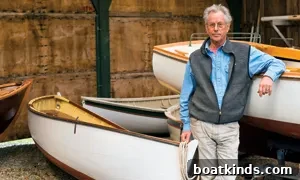
Wilson took that inaugural issue to the Newport International Boat Show in Rhode Island and sold 400 copies while signing up 200 subscribers. Over the following decades the enterprise grew substantially. WoodenBoat now reaches a circulation of roughly 100,000 readers, operates a book-publishing arm, runs The WoodenBoat School for boatbuilding and maritime arts, publishes a sister title, Professional BoatBuilder, and organizes the annual WoodenBoat Show—recently hosted at Mystic Seaport Museum in Connecticut. The influence of one committed individual on the revival of wooden-boat traditions is difficult to overstate.
Wilson has not rested on his success. In addition to leading WoodenBoat, he directs a national nonprofit, JUST Alternatives, which facilitates restorative, face-to-face dialogue between victims of violent crime and the people who harmed them. Below, Wilson shares memories of how his lifelong connection to boats began, the vessels that shaped him, and the experiences that continue to inspire his work with wooden boats and maritime education.
First memory of being on a boat: Riding the Thimble Islands ferry Volsunga, a 32-foot double-ender that carried island residents from the public dock in Stony Creek, Connecticut, captained by the gifted Dick Howd. My first sailboat was a Cape Cod 18 Knockabout on Salt Pond in Wakefield, Rhode Island. For rowing, it was the family’s old flat-bottom skiff in Stony Creek—hard to move when I was small. Wood, planks, frames, paint, varnish and soul: those elements formed the foundation of my relationship with wooden boats.
First boat you owned: The old ferry Volsunga, which I bought from Howd for $300 after she was taken out of service. Built in 1910, she was far more vessel than a 1960s teenager could properly care for. A more manageable early project was a Charles Wittholz-designed Flying Finn, a 17-foot lapstrake runabout rebuilt with the skilled guidance and help of Jim Curry, my mentor and co-worker at Dutch Wharf Boat Yard in Branford, Connecticut.
In general, power or sail? Yes!
Last or current boat: Currently I own Free Spirit, a Concordia 33 that represents an early draft of what evolved into the famed Concordia yawl. I also keep Riverbird, a customized 22-foot 1967 Chris-Craft Cutlass adapted for picnicking and overnight cruising.
Favorite boat you’ve owned: Free Spirit—she’s been in my care for 33 years and remains my favorite.
Your dream boat: A 55-foot wooden ketch-rigged motorsailer that blends the design genius of Aage Nielsen, Philip Rhodes and Olin Stephens.
Most rewarding professional experience: Founding WoodenBoat magazine and establishing The WoodenBoat School. Both projects have allowed generations to reconnect with traditional boatbuilding and maritime arts, expanding hands-on learning and appreciation for wooden craft.
Scariest adventure aboard: A close encounter with another boat in heavy winds and thick fog. The other vessel was on a reciprocal course toward the same sea buoy and emitted no horn signals. We had no radar then; the sudden burst of adrenaline from that near miss remains vivid.
Most memorable experience aboard: Sailing home to Maine from Newport and running before a light breeze over Stellwagen Bank at midnight. Strange sounds from below drew us into the companionway, where a jaw-dropping chorus of whale song reverberated through the hull planking—an unforgettable, almost mystical moment at sea.
Longest time you’ve spent aboard: Six weeks on the Baltimore Clipper schooner Pride of Baltimore II, traveling from Spain to the Virgin Islands and then into Chesapeake Bay under the command of Capt. Jan Miles, who handled the 108-foot vessel with the finesse of a small-boat sailor.
Favorite destination so far: Almost anywhere between Eggemoggin Reach and islands around Merchants Row off Deer Isle, or arriving at Provincetown’s Race Point at daybreak after an overnight crossing of the Gulf of Maine.
Place you still want to get to on your own bottom: Cuba—ideally aboard a comfortable motorsailer.
Favorite nautical book: Sou’West and By West of Cape Cod by Llewellyn Howland—the man behind the creation of the Concordia yawl—about growing up around the waters of New Bedford and South Dartmouth, Massachusetts.
Favorite nautical cause you support: Programs that get children, both urban and rural, into workshops where they can learn to build boats and then take those boats out on the water. Teaching hands-on skills and maritime stewardship creates lifelong connections to the sea.
Favorite quote about the sea: I have two—one for gentle days and one for the ferocious ones:
“Hark now, hear the sailors cry,
Smell the sea, and feel the sky.
Let your soul and spirit fly,
Into the mystic.” — Van Morrison
“Thy sea is so great
And my boat is so small.” — Unknown
(often referred to as the Breton Fisherman’s Prayer)
This article originally appeared in the July 2015 issue.