
North Rip 21: US Watercraft Launches Second-Generation Deep-V Center Console
Rhode Island boatbuilder US Watercraft will introduce the second-generation North Rip 21 this spring, refining an already seakindly deep-vee center console to better meet the needs of anglers and family boaters alike. The latest version closes the transom and relocates the outboard to an Armstrong engine bracket, which opens up cockpit space for a dedicated live well and additional storage. The change also contributes to a drier, safer cockpit area when reversing or drift fishing, according to Max Buerman, US Watercraft partner and chief financial officer.
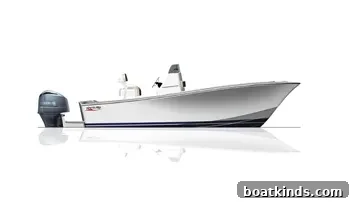
“The 21 is a versatile boat — ideal for protected bays yet capable of heading offshore,” Buerman says. “With the enclosed transom you’re less exposed to the elements when backing down or fishing a current. It’s definitely safer and drier.” That enclosed transom paired with an Armstrong bracket gives owners a cleaner cockpit layout and makes room for practical storage solutions without compromising the boat’s handling.
At cruising speeds the North Rip 21’s flared bow deflects waves and reduces spray, helping it ride in a manner typical of much larger center consoles. Buerman adds, “It rides like a much larger center console.” This behavior is one reason long-time owners have praised the model’s seakeeping abilities.
US Watercraft builds the hulls using resin infusion, a process that yields a stiff, strong structure while controlling weight and resin distribution. The company uses Plexus, a high-strength methacrylate adhesive, to bond the hull to the internal stringer-bulkhead grid, liner and deck cap, creating a robust, integrated structure designed for long-term durability and heavy use.
The North Rip 21 has a long production history that dates to 2001 and has persisted through changing ownership and economic ups and downs, including the Great Recession. The original designer, Daryl Wilbur, noted in a 2010 Soundings article that many owners referred to their 21s as “pocket battlewagons” because of the boat’s big-boat seakeeping traits. Wilbur produced the design through 2007; US Watercraft acquired the mold from Pearson Composites in 2012 and has continued development since then.
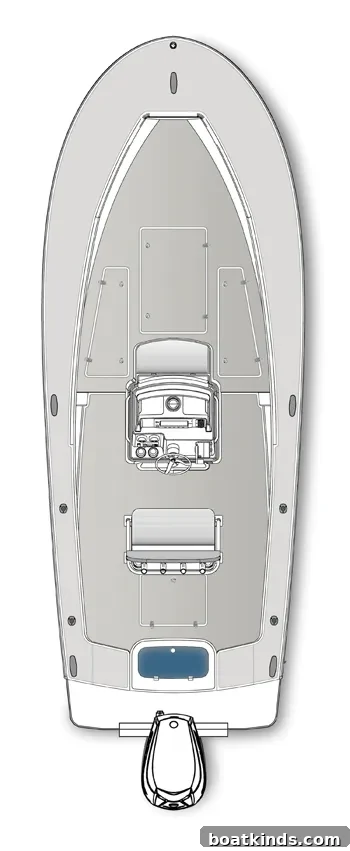
The deck plan remains straightforward and purpose-driven. The raised foredeck houses a large 180-gallon fishbox with two 20-gallon fishboxes positioned on either side. A 20-gallon live well sits in the transom. That foundation makes the boat a serious tool for tournament or recreational fishing, while still allowing it to convert easily into a comfortable family dayboat. Options include a forward console seat (with or without its own live well), either a permanent or flip-up stern seat, a canvas T-top with four rod holders, and hydraulic trim tabs.
Performance and fuel economy are part of the package. With a single 200-hp Yamaha the North Rip 21 returns about 4 mpg at 27.5 mph, giving a practical cruising range of roughly 400 miles. A 150-hp outboard is the standard installation, and US Watercraft will rig whatever outboard brand a buyer prefers.
To refine the layout and ensure the boat meets the demands of working anglers, US Watercraft consulted Rhode Island charter captain and tournament fisherman Jack Sprengel. “Storage space on your typical 21-footer is lacking,” Sprengel observed. “So we really concentrated on adding storage everywhere possible.” That emphasis on usable, well-placed storage helps the North Rip 21 function efficiently as both a serious fishing platform and a comfortable dayboat for family outings.
Overall, the second-generation North Rip 21 builds on a proven hull with thoughtful refinements that enhance safety, usability and comfort. The closed transom and Armstrong bracket improve cockpit ergonomics and protection from the elements, while proven construction techniques such as resin infusion and Plexus bonding aim to deliver a durable, well-performing hull that will appeal to anglers and family boaters who want big-boat manners in a trailerable 21-foot package.
This article originally appeared in the May 2016 issue.