
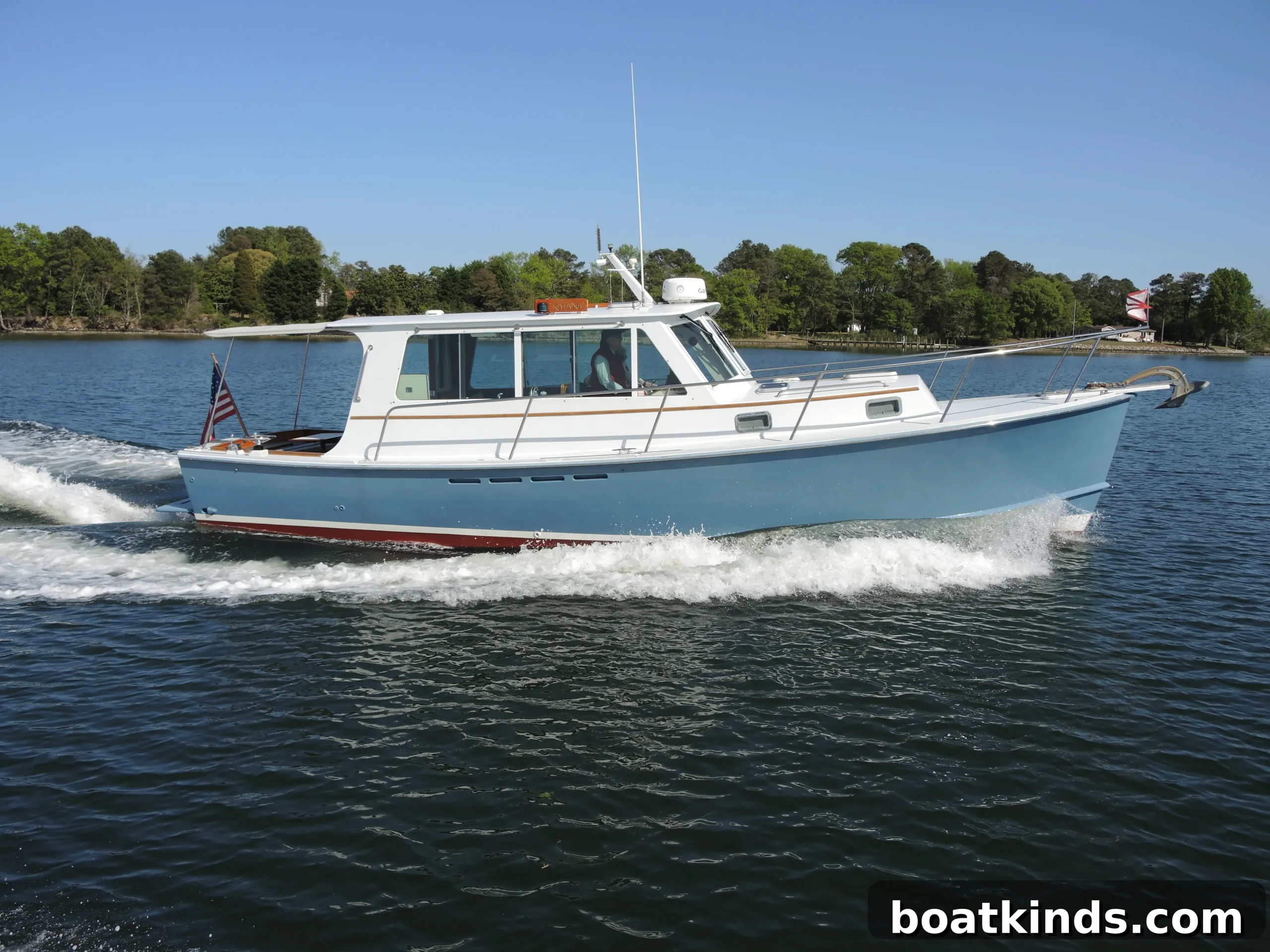
David Godwin and Carol Buchman have spent decades on the water. Their sailing roots began racing Cal-25s around Annapolis, Maryland, and later they moved into fast cruising with a C&C 37. After buying a house on Cockrell Creek in Reedville, Virginia, in 2002, they purchased their first powerboat, a Mako 26 center console powered by twin 200-hp outboards. That boat gave them the freedom to explore the many creeks and river passages of their region, but they always intended to move into a coastal cruising Downeast-style powerboat when the time was right.
When a Thomas Point 34 became available, the couple recognized it as the right fit. “It was the right style and the right size for the two of us,” Godwin says. The design checked the boxes they cared most about: sound construction, classic Downeast lines, and manageable systems for two-crew cruising. In September 2020 they purchased the boat and christened her Katana.
Katana is a 1998 Thomas Point 34, drawn by naval architect Mike Kaufman and built by Joe Reid at Mast & Mallet Boatworks in Edgewater, Maryland. Reid and his craftsmen produce versions of this design in sizes ranging from 30 to 44 feet. The hull of Katana is cold-molded with two overlapping layers of Western red cedar laid fore-and-aft and bonded with West System epoxy. The hull receives two layers of 10-ounce fiberglass cloth for added stiffness and protection, a construction method that has proven itself in long-distance cruising—one sister boat, named Sawdust, completed a 7,000-mile Great Loop passage with a winter stay in the Bahamas before returning to Annapolis.
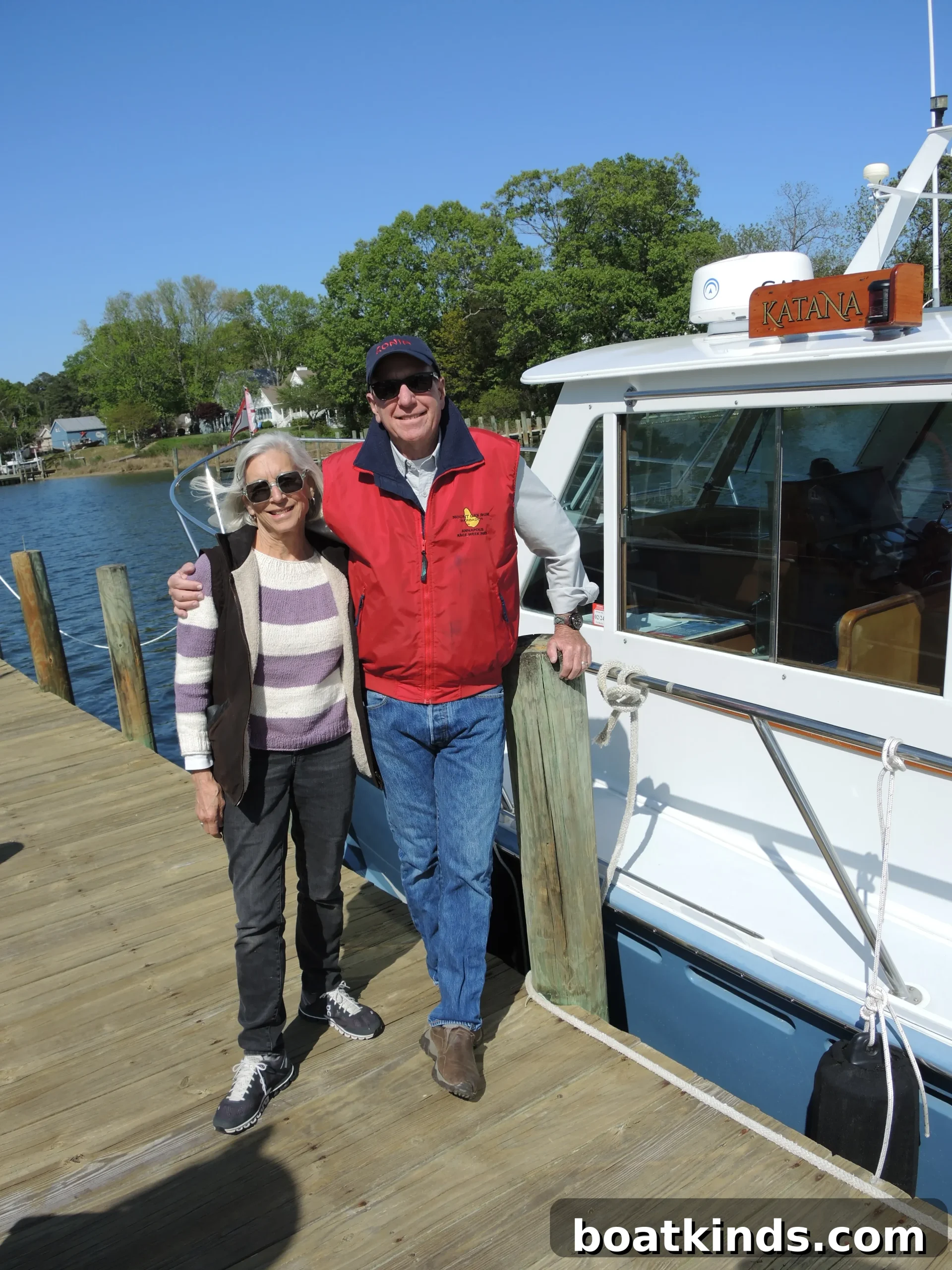
When Godwin and Buchman took ownership, Katana was fundamentally sound but overdue for some systems and cosmetic updates. They replaced older electronics with a fully integrated Garmin suite, including chartplotter with AIS, radar and autopilot, to modernize navigation and safety. Attention then turned to the hull bottom: the original 23-year-old antifouling layers were blasted away to bare wood, followed by three coats of Interlux barrier coat, a dark guide coat, and three topcoats of Sea Hawk water-based ablative antifouling to restore performance and protect the cold-molded hull.
Godwin completed the exterior varnish and removed the twin cabin doors for refinishing during the winter, sanding and finishing them in his shed. Outside, the varnish is modest—limited to the belt line and mahogany trim around the aft deck—while the interior showcases extensive woodwork. The cabin is richly finished in Honduran and Luan mahogany with a teak-and-holly sole, creating a warm, traditional aesthetic consistent with Downeast styling.
The hull form begins with a sharp 60-degree entry at the bow and fairways to a 9-degree transom deadrise, with a forward splash rail evolving into hard chines that run the full length of the boat. This geometry contributes to a dry ride and efficient handling in a range of conditions. Power comes from a 330-hp Cummins diesel with fewer than 2,000 hours, and a Next Gen 5.5-kW generator provides power for air conditioning and reverse-cycle heating. In practice, the owners report a top speed near 22 knots, though they typically cruise at a more economical 16 knots—about 2,200 rpm at 80 percent throttle—using roughly 8.6 gallons per hour at full load.
Their cruising plans emphasize regional exploration of the Chesapeake Bay’s extensive shoreline, with overnight destinations such as Onancock and Cape Charles on their list. They used Katana to travel to Annapolis for the Cal-25 Nationals and are planning longer trips, including a cruise to Sag Harbor to visit friends and voyages south to Beaufort and Surf City, North Carolina. For longer passages offshore they keep davits and a RIB ready to mount on the transom coaming; when they stay in marinas they typically leave the tender ashore.
WALKTHROUGH
The Thomas Point 34 layout balances safe deck access and comfortable interior living. Wide side decks and sturdy safety rails make moving forward straightforward, while the main cabin remains spacious with good headroom. Large windows surround the cabin, delivering abundant natural light and 360-degree visibility for the helmsman and co-captain. Overhead hatches and opening side windows provide cross-ventilation, improving comfort during summer cruising.
The starboard-side galley is equipped with full-size appliances, generous counter space and thoughtful storage, suitable for extended coastal trips. Forward of the galley is the owners’ stateroom, where mahogany ceiling strips add a traditional finish. To starboard of the stateroom is an enclosed head with a separate shower stall, providing practical amenities for two-person cruising.
This article was originally published in the September 2022 issue.