
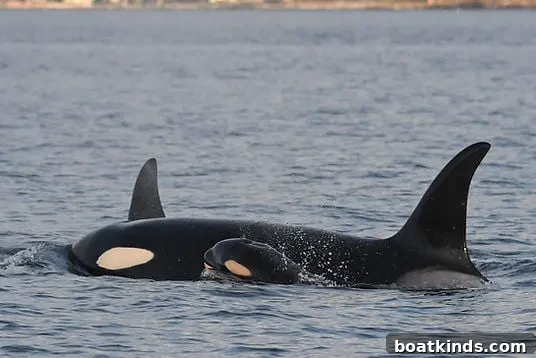
New Calf Brings Hope for Endangered Southern Resident Killer Whales
The Center for Whale Research has confirmed the arrival of a new calf in the Southern Resident Killer Whale (SRKW) population: J59, the first calf born into the J pod in two years. This birth is a rare and welcome event for a population that numbers roughly 74 individuals and spends much of its time around the San Juan Islands and in Puget Sound, Washington. For a community listed as endangered, each healthy newborn is a crucial step toward long-term recovery.
Southern Resident Killer Whales rely almost entirely on Chinook salmon for food. Declines in Chinook abundance over recent decades are a primary factor in the orcas’ ongoing struggle to survive. Reduced prey availability directly affects body condition, reproductive success and calf survival. Scientists estimate that only about one in three calves survive to maturity, a grim statistic that underscores how fragile this population remains.
J pod itself is made up of 23 individuals and has drawn public attention in past years over deeply affecting events that illustrate how precarious life is for these whales. In 2018, J35 gave birth to a calf that died within half an hour. The loss was heartbreaking, and the image of the mother carrying her deceased calf for 17 days became a powerful symbol of the orcas’ vulnerability and the profound bond between mother and offspring.
While J59’s birth is cause for optimism, researchers are also reporting contemporary signs of reproductive loss in other members of the pod. Marine mammal scientists John Durban and Holly Fearnbach, working with the rescue and research nonprofit SR3, have observed that two other J pod females—J19 and J36—are showing decreases in body width without visible calves. These observations match a pattern of reproductive failures documented by researchers in recent years and raise concern about how often pregnancies are being lost before or shortly after birth.
Reproductive loss in Southern Resident Killer Whales has multiple likely drivers. Low Chinook salmon numbers reduce the energy available for pregnant females, increasing the risk of miscarriage or early calf mortality. Other stressors such as elevated underwater noise from vessel traffic, chemical contaminants and habitat degradation can compromise health and interfere with foraging and communication, further affecting the whales’ ability to carry pregnancies to term and successfully raise calves.
Marine biologists and conservation organizations emphasize that protecting and restoring Chinook salmon runs is central to improving SRKW recovery prospects. Actions that reduce underwater noise, limit vessel disturbance, and address pollution in the Salish Sea can also improve conditions for feeding and nursing. The recent confirmation of J59 offers renewed motivation to intensify recovery efforts aimed at ensuring a future where more calves survive into adulthood.
For the communities that watch and study these whales, the J59 birth is both a moment of celebration and a reminder of urgency. Each new calf offers a chance to rebuild the population, but the persistent pattern of reproductive loss means that long-term recovery will require sustained and coordinated efforts across fisheries management, habitat restoration and regional policy to reduce threats. Scientists, rescuers and advocates continue to monitor the health of the SRKWs closely, documenting body condition and reproductive outcomes as they work to better understand and address the factors driving decline.
In short, the arrival of J59 is an important, hopeful sign for the Southern Resident Killer Whale population. At the same time, observations of potential pregnancy loss in J19 and J36 make clear that the population remains under severe pressure. The path forward lies in targeted conservation measures that restore prey availability, improve habitat quality and reduce human-caused stressors so that more calves can survive and the population can move toward recovery.