
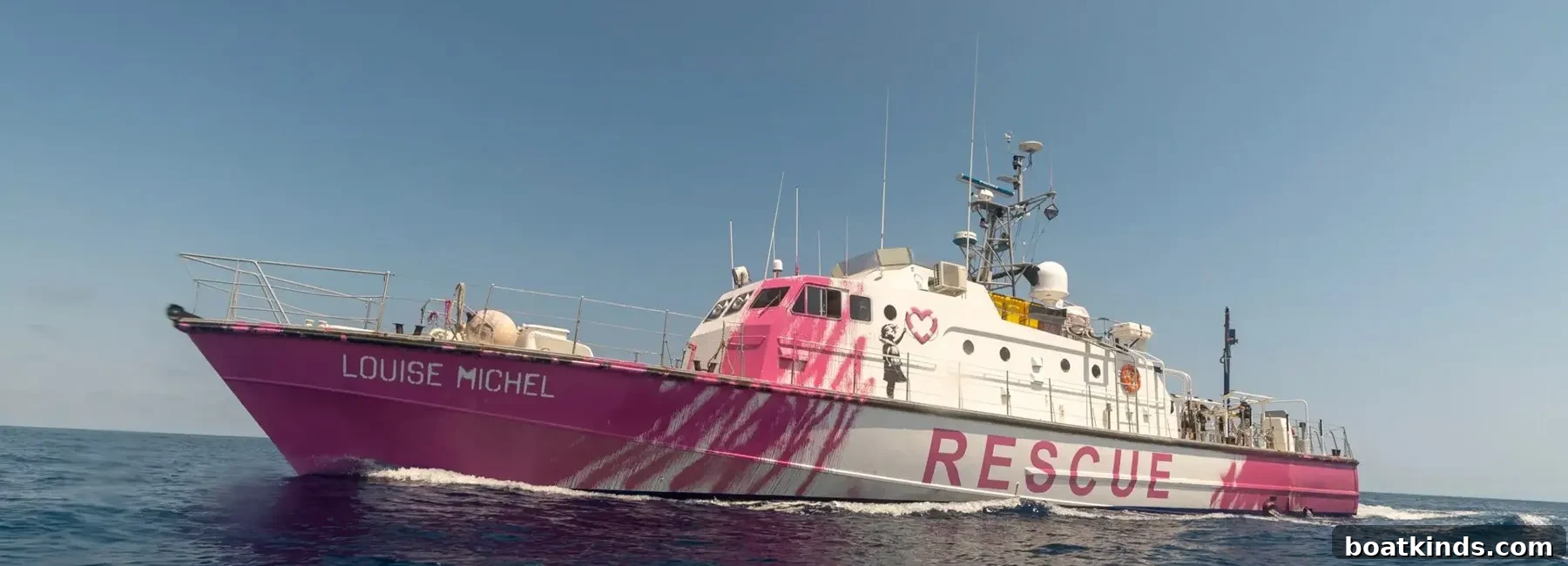
Banksy’s Pink Rescue Ship “Louise Michel” Heads to the Mediterranean to Aid Migrants
The enigmatic British street artist Banksy has taken a dramatic step from public murals into direct humanitarian action by acquiring a former French Navy vessel, repainting it bright pink, and sending it into the central Mediterranean to assist migrants and refugees attempting dangerous sea crossings from North Africa to Europe. The project has drawn widespread attention for its bold visual statement and its hands-on approach to lifesaving at sea.
The vessel, measuring 99 feet in length, was purchased with proceeds from the artist’s work and renamed Louise Michel, in reference to the nineteenth-century French anarchist. Capable of reaching speeds up to 28 knots, the boat has been described by the project as “as agile as she is pink,” emphasizing both its practicality and its deliberately provocative appearance. The ship’s striking color and name are intended to send a clear signal about its mission and the humanitarian values behind it.
Organizers of the Louise Michel project say the boat will operate under the principles of maritime law, with a stated aim to “uphold maritime law and rescue anyone in peril without prejudice.” That mission echoes themes common in Banksy’s work, which frequently explores social and political issues including conflict, institutional failure, and the plight of displaced people. By equipping a fast, visible rescue vessel, the initiative attempts to turn artistic provocation into concrete rescues at sea.
The Louise Michel set sail on August 18 for its initial deployment. On that first mission the vessel assisted in rescuing 89 people in distress. In subsequent operations, the ship helped rescue a further 250 people over a single weekend, showcasing the operational capacity and immediate humanitarian impact of the effort. These early missions underline both the need for search-and-rescue resources in the Mediterranean and the capability of relatively small, fast vessels to respond quickly to distress calls.
Context and Purpose
The central Mediterranean has long been a perilous route for migrants and refugees seeking safety and opportunity in Europe. Over the years, overcrowded and unseaworthy boats, unpredictable weather, and limited search-and-rescue coverage have combined to create repeated maritime disasters. Civil society groups and private initiatives have increasingly stepped in to fill gaps left by official search-and-rescue services, and the Louise Michel represents one of the more high-profile examples of that trend.
While the boat’s vivid pink paint and association with a well-known artist draw media attention, the core of the effort is operational: to locate people in distress, provide immediate medical and humanitarian assistance, and coordinate with authorities as required by maritime law. The project’s stated commitment to rescuing anyone in peril “without prejudice” highlights a focus on saving lives first, ahead of political or legal disputes about migration policy.
Public Reaction and Implications
Reactions to the Louise Michel have been mixed. Supporters praise the initiative for putting resources where they are needed and for using high-profile art to spotlight an ongoing humanitarian crisis. They point to the tangible results of early missions as a demonstration of how private efforts can deliver lifesaving assistance. Critics, meanwhile, raise concerns about legal and diplomatic complications, the role of non-governmental vessels in migration flows, and the broader political debate surrounding immigration and asylum policies.
Regardless of differing viewpoints, the Louise Michel has already influenced public conversation by connecting Banksy’s cultural influence with a concrete humanitarian intervention. The project underscores how artistic actions can extend beyond symbolism into practical, on-the-ground efforts to address human suffering.
Looking Ahead
As the Louise Michel continues its operations in the Mediterranean, its future missions will likely remain under close scrutiny from media, governments, and humanitarian observers. The ship’s early rescues demonstrate both the urgency of search-and-rescue needs in the region and the potential for unconventional actors to contribute to lifesaving efforts. Whether the vessel’s presence will inspire additional private initiatives, shape policy discussions, or prompt changes in how sea rescues are coordinated remains to be seen.
For now, the pink ship serves as a vivid reminder of the human stakes of migration across the Mediterranean: behind headlines and political debates are thousands of individual lives at risk, and the Louise Michel aims to answer that crisis with immediate action at sea.