
Linda Greenlaw: Sea Captain, Commercial Fisherman, and Bestselling Author
Linda Greenlaw’s introduction to commercial fishing began while she was an undergraduate at Colby College in Maine, where she earned a degree in English and government. Needing money for tuition, she took a job as a cook and deckhand on the swordfishing boat Walter Leeman. She discovered she not only enjoyed life at sea but was also talented at the work. After graduation she chose to make fishing her career, eventually becoming the first woman to captain a swordfishing boat on the East Coast and one of the industry’s most respected skippers.
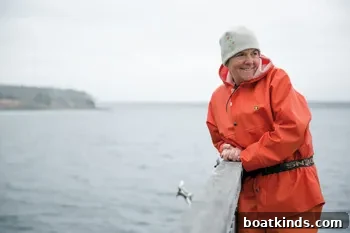
Greenlaw’s English degree proved invaluable. Her presence in Sebastian Junger’s account of the Andrea Gail disaster, The Perfect Storm, brought her broader public attention and opened the door to publishing. Her first book, The Hungry Ocean (1999), drew on her experiences at sea and spent three months on The New York Times bestseller list. She followed that success with The Lobster Chronicles (2002) and All Fishermen Are Liars (2004). While lobstering from Isle au Haut, Maine, Greenlaw collaborated with her mother, Martha Greenlaw, on two cookbooks—Recipes From A Very Small Island (2005) and The Maine Summers Cookbook (2011)—and wrote two mysteries, Slipknot (2007) and Fisherman’s Bend (2008).
In 2009 Greenlaw brought her expertise to television when she joined Swords, Discovery Channel’s reality series about commercial swordfishing. She continued publishing nonfiction titles such as Seaworthy (2010) and Lifesaving Lessons (2013), and she expanded her mystery series with additional installments, including Shiver Hitch.
Despite a busy writing career, Greenlaw consistently identifies first as a fisherman. Her love of the sea and the practical knowledge she demonstrates as a captain infuse her books, making her writing compelling for readers who love maritime life, commercial fishing, and coastal culture.
First memory of being on a boat: I was about five or six, sitting beside my father in the flybridge of our 42-foot sportfisher, searching for buoys in a fog. My dad was a skilled dead-reckoning navigator and could reliably find his way with a compass and a watch.
First boat you skippered: Gloria Dawn, a 68-foot Desco Marine set up for hook fishing. I ran her year-round to the Grand Banks of Newfoundland—long-lining for swordfish in summer and fall, and auto-lining for halibut, hake, cod, and other species in winter and spring.
Current boat: Earnest, a 41-foot Lowell-designed wooden lobster boat. I fish Earnest inshore from May through January 1 for lobster and halibut.
Favorite boat you’ve owned or skippered: It’s a tie between Hannah Boden, a 100-foot “lobster liner” that worked offshore lobster in winter and swordfish and tuna the rest of the year, and Hazel Browne, a 46-foot Wesmac. I skippered Hazel Browne for two seasons on the Gulf of Maine and Georges Bank for giant bluefin tuna. Coming from years on much larger ships, I was surprised by her seakeeping and performance—she is very much a “fishy” boat.
Your dream boat: A 46-foot Wesmac rigged for lobster, halibut, and tuna. Given that I am married to Steve Wessel, founder of Wesmac Custom Boats, I expect that dream is more realistic than it sounds. Customers come first, but I am on “the list.”
Most rewarding professional experience: The most gratifying part of a lifetime at sea has been watching commercial fishermen accept responsibility for the health of our oceans and fisheries. Many people and businesses made sacrifices under new regulations, and some left the industry. Those who persevered are now seeing healthier, rebounding stocks—a hopeful outcome for coastal communities and future generations of fishermen.
Scariest adventure aboard: I could joke about running out of coffee and cigarettes, but the most terrifying moment I remember is a winter storm with a full load of lobster traps on the Hannah Boden. A stack of about 500 traps shifted after we were hit by an odd, powerful wave, and the boat listed dramatically to starboard. The wind screamed and the seas grew so high that a 700-foot oil tanker riding out the same storm couldn’t distinguish my 100-foot steel vessel on radar. It was a long, frightening night filled with prayers and promises. Gordon Lightfoot captured that feeling well: “Does anyone know where the love of God goes when the waves turn minutes to hours?”
Your most memorable experience aboard: It’s either the day we landed 115 swordfish on the Hannah Boden or the first two-bluefin-tuna day I had on the Hazel Browne—both unforgettable in different ways.
Longest time you’ve spent aboard: The 47-day halibut season in 1992, which I often call a disaster. But that kind of long haul reflects the optimism that keeps fishermen going: you always expect the next haul to be the big one.
Favorite destination so far: 45°N, 45°W—the Grand Banks off Newfoundland.
Favorite nautical book: Two Years Before the Mast by Richard Henry Dana.
Favorite nautical cause you support and why: The Gulf of Maine Research Institute is my primary nautical cause. Their work focuses on education, stewardship, coastal communities, tradition, heritage, and sustainable opportunity—values that resonate deeply with commercial fishermen and coastal residents.
Favorite quote about the sea: “I don’t care how big your vessel is, at the hands of Mother Nature, they all get small.” — L.G.
This article originally appeared in the May 2016 issue.