Back Cove Downeast 37: Five-Day Review and Cruise Report
My family and I spent five days and four nights aboard Back Cove’s new Downeast 37, cruising from Portland, Maine, to Newport, Rhode Island, with stops in Kennebunkport, North Weymouth, Plymouth and Falmouth, Massachusetts. This extended cruise gave us a deeper understanding of the boat’s capabilities and behavior at sea than a typical half-day test could.
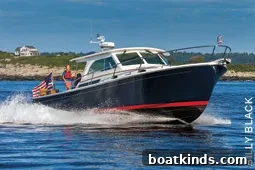
The Downeast 37 is a modern reinterpretation of Back Cove’s original 37, sharing the same hull but featuring a larger, flush cockpit and a smaller pilothouse and cabin. Generator and battery locations have been shifted aft to balance the redesigned deckhouse. With proportions reminiscent of classic New England sedans and charter boats, the Downeast 37 blends attractive lines with practical seaworthiness.
Construction
Back Cove employs vacuum-infused vinylester construction for consistent resin-to-glass ratio and strong skin-to-core bonds. The hull sides are solid fiberglass to reduce print-through, while the bottom uses Core-Cell foam cored panels for stiffness, impact resistance, quieter operation and thermal insulation. The forward bottom is cored with thicker foam, permitting a lower cabin sole and favorable profile or increased headroom depending on the viewpoint.
Interior finishes rely on molded fiberglass liners with fabric panels and tasteful wood trim. This approach yields an attractive, easy-to-maintain cabin and pilothouse that avoids the complexity and cost of fully ornate wood interiors.
Hull Form
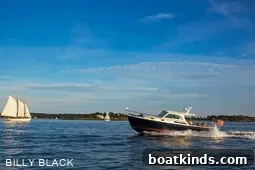
The Downeast 37’s hull departs from the traditional lobster-boat full keel. Instead, it uses a hard-chine modified-vee bottom with deadrise aft to provide directional stability and reduced drag at planing speeds. The chines and spray-control features keep the hull drier and more efficient while helping it heel into turns for safer handling. This hull form is well suited to the boat’s 16-plus-knot cruise range. On our trip it proved to be a highly capable sea boat, though a few spray-strake refinements could make it even drier.
Cabin
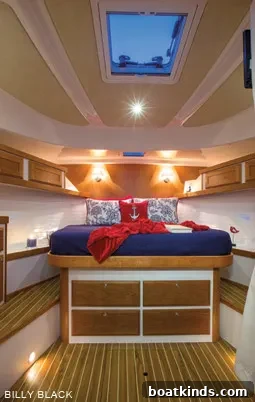
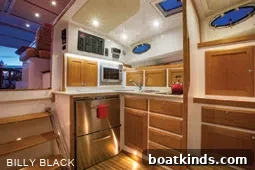
The cabin accommodates two on a forward island berth and features a separate head with shower to starboard. Opposite the head is a practical galley with a large counter, microwave, drawer-style freezer and refrigerator. Sunlight and ventilation come through one large and two smaller overhead hatches plus side ports. With 78 inches of headroom at the companionway and even more forward, the cabin feels roomy and comfortable for its class.
Pilothouse
Steps and a handrail lead up from the cabin to a pilothouse that opens to the cockpit, reflecting the Downeast 37’s role as an entertaining dayboat. To port is a convertible seating module that faces forward or aft and a dinette with a table that converts to a double berth. The forward seat lifts to reveal significant storage beneath the helm.
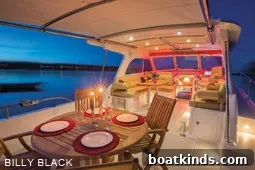
The helm sits to starboard with room for one or two large electronics displays mounted on an angled dash at eye level for clear sightlines. Large windows with slim mullions provide excellent visibility; ventilation is aided by an opening center windshield, sliding overhead hatch and side windows. I would recommend a non-glare finish on the dash to reduce windshield reflection.
Engine Room
A large hatch aft of the pilothouse gives access to a spacious engine room. The single-engine layout—with an optional 600-hp Cummins 8.3-liter diesel on our test boat—creates generous service space. Components such as the fuel filter, raw-water strainer and seacock are easy to reach, and wiring and plumbing run neatly in protected chases. The design uses a pair of hull stringers as engine beds, producing a lightweight, efficient longitudinal structure that contributes to the boat’s ability to plane at modest speeds.
Cockpit
The long, flush cockpit is contiguous with the pilothouse deck, removing steps and increasing usable space and below-deck storage. Back Cove compensated for the lower aft gunwale by installing a sturdy railing about 29 inches above deck. A centerline transom door opens to a full-beam swim platform, and a powered SureShade extends to protect most of the cockpit from sun or rain.
Lazarette
A large lazarette aft of the engine room provides abundant storage. Our boat stored a teak table and four chairs behind the fuel tank along with fenders and lines. The Kohler diesel generator sits in a sound shield to port, and the battery bank is covered for protection. The rudder installation appears robust, designed so the rudder stock would likely bend before damaging the hull in the event of a severe grounding.
The Downeast 37 carries a 316-gallon cross-linked polyethylene fuel tank in the lazarette, with all four tanks on board made of poly for corrosion resistance and clear visual level checks. I appreciated being able to visually confirm fuel levels at day’s end rather than relying solely on gauges. Equipment in the lazarette—stern thruster, genset, seacocks and strainer—is laid out for easy access, encouraging routine maintenance.
Foredeck
Wide molded cockpit steps and broad side decks make forward access safe and comfortable. The 25-inch stainless bow rail is solidly mounted on blind-bolted stanchions; I would prefer 30-inch rails set slightly inboard to improve security and reduce exposure to piling impacts. Still, topside ergonomics emphasize safety and functionality over purely stylistic choices.
Sea Handling and Test Ride
Our five-day cruise provided a rigorous test of the Downeast 37 in New England fall conditions, with winds mostly 10–20 knots and seas up to 4 feet, occasionally higher. The boat’s moderately fine entry and hull design produced a smooth ride in head seas, attenuating wave impacts and delivering a lower-G experience that passengers, including my non–rough-water-loving wife and two small children, found comfortable at 17–18 knots.
The test boat was equipped with Lenco Auto Glide trim tabs that automatically adjust during plane-up and then raise at higher speeds. For running downsea I turned the auto feature off to increase trim for improved course keeping. The boat tracks well due to its hull form; however, a quicker steering ratio and larger rudder would enhance responsiveness. Manual hydraulic steering on our boat had six turns lock-to-lock—typical of many inboards but less crisp than a three-turn system with power assist.
Acceleration was strong, with plane achieved in seconds and a plane threshold near 11–12 knots with minimal bow rise. We cruised comfortably between 18 and 21 knots, recording just over 29 knots at wide-open throttle. Noise at the helm during cruise registered in the high 70s to low 80s dBA—acceptable for an inboard of this type—while fuel efficiency was notable: about 1.4 nmi/gal at 13 knots and 1.2 nmi/gal at 21 knots.

The single-diesel layout delivers practical advantages: simpler maintenance, lighter weight, efficient planing behavior and excellent fuel economy across common cruising speeds. The Downeast 37 handled more comfortably into the sea than many comparable boats with blunter lines and broader beams, and it overtook several larger sportfishing convertibles during our trip.
Precision Control and Docking
With a single prop and rudder coupled to proportional Side-Power bow and stern thrusters, the Downeast 37 proved exceptionally easy to control in close quarters. The thrusters apply lateral thrust both forward and aft, giving authoritative, precise maneuvers and enabling tight turns, quick pivots and secure holds at the dock. During a tight-turn demonstration in Menemsha Creek, we completed a turn in just over a boat length by backing and filling while using opposite thruster action—an impressive display of control and responsiveness.
Conclusions
Measured against its mission and direct competitors, the Back Cove Downeast 37 is superbly built and well engineered: practical, safe, attractive and genuinely seakindly. It’s an ideal family dayboat that can comfortably and efficiently travel 100+ mile passages in a day while using relatively little fuel. The single-engine layout simplifies maintenance and contributes to a balanced, efficient hull form.
Minor improvements I would suggest include a quicker steering ratio, subtle helm ergonomics updates, a non-glare dash finish and modest refinements to chines and spray strakes for an even drier ride. Overall, however, the Downeast 37 offers exceptional value for anyone seeking a capable, comfortable and easy-to-handle coastal cruiser.
Contact Back Cove Yachts, Rockland, Maine, (207) 594-8821.
Originally published in the December 2013 issue.