
Flags and pennants snapped in a steady southerly breeze as the whaleship Charles W. Morgan stood proudly dressed out at Chubb’s Wharf at the Mystic Seaport Museum in the 1950s. The photograph captures a moment of ceremonial display for a working whaler that had been transformed into a museum centerpiece, its rigging and spars trimmed in celebration and memory.
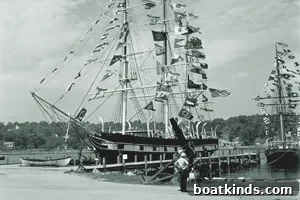
Built in New Bedford, Massachusetts, the Charles W. Morgan arrived at Mystic, Connecticut, in 1941 to begin a new life. No longer a ship of commerce and industry, she was “launched” into a second career as a vessel preserved for public education, research, and commemoration. Over the decades that followed, the Morgan came to symbolize an important chapter of American maritime history. Designated a National Historic Landmark, she helped establish Mystic Seaport’s reputation as one of the country’s foremost maritime museums.
The Morgan’s survival was far from assured. After completing 37 voyages and earning roughly $1 million during her active service, the whaler was retired in 1921. The ship was already eight decades old and purpose-built for an industry that had largely vanished. Left tied at a New Bedford wharf, the Morgan drifted through a precarious period. For a time she found roles in motion pictures — including the 1922 feature Down to the Sea in Ships, which provided one of her more unusual occupations and an early screen appearance for Clara Bow — but such engagements were no substitute for a permanent future.
The vessel endured misfortune. In 1924 a burning steamer drifted into the Morgan and set her aflame, causing significant damage. Years later, the New England Hurricane of 1938 inflicted severe harm, leaving the ship vulnerable and, for a time, threatened with demolition. It was during this precarious interval that the founders of Mystic Seaport Museum stepped in. They arranged for the Morgan to be towed by tug from New Bedford up the Mystic River and secured at Chubb’s Wharf, the same historic waterfront where whaling vessels had tied up generations earlier. That intervention preserved the ship and marked the start of her role as an educational artifact and cultural icon.
By the time this piece was written, the Charles W. Morgan was noted as being 168 years old and in need of careful conservation. Recognizing both her historic importance and the challenges of preserving wooden vessels, the museum launched an extensive restoration program. A three-year, $5 million conservation effort began at Mystic Seaport’s Henry B. DuPont Preservation Shipyard with the twin goals of shoring up the hull below the waterline to the turn of the bilge and stabilizing the ship’s overall structure. Such work preserves not only the vessel’s physical fabric but also the tangible connections to the labor, technology, and seafaring culture of the whaling era.
The photograph of the Morgan in celebratory dress comes from the museum’s extensive image collection and was made by Carleton Mitchell, the noted yachtsman and photographer. Images like this one document both the ship’s long life and the evolving efforts to preserve her. They also offer modern viewers a window into a bygone maritime world: the rigging, hull lines, and seafaring gear that reflected a working ship’s form and function.
Preserving a ship such as the Charles W. Morgan does more than save timber and iron; it sustains a place where visitors can encounter history directly. As a museum vessel, the Morgan has served as an educational platform for students, historians, and the public, helping to tell the complex story of 19th-century American whaling — its economic importance, its human dimensions, and its environmental and cultural impacts. The restoration and ongoing care carried out at Mystic Seaport ensure that future generations will be able to see and learn from a rare surviving example of that maritime heritage.
This article originally appeared in the March 2009 issue.