
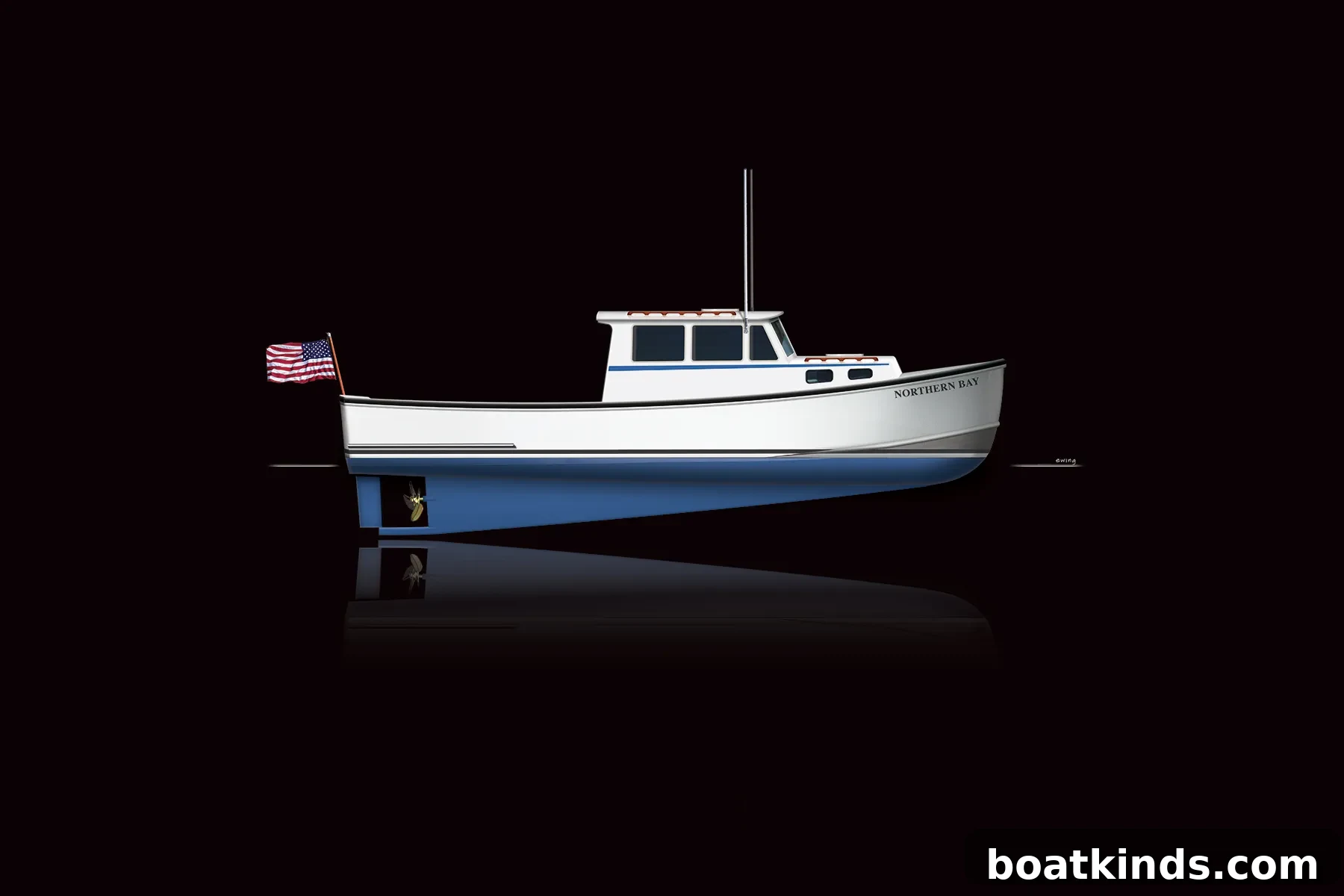
Northern Bay 36: A Practical, Comfortable Lobster Boat Designed for Performance
When John Hutchins launched Downeast Boats and Composites in Penobscot, Maine in the early 1990s, one of his first projects was the creation of hull and deck molds for a 36-foot lobster boat drawn by noted designer Spencer Lincoln. The resulting Northern Bay 36 struck a careful balance between commercial practicality and seagoing comfort—qualities that helped make it a popular choice among working fishermen and recreational owners alike.
Spencer Lincoln’s lines for the Northern Bay 36 display the hallmarks of a well-thought-out commercial hull. Upfront she has a springy sheer and a fine entry at the stem to cut through head seas smoothly. The keel is deep where it matters—starting from a modest forefoot and progressing into a full keel aft—to protect the propeller and rudder while preserving tracking and directional stability. Rounded chines were incorporated to produce an easy, rolling motion that is forgiving for crews working traps and lines.
What sets the Northern Bay 36 apart from many traditional lobster boats is the way deadrise is handled through the hull. Rather than carrying a sharp deadrise continuously to the transom, the design transitions quickly from a sharper deadrise at the bow to flatter sections amidships and then to long, nearly flat buttocks aft. That geometry reduces resistance at displacement speeds, improving fuel economy and creating a broad lifting surface aft that enables the boat to reach semi-planing speeds when desired. The combination of a comfortable ride, lower drag, and the ability to accelerate beyond pure displacement speed made the design attractive for a range of applications.
Hutchins built and sold 135 Northern Bay 36 hulls and introduced additional models as his yard expanded. Early advertisements marketed the 36 with a 220-hp John Deere diesel and quoted a $73,000 base price, reflecting its role as a capable, no-nonsense commercial platform. The boats were often delivered as hull-and-deck kits so other builders could complete the interior fit-out and systems installation to suit individual needs. Construction methods varied: some hulls were solid fiberglass, while others were cored with end-grain balsa to save weight without compromising stiffness.
In 2005 Hutchins sold the Northern Bay 36 molds to Stacey Raymond of General Marine in Biddeford, Maine. Raymond, familiar with Lincoln’s work and the design’s reputation, continued to offer the model with a wide range of propulsion options—from practical, workboat-level powerplants around 300 hp to extreme high-performance installations up to 1,200 hp. With a mid-range example—a 500-hp Cummins 8.3L diesel—the Northern Bay 36 is reported to cruise at roughly 20 to 22 knots, consuming about 1.5 to 1.8 gallons per mile, and to reach a top speed near 27 knots. For owners seeking very high speeds, installations such as a Caterpillar C18 could push the boat into the mid- to high-50-knot range, depending on prop selection and overall displacement.
Raymond has been careful to preserve the hull lines that define the Northern Bay 36, insisting he will not alter Lincoln’s underwater geometry out of respect for the original design’s balance of ride and performance. He did, however, make a practical accommodation for modern owners by raising the deckhouse on General Marine’s versions to increase interior headroom—improving liveability without changing the hull’s hydrodynamic character.
The Northern Bay 36’s longevity and appeal stem from its clear design priorities: a stable and comfortable motion for working conditions, efficient cruising at displacement speeds, and the ability to accelerate when needed. Those features made it a natural fit for lobstering and other commercial uses, and they also attracted recreational buyers who valued a solid, seaworthy Downeast-style boat that could perform reliably with a variety of engine choices.
Across its production run and subsequent iterations, the Northern Bay 36 demonstrates how intelligent hull design and straightforward construction can produce a vessel that serves multiple roles—commercial workboat, comfortable cruiser, and capable performance hull—while remaining faithful to the practical needs of its owners and operators.
This article was originally published in the October 2023 issue.