
Choosing the Right Open Powerboat: A Practical Guide
Feel the wind on your face and the salt air in your lungs. Hear water sliding along the hull and watch gulls dive for a meal. Those immediate sensory connections—sight, sound and scent—are a big part of why so many boaters prefer open powerboats. With fewer enclosed structures than boats with pilothouses or enclosed bridges, open boats put you closer to the elements and the full pleasure of being on the water.
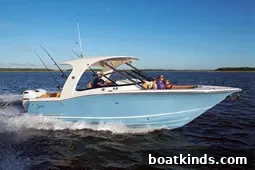
Open boats also make socializing easier. Modern buyers, often short on free time, want boats that let them share the experience with family and friends. Builders have responded by fitting more comfortable seating into smaller footprints, and many seats now serve dual purposes, offering convenient storage beneath.
“Buyers are much more interested in multi-utility functions and [boats] they can do a lot of stuff with,” says Scott Deal, president and CEO of Maverick Boat Co., which builds several well-known brands. “They want to be able to use their boat every day, regardless of the mission. They may want a family day one time and a fishing trip the next. Multiple use—that’s what it’s all about.”
Understanding the main open-boat categories simplifies the selection process. The most popular styles are center consoles, dual consoles and bowriders, and each has its own subtypes. Center consoles include fish-and-cruise designs, flats boats, inshore/offshore hybrids and bay boats, with sizes commonly ranging from about 15 to 45 feet. These boats are often optimized for fishing and open-water handling while remaining versatile for family outings.
Dual consoles offer a spectrum of layouts: some have a fully enclosed bow and continuous windshield like traditional runabouts, while others feature a split windshield with a passageway leading to bow seating. These models have grown in size—approaching 40 feet in some cases, as seen in Grady White’s Freedom 375—making them attractive for families who want a mix of comfort, protection and functionality.
Jeff Vaughn, vice president of sales, marketing and customer service at Boston Whaler, summarizes the distinction: “Many of the people buying dual-console boats are looking for a multitasking boat. Our center-console boats are fishing boats that are very comfortable for recreational boaters, while our Vantage [dual console] boats are recreational boats that are very fishable.” That succinctly captures how manufacturers are tailoring layouts to multiple uses.
Bowriders tend to emphasize sporty performance. Many reach speeds near 60 mph and carry a sleeker, sport-boat appearance that makes them popular for lake use and water sports. Larger bowriders now extend to roughly 35 feet; for example, Sea Ray introduced a 350 SLX capable of seating up to 18 passengers. A bowrider is a smart choice if your main activities include towing skiers, tubing or fast-day cruising.
Before you buy, clearly define how and where you’ll use the boat, how often you’ll go out, and how many people will typically be aboard. If your plans include fishing in skinny water one weekend and offshore trips the next, consider hybrid center consoles. If the primary goal is wake sports for kids and family, a bowrider is likely the best fit. For relaxed cruising—afternoon harbor runs or drinks with friends—deckboats and pontoon boats offer generous space and stability. Note that modern pontoon designs have improved hull shapes that allow respectable speed and even the ability to tow a skier.
Open boats are generally lighter than vessels with substantial superstructures, which often makes them more fuel-efficient and easier to tow. Propulsion choices have expanded, too. Four-stroke outboards have surged in popularity because they are typically less costly and easier to service than sterndrives. Even traditional sterndrive-powered sportboats are being offered with outboard options; Baja, for example, recently introduced a 26 Outlaw equipped with twin 300-hp outboards.
Outboard power has grown significantly—production outboards now reach up to about 350 hp—enabling builders to produce large offshore-capable center consoles approaching 45 feet. At the same time, sterndrives still deliver strong performance and can propel big bowriders to high speeds, making propulsion choice a matter of intended use, maintenance preference and budget.
Finally, take your time choosing. “Too many people rush into their decision, and when they start using their new boat they find out it’s really not what they wanted,” Vaughn warns. Think through typical missions, test-drive different layouts and propulsion setups, and weigh operating costs. Do the homework up front and you’ll increase the odds of many enjoyable years on the water.
January 2014 issue