
“I’m a bloke. I just took it out of the box and attached it to my life jacket,” says Andrew Taylor, recalling the moment before he was swept overboard during the 2013–14 Clipper Round the World Race. Taylor, now 47 and a London sporting events caterer, nearly died after a wave washed him into freezing North Pacific waters. “I didn’t read the instructions,” he adds.

Taylor survived roughly 100 minutes in 52°F (about 11°C) water. He became hypothermic, experienced hallucinations, and was likely close to death when the crew of the 72-foot Yacht London-Derry Doire pulled him back aboard. He was wearing a McMurdo Smartfind S10 AIS man-overboard beacon clipped to his life jacket, but because he hadn’t correctly activated it, the internal GPS never locked on. Had it been turned on properly, the beacon would have transmitted his precise GPS position to the yacht’s chartplotter and broadcast his location every two seconds to any AIS-equipped vessel within range.
“I hadn’t tested it. I hadn’t trained with it,” Taylor admits. “I should have read the instructions.”
The incident occurred around midday on March 30 while London-Derry was racing across the Pacific from Qingdao, China, to San Francisco. Taylor and skipper Sean McCarter were at the bow, changing headsails in 35-knot winds and 15- to 20-foot seas. They were having trouble unhanking the sail; Taylor knelt to unclip from the jackline to fetch pliers below.
As he unhooked, another crewman offered to help. “I stood up, and we got hit by an enormous wave,” Taylor says. The boat rolled hard, and when it came upright he was no longer on deck. He was thrown across the stubborn headsail and over the rail into the ocean, some 3,000 miles from land.
“It happened so fast,” he says. “There was no loss of balance, no chance to steady myself or grab anything. One second I was on deck, the next I was in the water.”
A rudder passed over his legs, spun him and pulled him under. “The pain was excruciating,” Taylor recalls. His life jacket inflated and his dry suit provided crucial insulation against the cold. He removed the AIS beacon from its pouch, noticed an arrow on the orange knob, pulled a cotter pin and twisted the knob. The beacon began to flash, but he likely turned it the wrong way and triggered a battery test instead of activating the GPS lock. As a result, the device did not transmit his position to London-Derry or other AIS-equipped vessels.
Aboard London-Derry, McCarter immediately called “man overboard,” hit the MOB button on the chartplotter to mark the location and initiated a practiced recovery routine: drop sails, start the engine, come about to return to the recorded MOB position, and post a lookout on the first spreader. As the crew scrambled into action, Taylor drifted away, carried by a current he would later learn was about four knots. After roughly 200 meters the crew lost visual contact. With no update from a functioning AIS beacon, the search intensified.
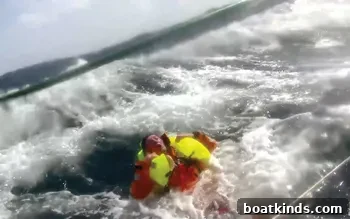
Taylor watched the boat vanish over the swell, convinced it would come back immediately. The next 100 minutes were brutal. He suffered intense pain in his legs and drifted in and out of consciousness as hypothermia set in. He lost all sense of time and clung to memories and thoughts to stay focused—friends and family, his mother and his daughter Siobhan. Realizing it was his mother’s birthday gave him the determination to survive: “I wasn’t going to die on my mum’s birthday,” he says.
As his body temperature fell, he passed through stages of hypothermia: the uncontrollable shivering faded, a dangerous numbness followed, and he began to hallucinate and feel strangely euphoric. For a time he even accepted the idea of letting go, but a rising awareness that this was a perilous state forced him back to fighting to live.
Storm clouds gathered and winds gusted to 50 knots; rain and hail stung his face. After about ten minutes the weather eased and he caught fleeting glimpses of London-Derry’s mast. He heard calls and saw a crewman aloft searching, which confirmed the crew hadn’t given up. Still, Taylor could not understand why he wasn’t showing up on their screens. “Everyone knows I have AIS. I should be up on their screen. They should know where I am,” he thought.
In a desperate attempt to fix the beacon, Taylor toggled it off and on. This time he manipulated the orange knob correctly and the device locked to GPS and began transmitting. McMurdo’s procedure for the Smartfind S10 requires pulling the safety pin, pulling and turning the orange knob clockwise, and releasing it to lock on to GPS; turning the knob the opposite way performs a test and springs back to its original position.

When Taylor’s position finally appeared on the chartplotter, London-Derry shifted from a broad search to an immediate recovery. He remembers hearing the boat bearing down through a wave and fearing it would run him down. Crewman Jason Middleton, clipped to a halyard for safety, entered the water and made contact. They wrapped their arms around each other while Middleton tried to pass a rescue strap; the first attempt failed and the boat had to circle for a second and then a third pass before the strap held and they were able to haul Taylor aboard.
“It’s a noise I’ll never forget,” Taylor says of being lifted back onto the deck. Once aboard, he drifted in and out of consciousness for four hours while the boat’s medic treated him for severe hypothermia. The crew rotated him in and out of dry sleeping bags and used warm water bottles to slowly raise his body temperature and manage shock. His legs, bruised and battered by the rudder and the sea, were not broken, and he eventually recovered enough to complete the race.
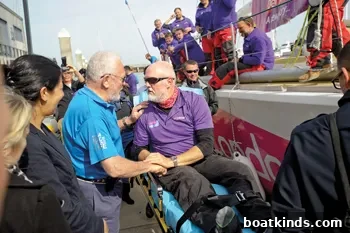
Taylor believes he was extremely fortunate. Several factors combined to save him: a functioning life jacket, the insulating dry suit, the eventual activation of his AIS beacon, and a trained crew carrying out practiced man-overboard procedures. The experience left him with a clear lesson: always test safety equipment and read the instructions before you head offshore.
This article originally appeared in the August 2015 issue.