
For a lifelong Star sailor, building the boats used by Olympic medalists felt nearly as rewarding as winning a medal himself. Jon VanderMolen of Richland, Michigan, a boatbuilder and devoted Star class sailor, constructed the Star boats for all three medalists in the class at the London Games.
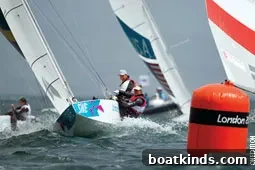
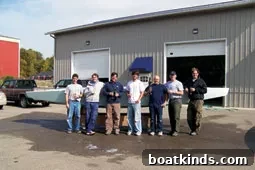
“We built 13 of the 16 Star boats that competed, and 11 of the top 12 finishers,” VanderMolen says. His shop, the North American Sailing Center, builds the PStar—designed by German Olympian and boatbuilder Marc Pickel—and has become a prominent name in high-performance Star class construction.
There are only four Star builders worldwide: Folli and Lillia in Italy; Mader Bootswerf in Germany; and VanderMolen’s North American Sailing Center in the United States. The “P” in PStar honors Marc Pickel, who collaborated with VanderMolen to produce the current design and production process.
Design and research behind the PStar
VanderMolen credits the PStar’s competitive performance to careful design and advanced construction techniques. In 2002 Pickel worked with the Yacht Research Unit in Kiel, Germany, to study hull shapes and underwater appendages for the Star class. Although Star is a one-design class, the measurement rules permit slight tolerances at various stations—a legacy of early wooden construction—so precise refinements can yield performance advantages.
Pickel’s team tested some 50 variations, adjusting dimensions by millimeters to find the most efficient geometry. They settled on a hull with a longer waterline and reduced volume that lets the boat sit lower in the water. On Olympic windward-leeward courses, boats with long waterlines typically perform better on leeward legs, a characteristic VanderMolen says explains part of the PStar’s speed.

Pickel built the first five PStars in Kiel before the 2008 Beijing Olympics, where he finished seventh. In 2009 he partnered with VanderMolen, and production moved to Richland—an arrangement that also benefited exports at the time due to currency factors.
600 hours per PStar
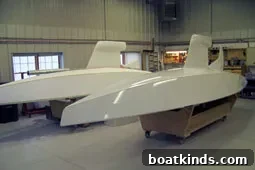
Production techniques set the PStar apart. VanderMolen explains that his shop is the only Star builder using prepreg fiberglass—fibers pre-impregnated with epoxy resin—along with vacuum-bagging and Core-Cell foam cores sandwiched between unidirectional S-glass and E-glass. This approach produces a lighter, stiffer hull built to tight tolerances.
While many components are standardized, the PStar offers semi-custom options: different rigging packages, custom layouts to suit a skipper’s preferences, and refined keel designs. Building a single PStar requires roughly 600 man-hours with a three-person team. That labor intensity and the higher-end materials explain why a PStar retails for about $85,000, compared with roughly $55,000 for a comparable Italian-built Star.
VanderMolen says the investment in advanced composites and production methods has paid off in results: recent world and European championships were won by crews sailing PStars. He believes other builders will need to adopt similar technologies to remain competitive.
Not all top sailors are unequivocal about the advantage. U.S. Olympic Star sailor Mark Mendelblatt, who sailed a Folli at Weymouth during the 2012 Games, initially wanted a PStar but could not secure one on VanderMolen’s schedule. When another PStar became available, he had already found speed and comfort in a new Italian-built Folli and stayed with it at the Olympics.
Mendelblatt says the Folli gave him an edge in lighter-air conditions and strong upwind speed, while the PStar was marginally faster downwind when surfing. In his view, results at the Olympics came down to who sailed the better regatta rather than boat selection alone.
Out of the Olympics
Despite building boats that performed at the highest level, VanderMolen faces uncertainty as the Star class was removed from Olympic competition. The Star has been an Olympic keelboat since 1932 and remains one of the most storied classes in sailing, raced by legends such as Torben Grael, Robert Scheidt, Iain Percy, Dennis Conner, and Mark Reynolds.
The International Sailing Federation made changes to the Olympic sailing program for the 2016 Rio Games that favored newer, more spectator-friendly disciplines. Kiteboarding, which draws crowds to the shore and features aerial maneuvers, and other modern classes were selected in place of some traditional keelboat events. VanderMolen says this shift reflects broader goals to increase television appeal and attract younger audiences, but it came as a shock to many in the Star community.
VanderMolen points out practical reasons cited by decision-makers: sailing events that are less costly and easier for developing nations to enter can boost global participation. Kiteboarding rigs are far less expensive than a high-end Star, and the sport offers instant visual appeal. Still, VanderMolen believes the Star’s Olympic status is not necessarily irrevocable. Brazil has a strong Star tradition and has produced world-class sailors; he says efforts continue to lobby for the class’s return.
Even if the Star does not return to the Olympic roster, VanderMolen expects the class to remain healthy. With roughly 2,200 members worldwide and active fleets in many countries, Star racing retains fierce international competition. Winning a Star world championship remains one of the most coveted achievements in sailing, and the class continues to draw top talent.
Business following the London Games
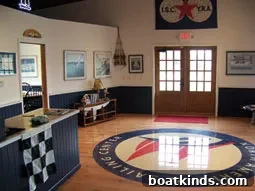
Following the London Games, VanderMolen reports he received about 15 inquiries for new PStars, most from European sailors who still view the boat as a premier racing option. He says he needs around five firm orders to justify another production run.
VanderMolen is also expanding into other one-design boats. He bought molds for the single-handed, deep-keel 2.4mR—a boat sailed in Paralympic and open international competition—and plans to market it to both disabled and able-bodied sailors. He believes the 2.4mR has broader appeal and estimates potential production of 30 to 50 boats per year if demand meets expectations.
VanderMolen’s success building high-performance Stars has raised his profile internationally, but the future of his business will depend on how the class evolves outside the Olympic program and how well his shop can adapt to demand for other one-design boats.
November 2012 issue.