
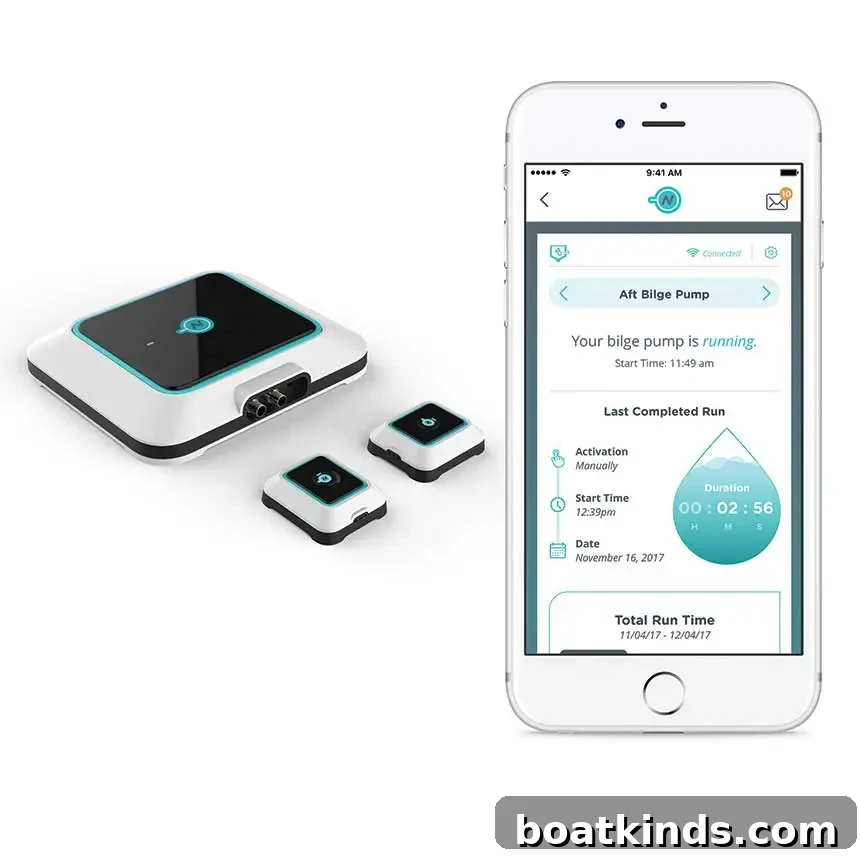
At boat shows this fall you’ll see a flood of monitors, connected devices and “smart” marine products built to make boating safer and more convenient. These systems—part of the Internet of Things (IoT)—are designed to give owners early warning of problems, reduce surprise failures and in some cases take automated corrective action.
Dan Harper, CEO of Siren Marine in Newport, Rhode Island, explains the evolving landscape in three practical tiers: basic boat monitoring, connected boat products and true “smart” boat systems. Understanding the differences helps boat owners choose the right mix of technology for their needs and budgets.
The first tier is the boat monitor. These proven devices track critical equipment—batteries, bilge pumps, fuel levels and location—and send alerts when readings fall outside user-defined limits. Common examples include Boat Command, FloatHub and the Boat Fix monitor. Boat monitors are primarily focused on status reporting and alarm delivery by text, email or push notification, making them an excellent first step for owners who want reliable remote visibility without complex automation.
The second tier includes connected boat products that expand monitoring to more systems and integrate with on-board networks such as NMEA 2000 and digital switching. These connected systems bring additional telemetry into a unified view and enable coordinated status checks across engines, chargers, tank sensors and other components. Products in this category mentioned by Harper include Siren Marine’s MTC, GOST’s Apparition and Navico’s Naviop. Connected systems are ideal when you want broader diagnostic detail and centralized control of multiple subsystems.
The third tier is the “smart” boat. Smart systems use data gathered by monitors and connected devices to perform automated actions or enable remote control decisions. These solutions link previously separate devices through IoT logic so the system can respond autonomously to changing conditions. While still emerging aboard many vessels, true smart boat products can, for example, take corrective steps when shore power fails or a battery bank drops below critical levels.
To illustrate the practical difference between tiers: if shore power fails, a basic boat monitor will detect dropping battery voltage and alert you via text or email. A connected system will likely also report the loss of shore power, monitor charging behavior and provide additional context such as which battery bank is affected. A smart system goes further—it can evaluate shore power status, battery charge, fuel level and generator readiness, then start the generator to recharge batteries and shut it down when appropriate. That automated response prevents large battery discharges and reduces the need for human intervention.
For day-to-day comfort and prevention, smart systems also offer useful automation. For instance, if you plan to leave your boat for several weeks, humidity and temperature become major concerns to avoid mold and mildew. With multiple temperature and humidity sensors on an NMEA 2000 network, a smart control system could automatically adjust air-conditioning or ventilation to maintain optimal conditions while minimizing energy use—much more sophisticated than manual guessing or fixed timer settings.
Manufacturers are approaching the market in different ways. Brunswick Corp., parent to brands such as Sea Ray and Boston Whaler and owner of Mercury Marine, promotes Nautic-On as a step into smart boating. Nautic-On uses Mercury’s SmartCraft protocol to monitor engines and focuses on batteries, bilge pumps and other key systems, often partnering with builders to equip new boats and alert dealers or service providers when issues occur. That dealer-notification model aims to streamline service so problems discovered over a weekend can be addressed quickly by Monday.
Boat Fix takes an alternative approach that mixes technology with human support. Its monitor covers batteries, bilges, location, engine hours and theft sensors, but for critical alerts it also places phone calls to owners and designated contacts. Additionally, Boat Fix provides access to mechanics by phone 24/7; the company reports that a large share of those calls are resolved during the call. CEO Alastair Crawford says 63 percent of calls to mechanics end with the problem fixed remotely, underscoring the value of combining automated alerts with expert human assistance.
Looking ahead, expect faster progress as more systems migrate to NMEA 2000 or IP-based connections. As integration deepens, owners will move beyond basic monitoring and alerts into smarter, automated systems that reduce maintenance overhead, improve safety and protect vessel value. The growing IoT ecosystem for boats promises better diagnostics, predictive alerts and increasingly useful automation—sooner than many expect.
This article originally appeared in the August 2019 issue.