
Eastport 32 OBX: A Chesapeake Deadrise with Carolina Sportfish Underbody, Now Available with Outboards
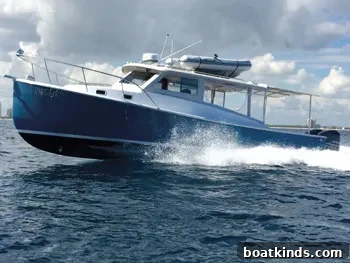
The Eastport 32 is immediately recognizable on the water—its classic Chesapeake deadrise profile above a Carolina sportfish underbody gives the boat a distinctive blend of tradition and performance. Until recently, every Eastport 32 left the factory with twin inboard diesels. Company principals Tom Weaver and Mick Price, both naval architects and co-owners of Eastport Yacht Co., have introduced an outboard-powered variant, the Eastport 32 OBX, expanding the model’s appeal and versatility.
On the OBX, twin 250-hp four-stroke outboards are mounted on an Armstrong bracket. Removing the inboard engine boxes opens up the cockpit and creates substantially more usable space. “We can get very creative with all the room,” says Price. The yard offers a standard layout, but buyers can customize the cockpit arrangement—options range from a four-person dinette to an unconventional passenger-ferry configuration with seating for 16 plus luggage, reflecting the boat’s flexible platform.
Weaver highlights the impression the enlarged cockpit makes: “Standing in the cockpit, the boat feels like a 40-footer.” The open deck and reconfigured transom area give the 32 OBX a much larger feel compared with the inboard version, while retaining the handling characteristics and seaworthiness that define the Eastport line.
Performance and range are among the OBX’s most notable benefits. The outboard variant carries 300 gallons of fuel, substantially more than the inboard’s 170 gallons, and it reaches higher top speeds—40 knots at wide open throttle versus 32 knots for the comparable pair of 260-hp diesels. Weaver notes the OBX also runs about 8 knots faster at WOT than the inboard configuration. Combined with a shallow draft of 22 inches, the OBX becomes a versatile platform for cruising, inshore fishing, and exploring shallow waters.
Below deck, the Eastport 32 OBX keeps a simple, functional layout. The cabin includes a single stateroom with a V-berth and a head with a shower. Forward of the cabin, abaft the raised two-person helm and to starboard, is a compact galley. A dinette sits abaft the companion seat, and these spaces can be tailored to the owner’s intended use—whether day boating, overnighting, or carrying passengers.
Although the boat’s silhouette evokes Chesapeake tradition, its running surface is pure Carolina: a narrow forefoot, pronounced hard chines and a modified-vee hull that flattens to 12 degrees of deadrise at the transom, complemented by generous bow flare. This hull form balances a soft, sea-kindly ride with stable, predictable handling and efficient planing characteristics.
Mathews Bros., located in Denton, Maryland, builds both the Eastport 32 and the 32 OBX. Construction uses PVC foam core in the hull and decks with a traditional hand-layup technique. Critical structural areas—the hull centerline and the chines—are solid fiberglass for strength and durability, reflecting a conservative, proven approach to composite boatbuilding.
“With this new boat, we are not abandoning our roots, just capitalizing on the advantages that outboards can bring to a boat,” Weaver says. The outboard configuration offers owners a combination of increased fuel capacity, higher top speed, shallower draft, and customizable cockpit arrangements, while preserving the design intent and styling that made the Eastport 32 popular.
The Eastport 32 OBX represents a thoughtful evolution of a distinctive model: the look and offshore capability of a Chesapeake deadrise married to the practical benefits and modern performance of outboard propulsion. Builders, designers and owners have aimed to retain the boat’s traditional character while opening new possibilities for how the 32 can be used on the water.
This article originally appeared in the February 2016 issue.