
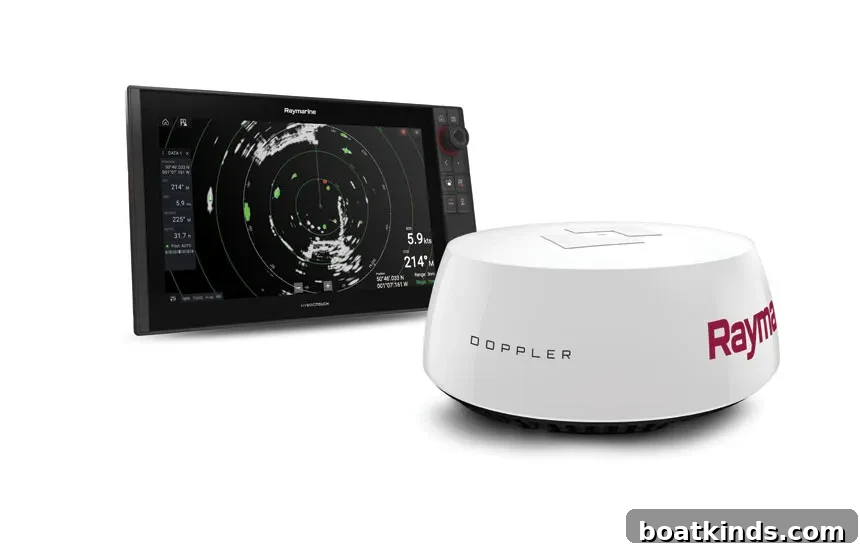
Raymarine Quantum 2: Solid-State Doppler CHIRP Radar for Safer Marine Navigation
The Raymarine Quantum 2 is a solid-state marine radar that combines Doppler target identification with CHIRP pulse compression technology to give skippers clearer, more reliable situational awareness at both long and short ranges. Built to detect motion and distinguish moving targets from stationary objects, the Quantum 2 uses frequency-shift processing to assess target movement and applies intuitive color coding so operators can instantly interpret collision risk.
How Doppler and CHIRP Work Together
Doppler processing evaluates the frequency shift in radar echoes to determine whether a detected object is moving toward or away from the vessel. In the Quantum 2, moving targets are color-coded—red indicates targets closing in, while green denotes targets moving away—so you can make faster decisions in traffic or reduced-visibility conditions.
CHIRP pulse compression complements Doppler by transmitting a swept-frequency pulse and then compressing the return signal. This improves target resolution and range discrimination, enabling clearer separation of closely spaced contacts and better detection of smaller objects. Combined, Doppler and CHIRP give a practical balance of movement detection and refined image detail for routine navigation and close-quarters maneuvering.
Practical Benefits for Boaters
As a solid-state unit, the Quantum 2 offers advantages commonly sought in modern marine radars: improved reliability, lower maintenance, and consistent performance in a variety of sea conditions. The radar is effective for collision avoidance, identifying vessels and objects in busy waterways, and supplementing visual navigation in fog, rain, or nighttime conditions.
In addition to moving-target identification, the Quantum 2 highlights potentially hazardous static targets in the vessel’s forward arc. According to the manufacturer, static hazards within roughly 650 feet ahead of the boat are accentuated and color-coded so users can quickly spot obstructions and make informed course adjustments. This forward-threat emphasis is especially useful when approaching harbors, navigating tight channels, or transiting anchorages with fixed structures.
Operational Considerations
Like all radar systems, optimal performance depends on correct antenna placement and integration with the vessel’s electronics. Proper mounting height, clear line of sight, and calibration will help ensure reliable target detection and accurate Doppler processing. The Quantum 2 is designed to be used alongside chartplotters, AIS receivers, and other navigation tools to provide a layered approach to situational awareness.
Users should also be mindful of the limits of any radar system: environmental factors, sea state, and target size affect detection performance. While Doppler processing improves interpretation of movement, small or low-profile objects can still be difficult to detect at longer ranges. Regular practice with the unit in varied conditions helps crews understand its strengths and limitations and use the color-coded information effectively.
Pricing and Manufacturer Information
Pricing for the Quantum 2 starts at $1,950. For more information, reference Raymarine’s contact details: Raymarine, Nashua, New Hampshire, (603) 324-7900. Manufacturer information is listed under the Raymarine brand and the product is often distributed through marine electronics dealers and installers.
This article originally appeared in the May 2018 issue.