
Jamie Wyeth’s Monhegan Skiff and the Enduring Legacy of Carpenter’s Boat Shop
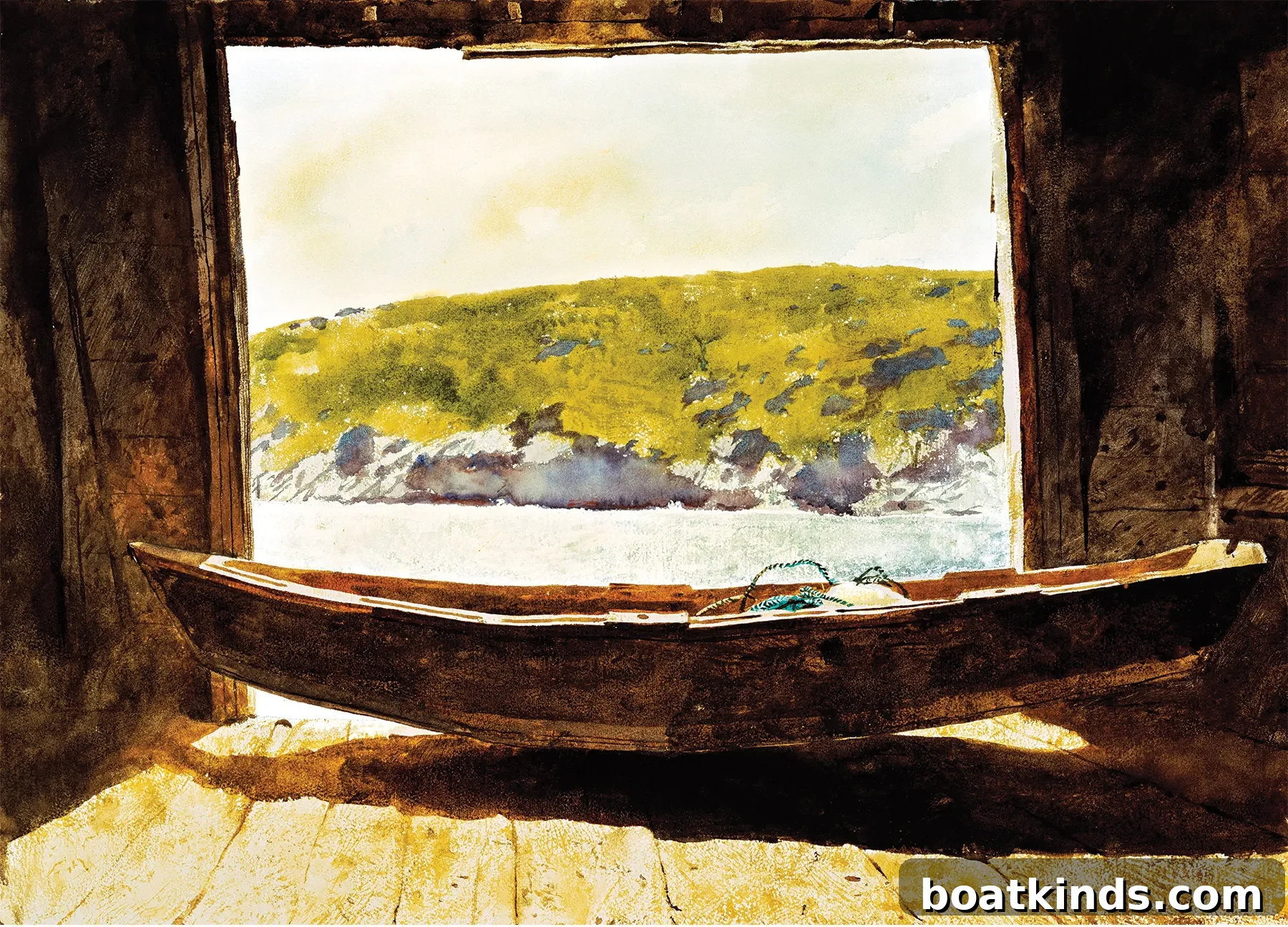
In 1984, renowned realist painter Jamie Wyeth—part of the celebrated Wyeth family of artists—commissioned a Monhegan skiff from the Carpenter’s Boat Shop in Pemaquid, Maine. Under the supervision of the shop’s founder, Robert “Bobby” Ives, an apprentice built the skiff that later became the subject of Wyeth’s painting titled Monhegan Skiff. Wyeth retained the boat while the finished painting went to a private collection in Colorado. Four decades later, in 2023, a member of the Carpenter’s Boat Shop board happened upon Wyeth’s painting during a visit to the Farnsworth Art Museum in Rockland, Maine—bringing that full-circle connection between artist, boat, and boatbuilder back into focus.
After that serendipitous discovery, the Carpenter’s Boat Shop worked closely with the Farnsworth Museum and with Wyeth himself to produce a series of prints of Monhegan Skiff. Those prints were created to raise funds for the nonprofit shop, which has a long-standing mission of nurturing lives and serving the community through the craft of wooden boatbuilding. As Alicia Witham, executive director of Carpenter’s Boat Shop, explained: “The boat shop, I think, is near and dear to a lot of people. On top of that there’s Bobby and then on top of that there’s Jamie, and this part of the world just has that affection for small wooden boats because that’s so much of what our maritime culture has been.”
The story of the Monhegan skiff is tightly intertwined with the seafaring traditions of Monhegan Island. These compact workboats—9 feet 6 inches long with a pronounced 11-inch rocker—were once essential to the daily routines of local fishermen. Built to be tough, nimble, and forgiving in choppy coastal waters, the skiffs ferried crew and gear out to moored lobster boats and earned the affectionate nickname “donkeys of the sea” for their reliability. The original line of Monhegan skiffs was built by Will Stanley Jr. until 1979. When Stanley stopped building them, his grandson contacted Bobby Ives and asked if Carpenter’s Boat Shop would continue the work. Stanley’s building plans and bevel board were transferred to Ives, and the shop took up the mantle.
Since adopting the Monhegan skiff pattern, Carpenter’s Boat Shop has produced more than 200 of these boats, keeping an important local design and way of life alive. The shop’s work is as much about people as it is about boats: apprentices learn hands-on skills under experienced craftsmen, community members gather around shared projects, and the tradition of wooden boatbuilding is preserved for future generations. The prints of Wyeth’s Monhegan Skiff helped emphasize that connection between art, craft, and community—using the image of a single small boat to tell a larger story about place, labor, and cultural memory.
Beyond the practical role the skiff played for fishermen, the vessel also became a symbol—captured in Wyeth’s painting—of a maritime culture rooted in small, human-scale boats and the knowledge that sustains them. The Carpenter’s Boat Shop, through its continued production of the Monhegan skiff and its broader nonprofit work, has kept that knowledge active. As long as local demand for these durable, versatile skiffs continues, the shop plans to keep building them as part of its ongoing commitment to craft and community.
Today, almost forty years after the original commission, Monhegan Skiff functions as a touchstone for the shop’s legacy: an artwork that documents a boat, a boat that inspired art, and a boatbuilding tradition that links generations. The partnership between artist, museum, and boat shop—reignited when the painting resurfaced in a public collection—demonstrates how cultural heritage, artistic expression, and community-based craft can reinforce and sustain one another.
This article was originally published in the April 2024 issue.