
A cruising couple got the boat they wanted: a Maine-built lobster yacht finished in Connecticut, tailored for slow, comfortable cruising.
Jim Long pilots Nancy Ann past a partially submerged log — one of the remnants of Tropical Storm Irene in the lower Connecticut River — on a late-season afternoon run. A retired project engineer, Long is showing off the boat he and his wife, Nancy, spent years assembling to suit their cruising lifestyle.
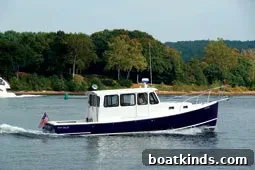
Nancy Ann is a 32-foot diesel-powered Osmond Beal lobster yacht with a semidisplacement, round-chine hull, a full keel and an integral skeg. Long commissioned the hull, cabin and pilothouse from a Maine builder and completed the fit-out at a Connecticut yard closer to their home in Ellington, Conn. Now 67, Long says this is likely the last boat he’ll own — and it suits them perfectly.
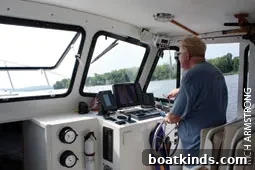
After five seasons aboard, the Longs have firmly embraced a relaxed cruising pace. “We don’t shy away from going in fog if we have a quarter- or half-mile visibility,” Long says. They prefer leisurely trips and the camaraderie of marina life over long, fast passages. The galley is located up in the pilothouse, with a forward V-berth below; the interior is intentionally simple and practical, reflecting their preference for low-maintenance finishes over high-end varnish and teak.
Nancy recalls their past as campers rather than dedicated boaters, and sees the yacht as a natural extension of that lifestyle: uncomplicated, comfortable and social. They use lawn chairs on deck, chat with slip neighbors and spend many weekends aboard without going far. Last fall they added a canvas aft top on welded stainless frames with zip-up screens, enhancing the “camping afloat” feel.
On the water
The couple typically cruises at about 12 knots. Their 370-hp Yanmar engine burns roughly 5.5 gallons per hour at 10 knots and about 7.5 gph at 12 knots. From their slip at Pattaconk Yacht Club in Chester, Conn., it’s a relaxed 10-mile run to Long Island Sound. They average about 50 hours a season on Nancy Ann — less than the 100–150 hours they used to run on a smaller Rosborough RF-246 — but the time aboard remains satisfying whether they cruise or simply enjoy the boat at the dock.
The Longs have taken two extended cruises: one into New York Harbor and up the Hudson River to Albany and Troy, N.Y., and another to Boston for Fourth of July fireworks. They typically overnight at marinas on longer trips, appreciating the convenience of shore power and services. Last summer they cruised to Block Island in the company of fellow Meriden Power Squadron members, and they hope to explore the New York canal system and Lake Champlain in the future.
Long values the boat’s shallow running draft of about 4 feet and the generous 6-foot-4-inch headroom in the pilothouse. At roughly 16,000 pounds, Nancy Ann’s round-bilge semidisplacement hull produces a rolling motion typical of that form, which the Longs prefer for comfort over the pounding of a planing hull.
Reflecting on choices made during the build, Long notes a few things he might change: the 370-hp engine is perhaps larger than necessary, and he spent $5,000 rerouting exhaust away from the transom to prevent fumes from entering the pilothouse. He also chose twin 125-gallon fuel tanks rather than a single 100-gallon tank; while the single tank would have suited their usage, the twin tanks provide redundancy if fuel becomes contaminated.
“All boats involve compromises,” Long says. “But after five seasons, we love the boat.”
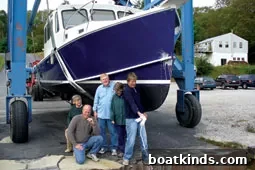
Moving up
Long grew up on the Connecticut River area, learning to handle small boats as a child. He began boating again as an adult after buying an 18-foot Sea Ray in 1993, then stepped up to a 20-foot Bayliner Trophy in 1996 that allowed day trips across Long Island Sound. He later bought a Rosborough 246, a semidisplacement pocket cruiser, and the comfortable ride of that hull form convinced him and Nancy that they wanted more space without sacrificing seaworthiness.
The Rosborough’s foam flotation and solid build impressed them, but after five years they wanted a larger, galley-up layout with more room for extended cruising. A 32-foot lobster yacht with the semidisplacement hull they preferred became their target.
The ‘last boat’
The Longs wanted a simple, practical vessel: a galley-up semidisplacement boat roughly 30 feet long with a broad beam. They initially considered rebuilding a used fishing boat but rejected the idea because of concerns about used engines and limited interior space. They also found that many traditional Down East builders favored showpiece interiors and weren’t willing to produce the plain, practical finishes the Longs wanted.
After an 18-month search, they settled on a 32-foot hull from a small Maine builder that produced both finished and unfinished boats. The solid fiberglass hull is hand-laid with vinylester resin and a heavy skeg. The molded top unit — foredeck, wash rails, stern deck, pilothouse and cuddy cabin — features a closed-cell foam core for structure and insulation.
Once the hull and top were joined at the Maine shop, the unfinished vessel was shipped south and finished over roughly six months at a Connecticut yard. During that phase Long visited frequently, collaborating with the carpenter on interior details that would mirror the simple, functional layout they liked on the Rosborough. The yard installed furniture, the V-berth, a shower and water system, deck hardware, rubrails and headliner, all with an emphasis on serviceability and accessibility.
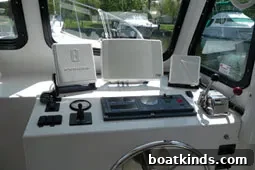
Long estimates the hull and basic structure cost more than $150,000, with another $100,000 to complete the boat — comparable to a production 32-footer at the time but customized to their needs. Nancy Ann’s electronics include a radar, chartplotter, sounder and a high-quality VHF with external speaker. A small air conditioner and a mounted fan keep the pilothouse comfortable, and an alcohol/electric stove serves well at anchor.
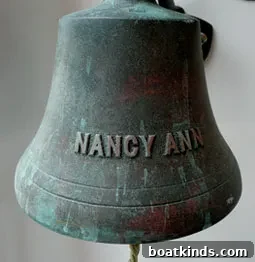
A brass bell cast in Maine and a repurposed windshield washer from a 1996 Jeep are small touches that reflect the Longs’ practical approach: spend on the things that matter and keep the rest simple. “You don’t have to spend a fortune to get a boat that works for you,” Long says. “If you can’t afford a magazine-feature boat, there’s still a better value out there that will give you what you want.”
This article originally appeared in the February 2012 issue.