
John St. Hilaire’s Down East Lobster Yacht Thorobred: A Piece of Maine Craftsmanship
The story of Thorobred, a Maine-built Down East lobster yacht owned by John St. Hilaire, reads like an unexpected evolution from tradition to modern performance. Conceived to echo the classic 43-foot wooden lobster boats of his youth, Thorobred ultimately emerged as a finely finished, cored carbon-fiber “lobster cruiser” that blends traditional lines with contemporary materials and engineering. Built by the Lowell Brothers yard in Yarmouth, Maine, the 38-foot red-hulled yacht reflects both the owner’s tastes and the boatbuilders’ willingness to push design boundaries.
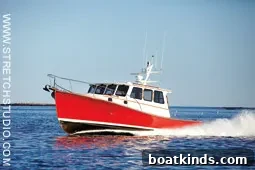
Jamie and Joe Lowell, who took over the family yard in 1997, admit the project shifted dramatically from the original brief. “If you saw the original contract and how the boat turned out, you wouldn’t believe it,” Jamie says. What began as a more conventional fiberglass and marine-plywood craft moved toward extensive carbon-fiber construction as the benefits for stability and finish became apparent. The result is a custom-feel vessel that St. Hilaire describes as “a piece of Maine craftsmanship.”
Design and Performance
Thorobred’s hull features a fine entry, pronounced deadrise forward, a streamlined bottom and a touch of tumblehome at the stern. Powered by a single 800-hp MAN R6800 diesel and carrying a 320-gallon fuel tank, the yacht demonstrated the design’s capabilities across sea trials and months of cruising. St. Hilaire reports a comfortable cruising speed in the low 20-knot range, a 34-knot top end and remarkably steady handling in beam and head seas. “In a head-on sea, the boat peels the water away very efficiently,” he says. “I can be going head-on in a 4- to 5-foot sea and almost go any speed I want — 22, 23 knots right through a head sea.”
Fuel consumption is reasonable for a performance-minded cruiser of this size. Thorobred typically cruises between 22 and 25 knots burning roughly 18 gallons per hour; on a trip to Monhegan Island she averaged about 27 gallons for the passage. These figures reinforced St. Hilaire’s confidence that the boat delivered on both performance and range for coastal cruising in New England waters.
Owner Background and the Build Process
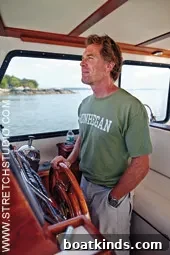
Born and raised in Maine, St. Hilaire’s lifelong attachment to the coast and to boats shaped his expectations. After years of day trips and family cruises in earlier powerboats, he wanted a vessel that evoked the working lobster boats he admired while incorporating modern creature comforts and performance. He found the Lowell Brothers at the Maine Boatbuilders Show and began a collaboration that ultimately took more than five years to complete.
Although the project started with plans for a traditional 43-foot recreational lobster boat, the Lowells persuaded St. Hilaire to consider a 38-foot platform for maneuverability, dockability and cost reasons. They also proposed a progressive approach to materials and construction: where the owner initially expected marine plywood and timber, the switch to a fully cored carbon-fiber topside and selected carbon components transformed Thorobred into a lighter, stiffer and more refined craft.
A Traditional Look, Unconventional Construction
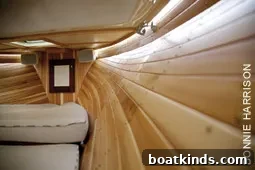
From the wash rails up, much of Thorobred is carbon fiber, including the saloon sole, and the interior and cockpit are designed to present a clean, integrated appearance. The visor is molded onto the hull, giving the cockpit a monolithic feel and eliminating clutter. The engine bed was redesigned from the original steel concept to a lighter aluminum structure, with custom stainless brackets to accommodate the mounting. Carbon-fiber tubing helps conceal wiring and keeps the engine bay tidy.
St. Hilaire wanted a large engine without raising the floor, and the team prioritized lowering the center of gravity and improving stability over fuel-efficiency alone. The finishing work was extensive: the interior received Awlgrip treatment, and the boat spent six months in the paint shop to achieve a smooth, high-quality finish. Jamie Lowell likens the approach to building a race-ready version of a classic car: the exterior silhouette may look familiar, but the technology and materials beneath the surface are markedly different.
Challenges and Collaboration
The project spanned a challenging economic period. The global recession reduced work for the Lowell yard, turning Thorobred into essentially a shop-wide focus. Progress was deliberate: mold building alone took two and a half years, and the switch to carbon fiber added roughly another year. The long timeline allowed iterative improvements, but it also required patience from the owner and the builders.
Over five-plus years, St. Hilaire and the Lowells navigated design changes and occasional disagreements — from hull color to nameplate decisions — ultimately arriving at a boat both sides could be proud of. “Building a boat is a very personal thing to us,” Jamie says. “How do you take pride in a boat you launched if you didn’t build it?”
Sea Trials, Upgrades and Cruising
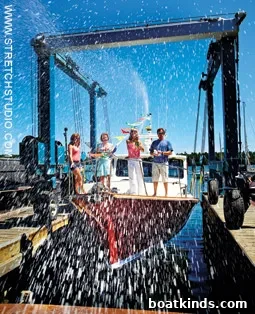
Sea trials on Casco Bay confirmed the yacht’s steady ride. Even when speeds reached the mid-20s knots, testers noted no hard pounding — “you could drink a martini on board and not spill it,” Jamie recalled. Despite shedding about 1,500 pounds through carbon construction, Thorobred still feels substantial and balanced, often described by the owner as “like a wooden boat” in its handling. A 7-hp bow thruster adds agility at the dock, and modest additions — rails to reduce spray and enhanced sound attenuation in the engine space — refined the cruising experience.
After launch, Thorobred spent summers cruising Casco Bay, Penobscot Bay, Boothbay Harbor and Monhegan Island, with enhancements added during winter refits: a mahogany chart table with flip-top storage, new head cabinetry, a reconfigured helm with extra storage, and a FLIR thermal camera mounted to the mast for navigation and safety. A life raft was stowed on deck in case future plans included a longer northern cruise.
Final Thoughts and Advice
For St. Hilaire, the finished Thorobred delivers on every expectation. The striking red hull — a choice he insisted on for tradition and visibility — draws attention and adds personality, despite the builders’ initial preference for more subdued colors. He also chose not to display the builder’s nameplate, a choice that encourages conversation and personal connection with admirers.
His advice to prospective owners: do thorough homework, define priorities early, consider involving a marine architect during the design phase, and allow extra time for unexpected delays. “If you’re told it will take two years, throw another year on there,” he says. The framed set of the boat’s lines that hangs in his office now reads “For John St. Hilaire” — a keepsake he calls “the museum piece in my life.”
December 2013 issue