
Trade schools are working to reshape the marine industry’s image as they help address a widening skills gap
John Headley had only limited experience with boats—sailing as a child and the occasional powerboat outing as an adult—but that did not stop him from making a major life change. After eight years at his job in Chicago and feeling ready for a new direction, Headley, now 40, moved his family to Bristol, R.I., to pursue training in the marine trades.
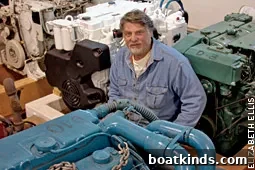
“My job in Chicago just played out. It wasn’t what I was cut out for long-term,” Headley says. He left his career as a computer technical consultant to enroll in the International Yacht Restoration School (IYRS) Marine Systems Program in Bristol, hoping to turn a personal interest in boats into a sustainable second career and to pursue boat restoration part-time.
Headley chose IYRS in part because of its location. “I picked IYRS because it was centrally located,” he explains. “Many of the other programs I looked at were in very remote places, and with a wife and two small children I wanted to be near services and community life.”
IYRS and other trade organizations are actively reaching people like Headley. To raise awareness about marine careers and recruit new workers, the International Yacht Restoration School in Newport partnered with the Rhode Island Marine Trades Association to host the first Rhode Island Marine Trades Day last October. The one-morning event attracted about 300 visitors who toured the facility, spoke with company representatives and collected literature from more than 120 exhibiting firms.
“It was the first event of its kind, and we were absolutely amazed by the turnout,” says Andy Tryska, president of Bristol Marine and a board member of RITMA. Tryska, who is active in regional education initiatives, says the goal was to raise awareness across the East Bay communities—Barrington, Bristol, East Providence and Warren—and then extend outreach statewide.
Employers at the show reported strong interest. Guy Gauvin, general manager of Goetz Custom Boats in Bristol, says more than 60 visitors came from across New England and Canada. “Twelve of those were solid job applicants, and many others wanted to learn more about careers in the marine industry,” Gauvin says. He also noted that many attendees were surprised to find modern boatbuilding facilities were climate-controlled and clean, and that the industry relies on advanced technology.
One of the central challenges organizers sought to overcome is a widespread misconception about marine trades. “There is a misconception that boating jobs are seasonal, low-paying and dirty,” Tryska says. “In fact, many positions are year-round, pay competitively and require people with strong technical skills.” He adds that Rhode Island has potential to expand its marine sector over the coming years if employers can fill the skills gap with qualified workers.
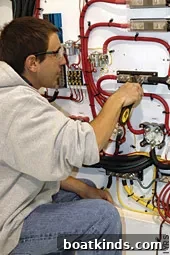
IYRS’s Marine Systems Program is one example of training aimed at closing that gap. Around two years before this article, IYRS partnered with the American Boat and Yacht Council to design a curriculum that teaches students how to install, maintain and repair major systems found on both power and sailboats. The program combines classroom instruction with hands-on work so students learn practical skills in realistic shop settings.

Course topics include electrical systems, electronics, fuel systems, engine maintenance and sail drives, air conditioning and refrigeration, and firefighting systems. A signature element of the program is the annual construction and outfitting of four practice hulls: “They get built every year,” says Geoff Almeida, a marine systems instructor. “At the end of the year we take them apart and start again.”
Almeida stresses that prior marine experience is not required. The program starts with fundamentals and develops students to a professional level through applied projects and mentorship. Every student completes a five- to six-week externship with a potential employer at the end of the course, giving real-world exposure and often providing a pathway to employment. “All seven of my full-time students from last year are now working in the industry,” he reports.
Employers like Goetz Custom Boats are looking for motivated candidates who are eager to learn. “If we find someone ambitious and coachable, we can train them to become a professional boatbuilder who can make a solid, stable living,” Gauvin says.
Organizers plan to continue the outreach efforts. Tryska expects the next Marine Trades event to be held in the spring in the West Bay region of Rhode Island to connect more job seekers and students with marine employers and training programs.
This story originally appeared in the February 2009 issue.
For more information about the Rhode Island Marine Trades Association and regional events, visit www.rimta.org.