
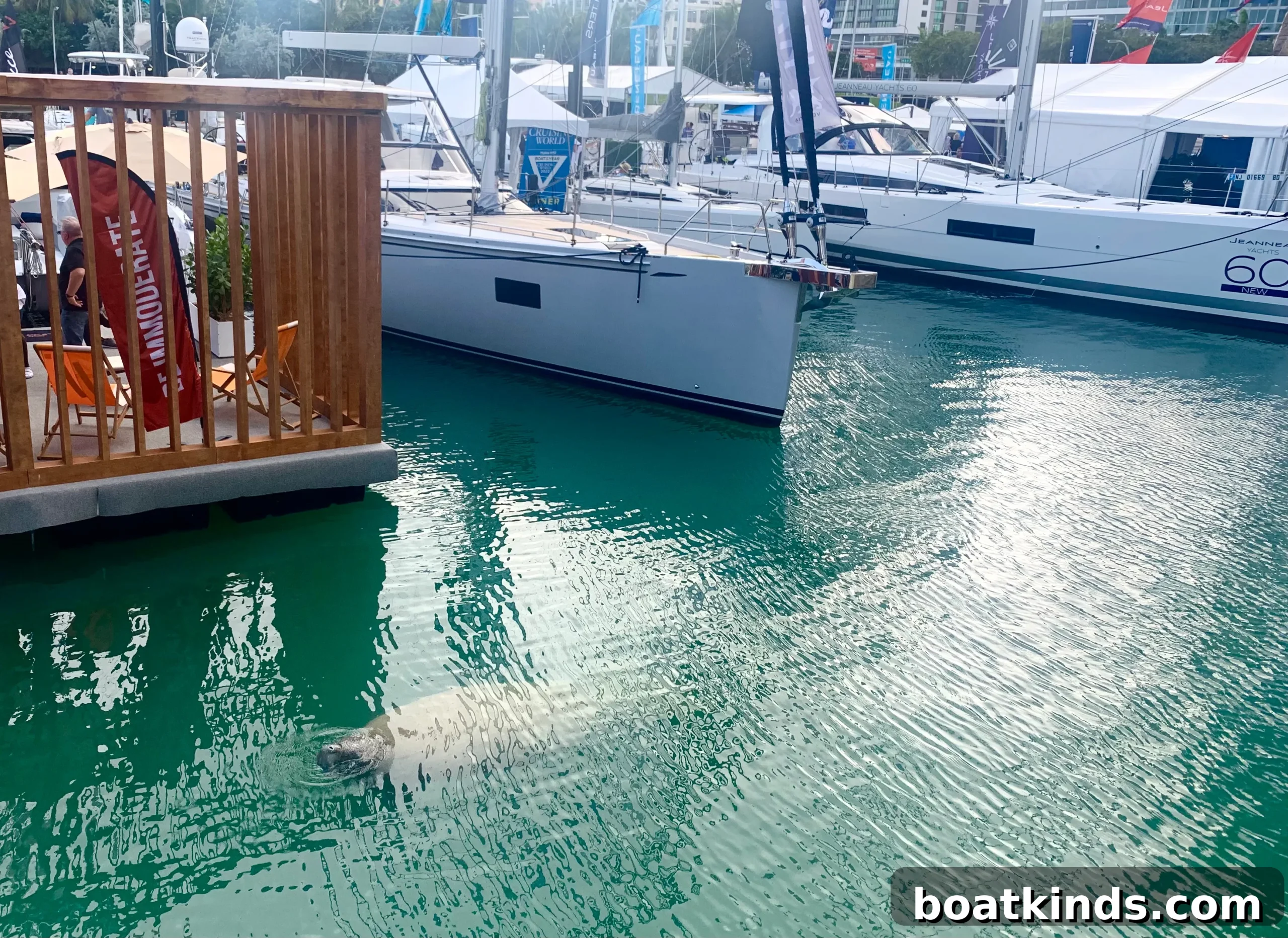
Boat shows are a prime opportunity for buyers, journalists, and industry professionals to sea-trial the newest models and marine technologies. At the recent Miami International Boat Show, however, the traditional buzz of eager brokers and prospective owners was interrupted by a very different kind of attendee: manatees. These gentle marine mammals appeared in and around Sea Isle Marina, the designated area for on-water test rides, producing delays and raising concerns among organizers and exhibitors.
The presence of manatees at the Sea Isle Marina triggered immediate safety and conservation considerations. Organizers and city officials were particularly worried about boats colliding with manatees or disturbing essential behaviors such as feeding and nursing. Those concerns had previously jeopardized on-water permit approvals: in 2022, similar issues nearly cost the show its permission to run live test drives. To avoid repeating that outcome, the show and local authorities agreed on a manatee-monitoring plan designed to protect wildlife while allowing the economic and recreational activities associated with the Miami International Boat Show to continue.
Under the monitoring strategy, organizers made several operational changes. Two of the three proposed sea-trial routes were removed to limit boat traffic in areas known to attract manatees. Show protocol required that test-ride activity be paused whenever a manatee was observed in the vicinity, remaining halted until either the animal moved away naturally or there were no confirmed sightings for a continuous 30-minute period. That pause policy was intended to minimize stress and the risk of injury to the animals while enabling captains to resume demonstrations as soon as it was safe to do so.
Multiple measures supported the on-the-water halt policy. A manatee-spotting boat patrolled the channels near the docks to keep an eye on marine activity and to provide immediate guidance to test-ride captains. Drones flew overhead to expand the field of view, helping spotters locate animals that might not be visible from the docks. Trained manatee spotters employed by the show coordinated directly with boat captains to manage test rides around each confirmed sighting. This combination of surface patrols, aerial observation, and human spotters created a layered approach to protection.
The city administration, led by Mayor Daniella Levine Cava, who campaigned on environmental stewardship, played a key role in requiring these permits and safeguards. The Miami International Boat Show is a significant event for the local economy—bringing in substantial revenue and supporting countless marine-industry jobs—so city officials sought a compromise that would both protect wildlife and allow the show to proceed. The resulting monitoring operation was framed as a pragmatic balance between environmental responsibility and economic activity.
By Thursday afternoon of the show weekend, organizers had recorded roughly 20 reported manatee sightings in the Sea Isle Marina area, causing intermittent delays to test rides. Despite the repeated stoppages and the logistical challenges of coordinating around wildlife, the event moved forward and test drives continued whenever conditions were deemed safe. The visible presence of manatees drew public attention, underscoring the need to integrate wildlife protection into marine event planning.
The measures taken at the Miami International Boat Show reflect a broader trend in which large-scale marine events adopt stricter wildlife safeguards to comply with permit conditions and public expectations. By limiting routes, pausing traffic when animals are present, and deploying spotters and drones, organizers aimed to reduce risk to manatees while preserving the show’s fundamental purpose: letting buyers and journalists evaluate boats in real-world conditions. The experience at Sea Isle Marina highlights how event planners, city officials, and marine professionals can work together to respect local ecosystems while maintaining commercial activity.
Coverage of the manatee sightings and the monitoring effort was reported by local media, which documented the interplay between conservation priorities and the economic importance of the Miami International Boat Show. In the end, organizers adapted their operations, manatees continued to use the marina, and the show went on with enhanced protections in place.