
Nordhavn 75 Expedition Yacht Sinks at Slip in San Jose del Cabo After Failed Tuna-Tube Fitting
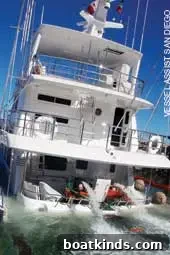
The Nordhavn 75 expedition yacht Melanie Jeanne sank at its slip in Puerto Los Cabos marina, San Jose del Cabo, Mexico, after a PVC fitting on a bait-fish “tuna tube” plumbing system came loose and flooded the engine room and lazarette while no one was aboard. The two-year-old, $4.5 million vessel sank bow-up around 10 p.m. on Feb. 3 as water entered at an estimated rate of 9,200 gallons per hour.
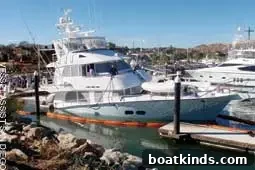
In the days after the incident, boaters and online forums raised numerous questions: how could the bilge pumps be overwhelmed, why was the bilge alarm not acted upon, and whether any design or installation choices contributed to the sinking.
According to Jim Leishman, vice president and principal of Nordhavn builder Pacific Asian Enterprises (PAE), the tuna tube plumbing was not part of the original build. The system — a plumbed PVC pipe in the cockpit used to keep bait fish alive by forcing water over their gills — and the plumbing that fed it were installed later by contractors in Mexico without PAE involvement.
Leishman describes the installation as having a 2-inch bronze through-hull placed 3 to 4 feet below the waterline, a large centrifugal pool pump mounted under the engine room floor plumbed to that through-hull, a short length of PVC pipe with a threaded collar screwed onto the pump outlet, and a sanitation hose running from the pipe to the tuna tube. He called the work “bad decision-making” and “bad workmanship,” adding that the fitting was not something he would trust in a critical application.
Salvors from Vessel Assist San Diego refloated the 270,000-pound yacht three days later. A diver who inspected the engine room found the PVC collar had “popped off” the pump outlet, allowing seawater to pour directly into the engine room through the pump. Wrench marks and sealant on the collar suggested the fitting had leaked and had been repeatedly tightened. The through-hull seacock was open and the watertight door between the engine room and the lazarette had been left open.
Leishman said that if the watertight door had been closed, flooding would have been confined to the engine room, which is separated by watertight bulkheads, and that confined flooding would not likely have sunk the yacht. He described the sinking as the result of a cascading set of failures: a compromised fitting, an open seacock, an open watertight door, and the vessel being unattended and locked at the dock.
The night of the sinking was windy — roughly 30 knots from the north — and it was a Thursday evening, so dock activity and attention were limited. While the bilge alarm probably would have been audible inside the pilothouse, Leishman believes ambient noise and distance meant the alarm did not attract timely attention on the docks. A security guard reportedly saw Melanie Jeanne listing but attributed the lean to wind.
Melanie Jeanne’s loss ignited debate about bilge-pump capacity and what owners should expect from unattended systems. Leishman explained that the engine room and lazarette each have redundancy: a 120-volt AC positive-displacement pump that can operate on batteries and an inverter and a DC centrifugal pump, both controlled by float switches. Taking into account head pressure required to pump water up approximately seven feet to the discharge point, the two nuisance-water pumps in each compartment have a combined rated capacity around 1,300 gallons per hour — suitable for condensation and slow leaks, not sudden breaches.
The yacht also carries an emergency hydraulic-driven pump with a capacity of roughly 10,000 gallons per hour, with suction lines to each compartment, and a backup 240-volt AC centrifugal pump of similar capacity. These higher-capacity pumps are manually activated and require hydraulic power from the engine or generator. Leishman emphasized that Melanie Jeanne’s installed pumping capacity meets American Bureau of Shipping standards and that he has never before seen a dockside sinking caused by a suddenly opened 2-inch opening below the waterline.
“In this case the ‘unattended bilge pumping’ capacity could have been doubled or tripled, and the results would likely have been the same,” Leishman wrote in his analysis. He added that if the opening had been larger — for example 4 inches — even the large emergency pumps would have struggled. His conclusion: watertight bulkheads and compartmentation are the most reliable safeguards against rapid flooding when an unattended through-hull breach occurs.
Industry guidance echoes that electric bilge pumps are intended primarily for spray, rainwater and normal seepage, not for controlling flow from hull damage. As boat systems become more complex and owners request more underwater fittings, designers and yards warn that adding below-waterline connections increases risk unless fitted and controlled properly.
Experienced designers and owners advise practical risk-reduction measures, including:
- Watertight bulkheads, especially around engine rooms and shaft logs.
- A single incoming saltwater intake with an easily accessible shutoff valve that can be closed when the boat is unattended.
- Refrigeration and air-conditioning systems that do not rely on raw seawater through condensing coils.
- Sheathing and protecting below-waterline fittings and using shutoff valves located above the waterline in metal or fiberglass standpipes.
- Dual automatic bilge pumps in high-risk areas such as the engine room.
Owners who followed the online discussion noted two different defense priorities: at the dock, audible alarms and easy access to shutoffs are crucial; at sea, large-volume pumps and crew capable of temporary hull repairs matter most. Some observers concluded that this incident resulted from an unlucky sequence of mistakes and oversights — a flawed repair, an unnoticed alarm, a locked vessel with no onboard personnel, and an open watertight door — any one of which might have prevented the sinking if corrected.
Melanie Jeanne and her twin 740-hp MTU Series 60 diesels remained submerged for three days while insurers evaluated the damage. Leishman said the extent of water intrusion may make the yacht a constructive total loss, since restoring it to original condition would be a major undertaking.
See related article: – Neglect is your boat’s dockside enemy
This article originally appeared in the June 2011 issue.