
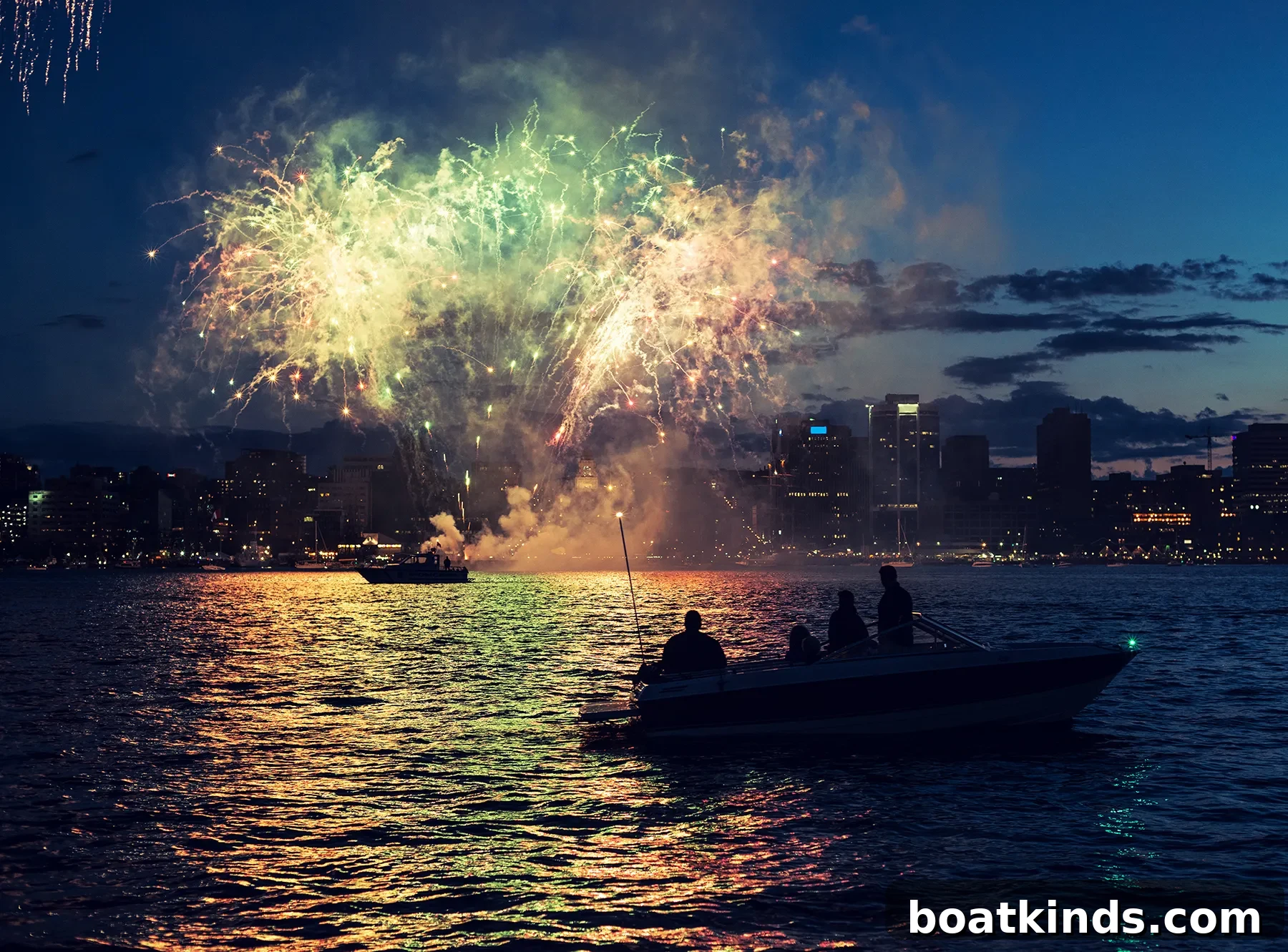
The July Fourth weekend is one of the busiest and most anticipated times of the summer for boaters, especially in the Northeast. With warm weather, long days, and a working boat at last, many families fill the holiday with cruising, overnighting on the hook, sandbar gatherings, fishing and water sports. It’s a great opportunity to relax and enjoy time on the water, but it’s also a period when traffic on the water multiplies dramatically.
Because waterways will be crowded with recreational and commercial vessels, your seamanship and boating etiquette need to be sharp. Good preparation helps keep you and your passengers safe and ensures you present yourself as a competent skipper—skills that other boaters will notice.
Start early by reviewing a thorough boating safety checklist. Essentials recommended by the U.S. Coast Guard include personal flotation devices (PFDs) for every person on board, a throwable flotation device, a suitable fire extinguisher, and proper visual distress signals. Confirm these items are onboard, accessible and in good working order.
Consider your guest list carefully. Avoid overloading the boat: many vessels under 20 feet have a capacity plate indicating the maximum number of people or the combined weight of people, motor and gear for safe operation in calm conditions. Exceeding those limits endangers everyone aboard and should never be taken lightly.
Fuel planning is also critical. Verify usable fuel and top off tanks well before the holiday so you avoid long fuel-dock lines or the embarrassment and hazard of running out and requiring a tow.
Prepare and share a float plan. Tell family or friends ashore your itinerary and check in with them nightly or at the end of your trip so they know you’re safe. Share the plan with everyone aboard and remind passengers to remain seated and hold on while the boat is underway.
On busy holiday weekends, many boaters you encounter will be inexperienced or unfamiliar with local rules. Adopt a defensive navigation approach and assume others may act unpredictably. One of the most common hazards is failure to respect posted no-wake or slow-speed zones. Some operators treat a boat like a car and expect others to yield; that attitude can be dangerous. An example from years past at Barnegat Bay shows how impatience and poor judgment near a bridge led to a tragic collision. Avoid such risks by staying alert and cautious.
Always watch not just ahead but to the sides and astern. Without a rearview mirror, a skipper must frequently scan the horizon for fast-approaching boats. A vessel idling along at 10 knots can suddenly be hit by a wake from someone throttling past at twice that speed, making for an unpleasant—or dangerous—ride for your passengers.
When approaching sandbars or crowded anchored areas where people gather to swim, picnic or shell, reduce speed early and arrive slowly and quietly. Boating on sandbars is a hallmark of summer boating culture, but it requires courtesy and care. If you plan to raft up with other boats, bring sufficient fenders and lines for both sides and come alongside gently.
Anchoring techniques matter when tides or currents change. Some boaters use a stern anchor in addition to a bow anchor to hold position as the tide shifts. If you anchor, use adequate rode scope—typically a minimum of 4:1 in calm conditions, and more depending on depth, vessel length and sea state. More scope increases holding power, but always allow enough room for the boat to swing without colliding with nearby vessels.
Fireworks are a common attraction on the Fourth of July. If you’re anchored or rafted up, you’ll likely have a comfortable view. If you plan to drift or anchor in a larger fleet, pay attention to navigation lighting and circulation. A drifting vessel is considered underway and must display sidelights and stern/mast lights; for boats under 39.4 feet overall, an all-around white light can substitute for separate mast and stern lights. If actually at anchor, extinguish sidelights and display the all-around white anchor light. In crowded anchorages, many boaters wait until other boats depart after fireworks before getting underway; this can improve visibility and reduce the chance of collisions at night.
Enjoy the holiday and the rest of the boating season, but make safety a priority. Good preparation, a responsible speed and constant vigilance will help ensure your Independence Day weekend is memorable for the right reasons.
QUIZ: Test Your Seamanship Knowledge
1. INTERNATIONAL RULES: Lights on a vessel shall be ON from:
A. One half hour before sunset
B. Sunrise to sunset
C. One hour after sunrise
D. Sunset to sunrise
2. INLAND RULES: In addition to sidelights and sternlight, a pilot vessel underway shall exhibit, when engaged in pilotage duty:
A. Red over white lights
B. Green over white lights
C. White over red lights
D. Red over white over red lights
3. INLAND RULES:
When there is doubt as to whether the situation is an overtaking or not:
A. Sound the danger or doubt signal
B. Assume an overtaking situation and act accordingly
C. Change course to forward of the beam of the other vessel to make sure of the situation
D. All of the above
4. NAVIGATION: One red pennant displayed at a storm warning display station forecasts:
A. Winds to 25 knots, but satisfactory sea conditions
B. Winds to 33 knots, dangerous sea conditions for small craft
C. Winds to 35 knots
D. Winds to 45 knots
5. INTERNATIONAL & INLAND RULES: Your vessel is at anchor in fog. The fog signal of another vessel, apparently underway, has been growing louder and the danger of collision appears to exist. In addition to your fog signal, what signal may be used to indicate your presence?
A. One prolonged, one short, and one prolonged whistle blast
B. No signal other than your fog signal may be used.
C. One prolonged followed by two short whistle blasts
D. One short, one prolonged, and one short whistle blast
ANSWERS: 1. D, 2. C (Rule 29), 3. B, 4. B, 5. D
This article was originally published in the July 2022 issue.