

This article originally appeared in the April 2019 issue of our sister publication, Power & Motoryacht magazine.
The Fuel Tool
“Jim,” I shouted into the fog. “We’re losing power. What’s going on?” Our engines were beginning to surge in a rhythmic, worrying way while we navigated a busy convergence of shipping lanes. A young first assistant engineer, who insisted he’d installed new elements in our duplex fuel filter, hurried off for the engine room. His confidence didn’t ease my concern—diesel engines that suddenly surge are a clear warning sign, and on the water, trouble like that can escalate quickly.
Incidents like this are all too common. Over the years I nicknamed some of these operations “oilfield yachting” when maintenance got sloppy and fuel systems became unreliable. Even today, boats still find themselves sidelined or drifting when a fuel-filtering system clogs or malfunctions at a critical moment. The simplest and most effective defense against that risk is a properly installed and monitored vacuum gauge on the fuel system.
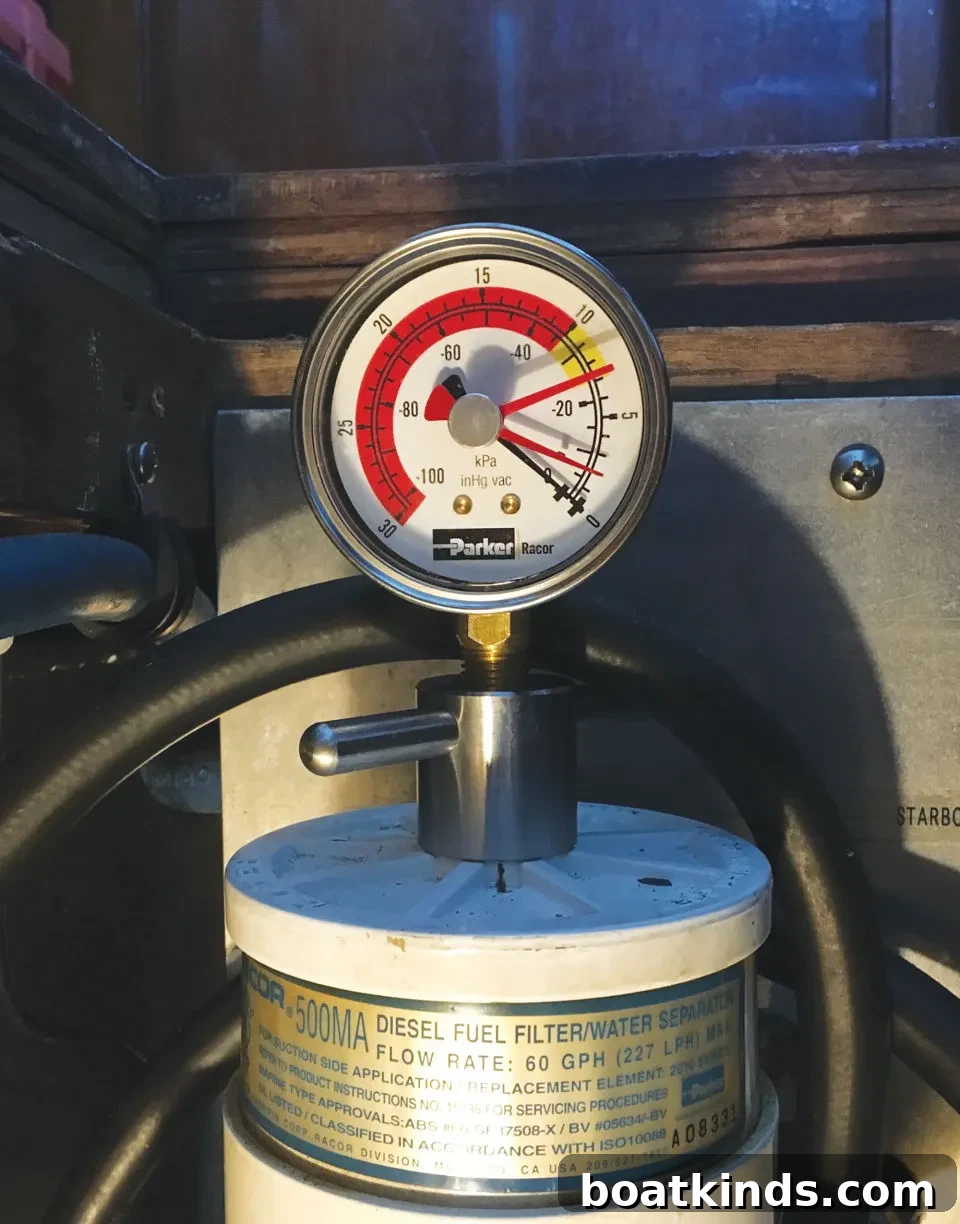
Where to mount the gauge is important. The ideal location is on the outlet side of the primary filter—between the filter housing and the engine—so the gauge measures the suction produced by the engine’s lift pump as it pulls fuel through the filter. That measurement tells you in real time how hard the pump is working and how much restriction the filter element is creating.
Using a vacuum gauge is straightforward, but it requires a simple routine. Begin with a clean element: install a fresh filter and run the engine at typical service or cruising speed. Record that vacuum reading as your baseline—the level of suction a clean, unrestricted filter produces under normal load. From that point on, monitor trends. As the filter captures dirt, water, or other contaminants, vacuum will rise. When readings steadily climb toward the limit you’ve determined, it’s time to change the element. Waiting too long invites fuel aeration, pump cavitation, loss of fuel pressure and, ultimately, engine stall.
Modern vacuum gauges are more capable than earlier models. Many display vacuum in inches of mercury (“Hg) and include a second, peak-reading needle that records the highest vacuum reached during operation. That peak indicator means you no longer have to visit a hot, noisy engine room midpassage to see whether the filter has been approaching a critical restriction—it’s logged on the gauge for inspection at a convenient time.
Additional features available on good-quality gauges help make maintenance predictable and repeatable. Bezel-mounted markers (set to the vacuum level at which you plan to change elements) provide a clear visual trigger. A reset button clears the peak recording after a changeout. Some gauges include pressure-relief or compensation valves that adjust for barometric shifts, improving accuracy when atmospheric pressure varies with altitude or weather systems.
Beyond installing a vacuum gauge, follow these practical maintenance habits to keep diesel fuel systems reliable: keep spare filter elements aboard and change them according to conditions and readings rather than a fixed calendar alone; routinely check water-separator bowls and drains; inspect hoses, fittings and housing seals for leaks or deterioration; ensure priming and lift pumps are functioning smoothly; and log vacuum readings and filter-change dates so you can establish trends and service intervals tailored to your vessel and operating environment.
Back on our boat, the sleep-deprived chief engineer and I supervised the assistant as he removed the fouled elements from the duplex system and installed fresh ones. The engines settled down and ran smoothly again. It was a simple fix, but the episode underscored two clear lessons: a vacuum gauge gives early warning of a clogged filter, and disciplined filter maintenance prevents avoidable, potentially dangerous engine problems.
This article originally appeared in the April 2019 issue of Power & Motoryacht magazine.